
Share this @internewscast.com
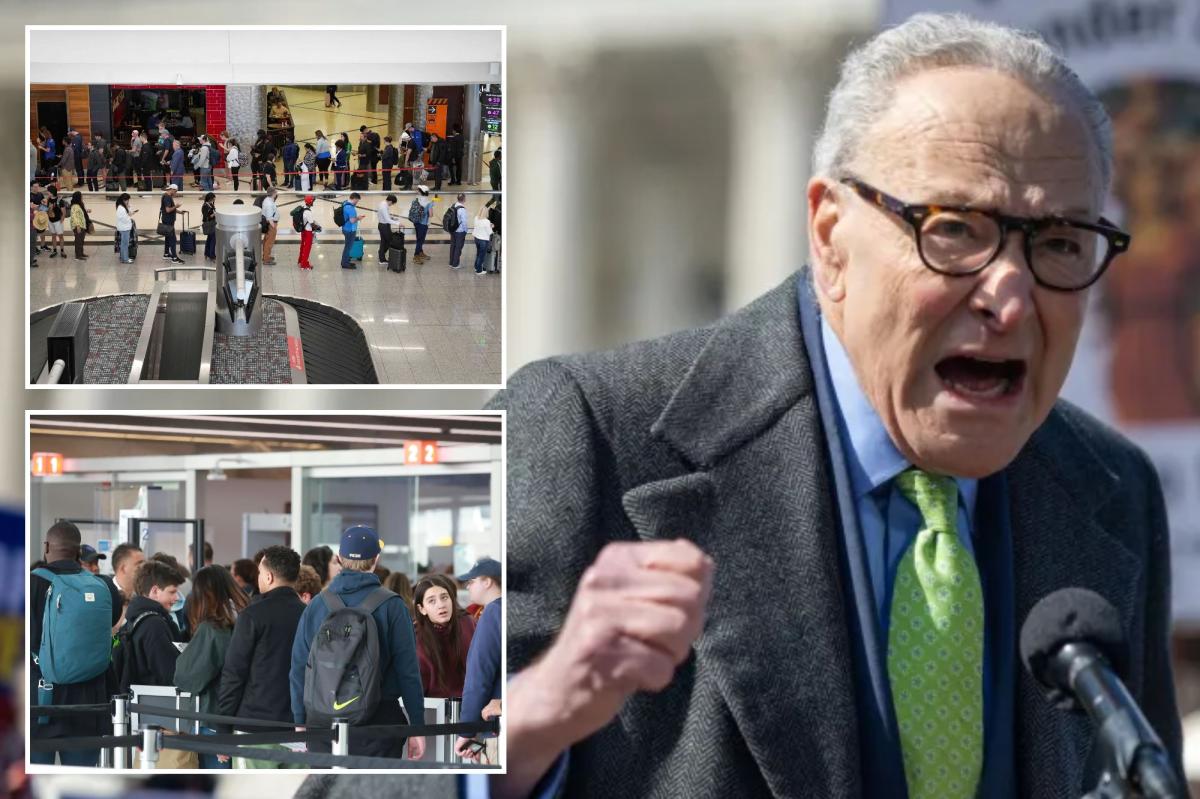
WASHINGTON — On Friday, the Senate was unable to secure funding for the Department of Homeland Security, leaving travelers to contend with long lines at airports as more Transportation Security Administration employees began calling in sick.
In their fifth attempt to pass a funding bill for DHS, only 84 senators participated, with the motion failing to reach the necessary 60-vote threshold, or even a simple majority. The vote split largely along party lines.
Forty-six Republicans, joined by Democratic Senator John Fetterman from Pennsylvania, supported the funding measure. However, 37 Democrats, led by Senate Majority Leader Chuck Schumer of New York, opposed it. This opposition was a stance against President Trump’s immigration policies.

“It seems to me that, up to this point, this is purely political for Chuck Schumer and the Democrats,” remarked Senate Majority Leader John Thune from South Dakota. “Their far-left base is insisting they resist the president.”
Both Republican and Democratic leaders acknowledge that they remain far from reaching an agreement on immigration reforms for the Department of Homeland Security, now 35 days into the shutdown.
Amidst the deadlock, TSA agents, who have missed paychecks, are increasingly calling in sick or resigning, prompting federal employee unions to take action.
“A TSO selling plasma to keep the lights on is unconscionable,” said AFGE National President Everett Kelley. “Tens of thousands of families turning to food banks because Congress refuses to do its job is a national disgrace.”
Talks between Trump’s border czar Tom Homan and Democrats took place Thursday night — but led to no breakthroughs. More discussion with Homan is expected Friday evening.

“The White House outlined an entire list of bipartisan solutions,” added Sen. John Barrasso (R-Wyo.). “They include expanding the use of body cameras for officers and making IDs for officers clearly visible. Democrats have rejected all our good faith offers. They’ve rejected bipartisan solutions.”
“Senate Democrats have repeatedly offered to fund TSA without tying it to ICE funding, only for Republicans to block it each time,” Schumer said.
“TSA agents could be paid, and airport lines could end right away if Republicans stop holding TSA hostage and vote yes,” he added. “The President fired Kristi Noem because he agrees with Democrats — ICE is out of control and a threat to public safety at large.”
Republicans have blocked moves by Democrats to offer legislation funding TSA at least six times — as well as other agencies separately — while avoiding funding ICE.
Sen. John Kennedy (R-La.) has said the GOP “should accept the Democrats’ offer to open up TSA” and other agencies instead of the entire department — and then pass the rest of the funding for ICE and immigration enforcement through a budget reconciliation bill.
“It is a fact that the Karen wing of the Democratic Party is in ascendency, and it is firmly in control,” he quipped. “I’m convinced that listening to the same thing over and over and over again is lowering my IQ when we know that nothing is going to resolve this because my Democratic friends politically can’t agree to a compromise about ICE.”
Almost 10% of TSA agents were off the job nationwide on Thursday, per the latest agency data. As many as 28.7% were absent from JFK Airport and 15.9% weren’t at LaGuardia — leading to long wait times at checkpoints.
Unions protecting federal workers have expressed frustrations with both parties for the prolonged shutdown, which could surpass the 43-day closure of the entire government last fall.
“Members of Congress have walked past our TSA members at airport security checkpoints more often than they’ve met to negotiate an end to this stalemate,” Kelley also said. “The time for excuses is over. Pass a measure to reopen DHS, pay these workers, and don’t go home until you do.”