
Share this @internewscast.com
As climate change causes the snow line to recede upwards throughout the Alps, numerous ski lifts have been left unused, leading to the closure of several resorts.
With the ski season commencing, social media videos illustrate a transformed European landscape, featuring ‘ghost stations’ where consistent snowfall is no longer guaranteed, leaving what were once snowy peaks stark and desolate.
In renowned skiing destinations such as Switzerland’s Leysin, France’s Chamonix, and Austria’s Tyrol, grassy patches, rocks, and dirt are now visible on slopes typically blanketed in snow.
Earlier this week, an Instagram video captured skiers navigating narrow icy strips and muddy snow, highlighting a concerning pattern as resorts prepare for their busiest time of year.
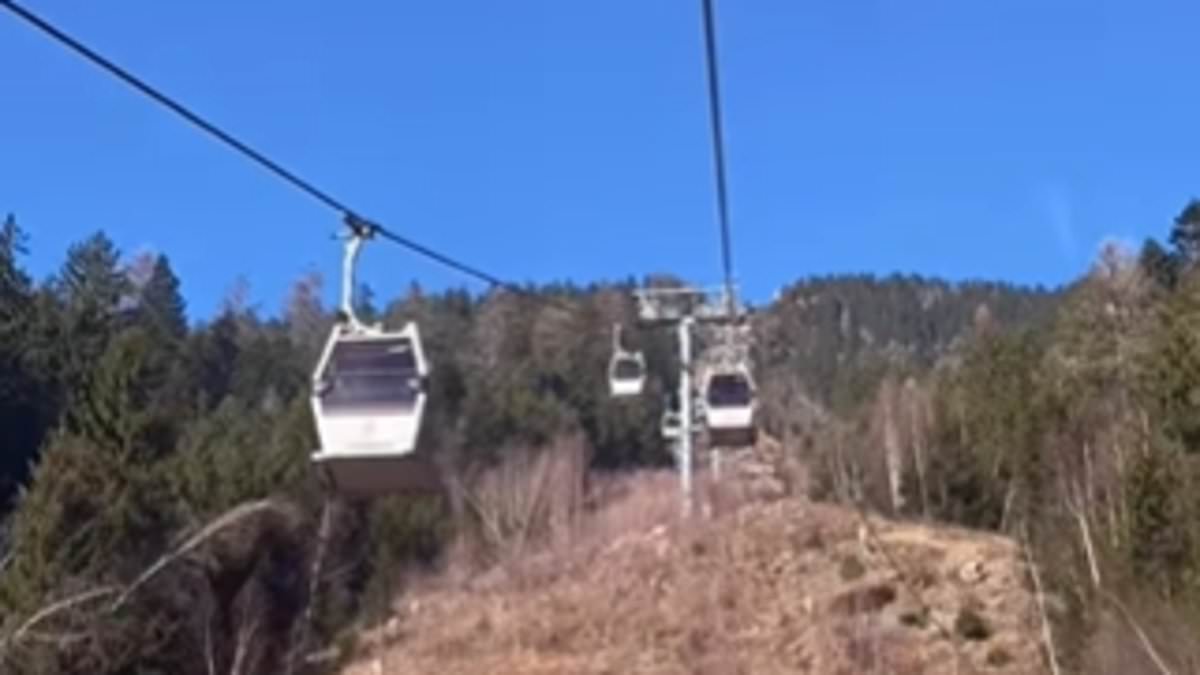
Another clip from the same French resort, filmed from a ski lift on Tuesday, depicted a snowless slope dotted with bare trees and intermittent yellow grass.
Skiers in Austria faced similar scenarios, as footage from a lift recorded last week showed a nearly barren slope.
A clip taken in the Dolomites in Italy showed a mountain covered only with patches of snow.
Resorts across the continent continue to battle unseasonably high temperatures that pose an existential threat to slopes at lower altitudes – and have already put many out of business.

Hundreds of ski lifts now lie abandoned as European resorts have been forced to shut

Videos show how Europe has been left with a new landscape of ‘ghost stations’, with unreliable snowfall leaving the once white-topped mountains now barren
Last month Urs Lehmann, the CEO of the International Ski and Snowboard Federation warned that melting glaciers and shrinking snow could have a devastating impact on the winter sports.
‘The ripple effect of climate change on every aspect of society is truly terrifying,’ he said during an event held on Switzerland’s Great Aletsch Glacier.
‘It turns out that the realm of snow sports — not only at a competitive level, but for all the communities that revolve around ski resorts — is among the first to experience this devastating impact directly,’ Mr Lehmann added.
A 2023 report warned that over half of Europe’s ski resorts will face a severe lack of snow if temperatures rise 2 degrees Celsius above pre-industrial levels, while nearly all would be affected by an increase of 4 degrees – presenting challenges for the tourism industry, and threatening a harsher reality for ski lovers.
In the paper in the journal Nature Climate Change, experts warned that a common solution — production of artificial snow – would only partially offset the decline and would involve processes like snow blowers that generate more of the same greenhouse gases that are heating up the globe in the first place.
Repeated and increasing wintertime thaws have saddled many European ski resorts in recent years, leaving many slopes worryingly bare of snow.
Along with glacier melt, snow shortages have become a visible emblem of the effects of climate change.
Everything from basic tourism to pro ski competitions have felt the effects.

Tourists ski along a poorly snow-covered access slope leading back to the low-altitude resort of Leysin, through a snowless surrounding landscape on December 27, 2025

Patches of grass, rock and dirt can be seen on typically-snow-covered slopes in some of Europe’s skiing meccas

A 2023 report warned that over half of Europe’s ski resorts will face a severe lack of snow if temperatures rise 2 degrees Celsius above pre-industrial levels

A snowboarder sits in a chair lift above a snowless landscape in La Clusaz resort near Annecy, southeastern France, on December 20,2025

As snowfall becomes more and more unpredictable across Europe’s top skiing destinations, conversations are now being raised over the future and state of these landscapes. Pictured: A skier slips down a poorly snow-covered access slope in the resort of Leysin on December 27, 2025
In France alone, 186 ski resorts have been permanently shut in recent years and there are 113 ski lifts totalling nearly 40 miles in length that have been abandoned.
The closure of Céüze 2000 ski resort at the end of the season in 2018 came as a shock for local residents, and the structures of the popular destination – which was once known for its dramatic white Alpine landscape – have now been left to rot.
As snowfall becomes more and more unpredictable across Europe’s top skiing destinations, conversations are now being raised over the future and state of these landscapes.
The Mountain Wilderness association estimates that there are more than 3,000 abandoned structures scattered around French mountains, slowly degrading Europe’s breathtaking terrain.
Over in Italy, some 90 per cent of the country’s pistes now rely on artificial snow to ensure even distribution, according to data from Italian Green lobby Legambiente. #
But transforming water into snow calls for temperatures close to zero degrees.
Meanwhile, around 70 per cent of pistes in Austria rely on artificial snow to keep pistes accessible, as well as 50 per cent in Switzerland and 39 per cent in France.