
Share this @internewscast.com
Iran fires missiles toward US-UK military base
Fox News senior correspondent Mike Tobin reports that Iran has launched missiles targeting a joint U.S.-U.K. military base, with analysis from Netanyahu advisor Caroline Glick featured on ‘Fox News Live.’
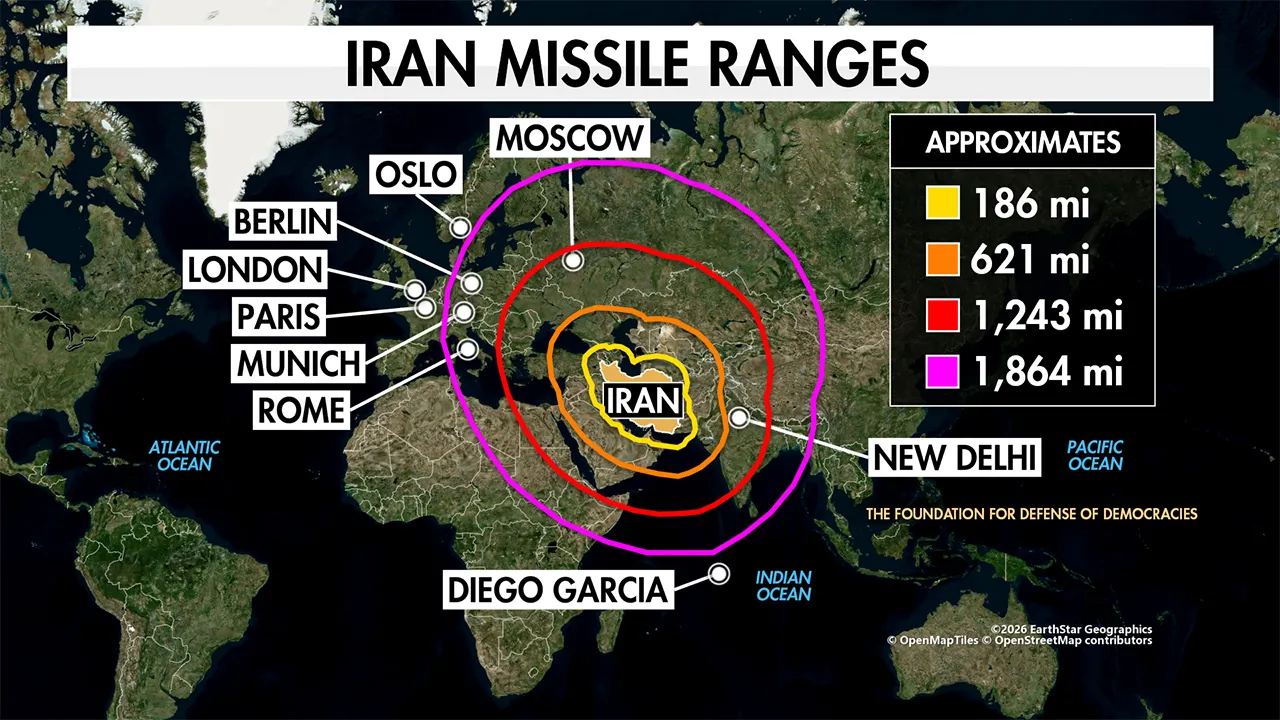
The Islamic Republic of Iran has ramped up its military actions against the United States by firing two intermediate-range ballistic missiles on Friday toward Diego Garcia, a strategic military base shared by the U.S. and the U.K. located in the Indian Ocean.
This move marks a significant shift in Iran’s military capabilities, as Diego Garcia is approximately 2,500 miles away from Iran, suggesting that Tehran’s missile technology has advanced beyond what was previously believed.
Prior to the launch of Operation Epic Fury on February 28, Iran’s Foreign Minister Abbas Araghchi stated, “We have deliberately limited our missile range to under 2,000 km, as we do not seek enmity with the American people or Europeans.” This recent development indicates a change in stance.
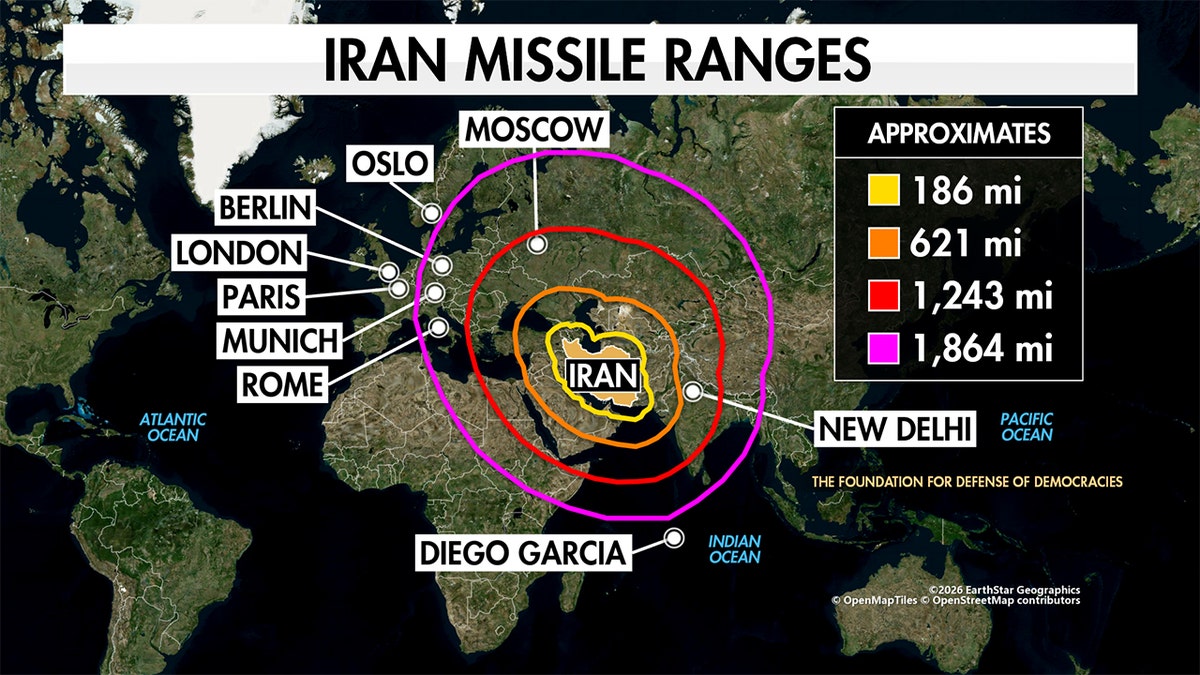
A map from the Foundation for Defense of Democracies illustrates the range of Iran’s missiles, highlighting the extent of their reach.
On Saturday, Israel Defense Forces Chief of Staff Lt. Gen. Eyal Zamir commented, “Just yesterday, Iran launched a two-stage intercontinental ballistic missile with a range of 4,000 kilometers [2,500 miles] aimed at an American target on Diego Garcia. These missiles were not directed at Israel but rather pose a direct threat to European capitals, including Berlin, Paris, and Rome.”
IDF spokesman Nadav Shoshani blasted the alleged Iranian deception on X: “Just 3 days before the war, the Iranian regime said they don’t obtain long-range missiles. Today, their lies were exposed once again, when missiles were fired 4000km away from Iran. They hoped to lie their way into becoming a force that can terrorize the world. We didn’t buy it.”
Jason Brodsky, the policy director of United Against Nuclear Iran (UANI), told Fox News Digital, “The Trump administration, in citing Iran’s missile threat as a rationale for Operation Epic Fury, was therefore justified in its decision to undertake military action as Iran has consistently refused to negotiate over its missile program. It also shows how dangerous it is to solely rely on Iranian nuclear weapons fatwas and the supreme leader’s public rhetoric in formulating U.S. policy. As long as Iran retains the technical capability beyond public pronouncements, it is a threat.”
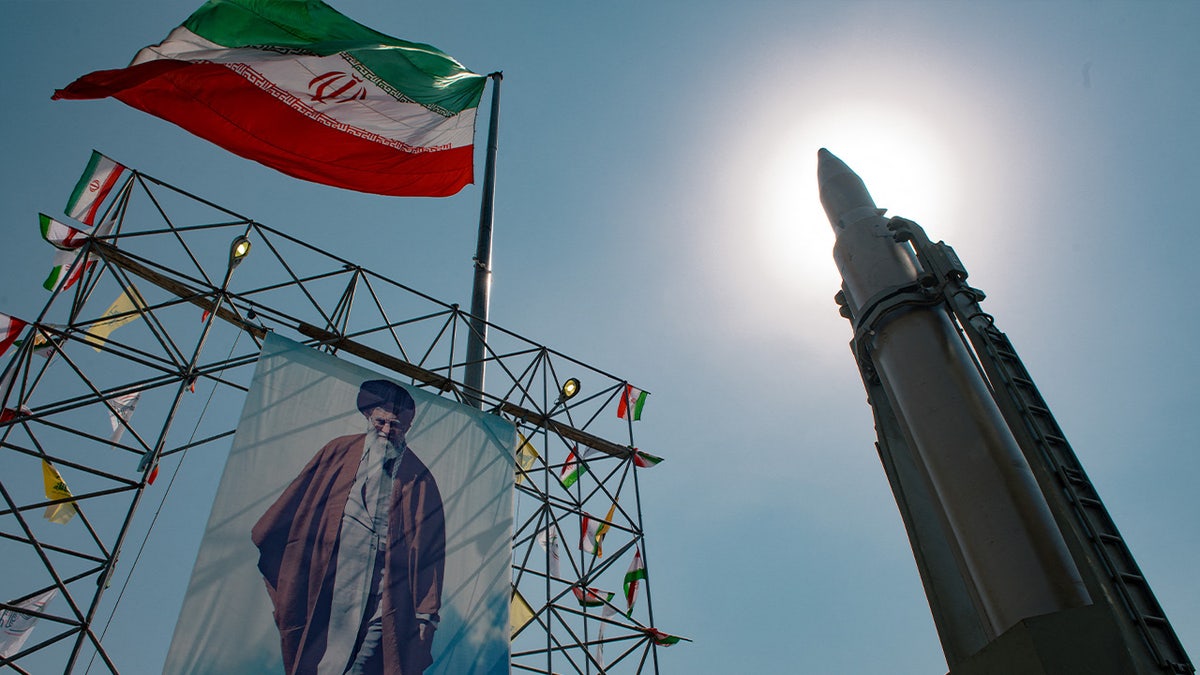
A big banner depicting Iran’s former Supreme Leader Ayatollah Ali Khamenei is placed next to a ballistic missile in Baharestan Square in Tehran, Iran, on September 26, 2024, on the sideline of an exhibition which marks the 44th anniversary of the start of Iran-Iraq war. (Photo by Hossein Beris /Middle East Images/AFP via Getty Images)
According to Brodsky, “I think it’s a message that the IRGC is in charge in Iran after Supreme Leader Ali Khamenei’s death. When Khamenei was alive, he limited the range of Iran’s missile program to 2000 km. Khamenei recounted in 2018 how he had rejected overtures from IRGC commanders seeking to increase the range to as much as 5000 km.”
He continued, “But now that he has died, those voices in the IRGC seeking to increase the range are likely driving the agenda. The launch of the missiles was likely meant as a signal of the IRGC’s capabilities to threaten U.S. allies beyond the Middle East. For example, this threatens Europe.”
The two long-range Iranian missiles did not hit the base, but the attempted attack marked a significant expansion of Iran’s reach beyond the Middle East and toward a major U.S. strategic hub. One missile reportedly failed in flight, while a U.S. warship launched an SM-3 interceptor at the other, officials said. It was not immediately clear whether the interception was successful. The remote base is a critical launch point for U.S. bombers, nuclear submarines and other strategic assets.
Ilan Berman, Vice President of the American Foreign Policy Council in Washington, D.C., told Fox News Digital, “The launch hammers home the president’s point about Iran being an imminent threat. It’s easy for casual observers to ignore, but the increasing maturity of Iran’s strategic programs, plural, has been exponentially expanding the threat that the Islamic Republic poses beyond the Middle East. That is what “Epic Fury” is seeking to address. The administration believes, absolutely correctly in my view, that these types of capabilities cannot be left in the hands of a radical, predatory regime.”
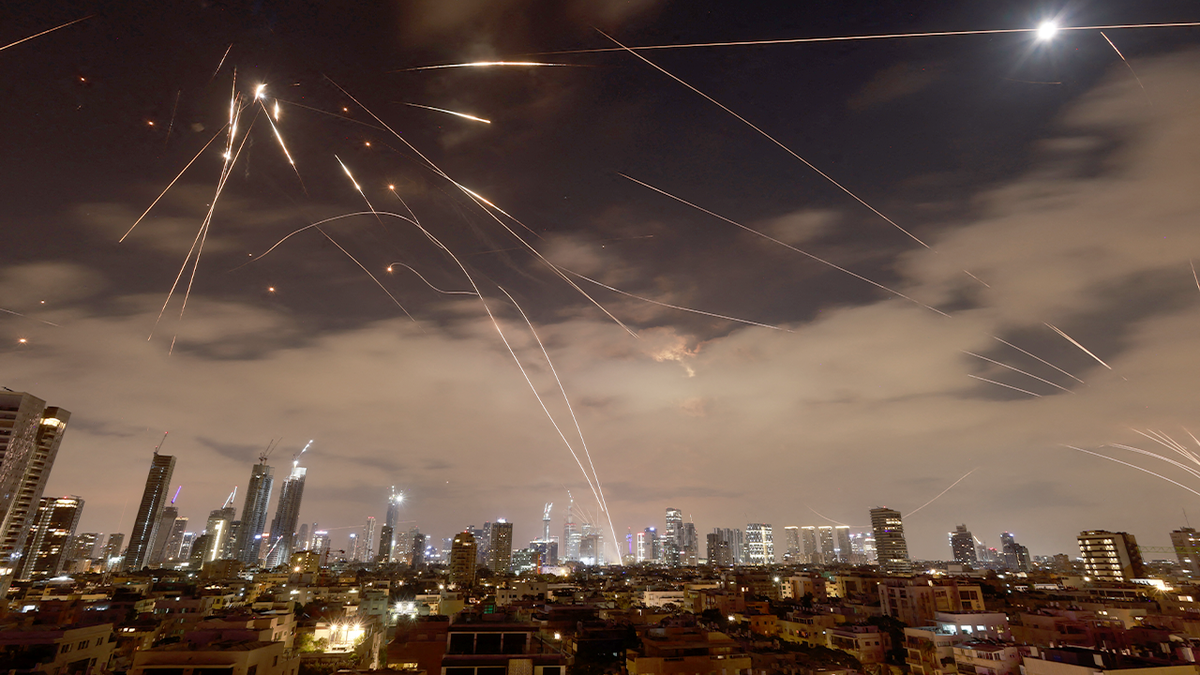
Israeli air defense systems are activated to intercept Iranian missiles over the Israeli city of Tel Aviv amid a fresh barrage of Iranian rockets on June 16, 2025. (Menahem Kahanna/AFP via Getty Images)
He continued that “Despite its public denials, it’s been clear that the Iranian regime has been working on expanding the range of its ballistic missile capabilities for years. The launch toward Diego Garcia confirms that it has made real progress toward that goal, and is already able to put targets in the same range as Central and Eastern Europe at risk. Moreover, it’s clear that the regime is seeking still greater capabilities – and that, if left intact, Iran’s ballistic missiles would attain intercontinental range soon.”
Berman, the author of “Iran’s Deadly Ambition: The Islamic Republic’s Quest for Global Power,” added, “The parallel development Iran has been carrying out on its space program is significant. The booster used to put payloads into orbit can be married onto a medium-range missile to create intercontinental range capabilities. Before the war, we were seeing a clear convergence of the regime’s strategic programs: its ballistic missile work, its space capabilities and its nuclear program.”
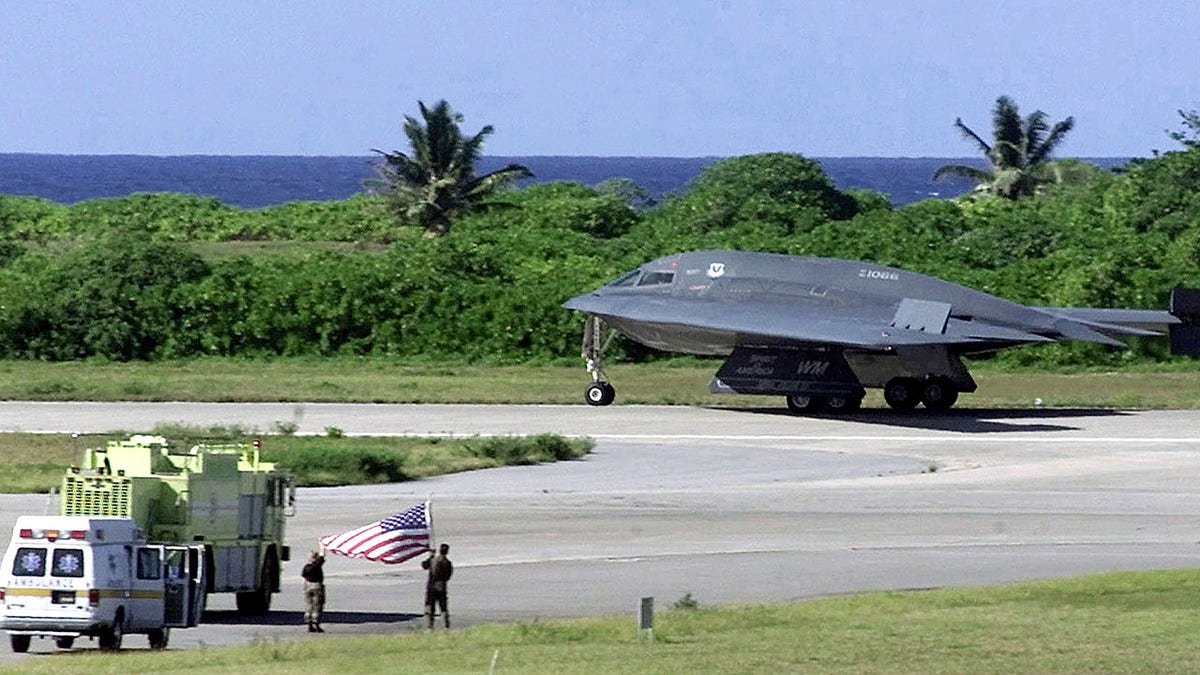
A U.S. B-2 Spirit bomber, part of the 509th Bomb Wing at Whiteman Air Force Base in Missouri, stops for refueling at the U.S. military base on Diego Garcia in October 2001, following an airstrike mission over Afghanistan in support of Operation Enduring Freedom. (U.S. Department of Defense/Senior Airman Rebeca M. Luquin)
He warned about the serious Iranian threat to continental Europe. “Europe is absolutely at risk, as the recent launch makes clear. I wouldn’t say that a failure to recognize this to date has been due to a grand deception by Tehran, though. It is more attributable to willful blindness on the part of European elites about the extent of the threat that the Iranian regime poses, as well as undue faith in diplomacy and arms control in containing it,” he said.
On Saturday, the United Kingdom condemned the attack. “Iran’s reckless attacks, lashing out across the region and holding hostage the Strait of Hormuz, are a threat to British interests and British allies,” the U.K. Ministry of Defense said in a statement. “RAF jets and other U.K. military assets are continuing to defend our people and personnel in the region.”
“This government has given permission to the U.S. to use British bases for specific and limited defensive operations,” it added.