
Share this @internewscast.com
Stubborn cellulite can be frustratingly persistent, often resisting even the most disciplined diet and exercise routines. However, experts suggest that what appears to be cellulite might actually be a lesser-known medical condition impacting up to 10% of women.
This condition, known as lipoedema, has gained attention thanks to celebrities like Shaughna Phillips, Josie Gibson, Kerry Katona, Gemma Atkinson, and most recently, Doja Cat, who have brought it into the public eye.
Lipoedema is characterized by an unusual accumulation of fat beneath the skin, predominantly affecting the legs, hips, and buttocks, and occasionally the arms, leading to a noticeable contrast between the upper and lower body.
In a recent TikTok post, Doja Cat shared her suspicion of having lipoedema, which influenced her choice to undergo liposuction in 2023. She described experiencing uneven fat accumulation around her thighs, knees, and calves.
This condition is believed to be initiated by hormonal changes during life events such as puberty, pregnancy, or menopause. Unlike typical body fat, lipoedema is largely resistant to traditional weight loss methods like dieting and exercise.
The condition is thought to be triggered by hormonal changes such as puberty, pregnancy or menopause – and unlike ordinary body fat, it is largely resistant to diet and exercise.
Yet despite affecting millions, it remains widely misunderstood.
Many women are misdiagnosed as simply overweight or confused with lymphoedema – a condition where lymph fluid builds up beneath the skin – while others are told nothing is wrong at all.

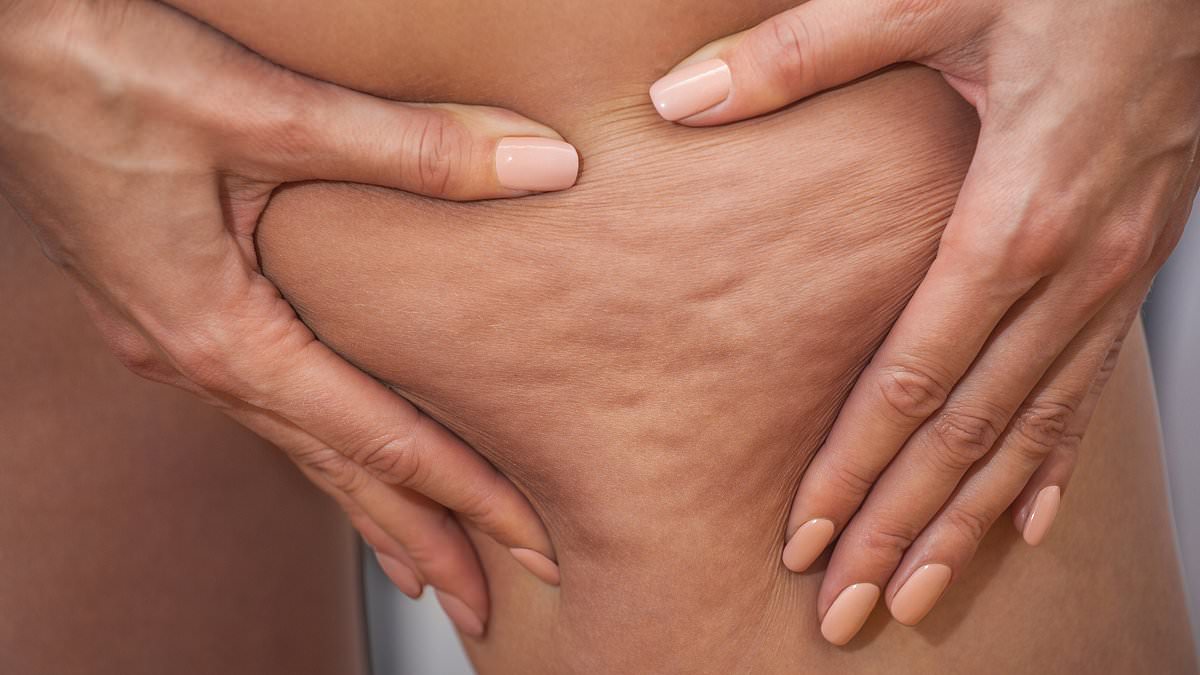
Both lipoedema and cellulite cause a dimpled ‘orange peel’ texture – but the similarities often stop there
Part of the problem is how closely it can resemble cellulite. Both can cause a dimpled ‘orange peel’ texture – but the similarities often stop there.
Experts say the key differences come down to pain, symmetry and whether the fat will shift.
Consultant plastic surgeon Mr Vasu Karri says lipoedema fat behaves very differently.
‘As lipoedema progresses, the skin becomes increasingly uneven, a change known as “mattressing”,’ he explains. ‘The fat becomes firmer, with small nodules under the surface.’
Cellulite, by contrast, is soft and superficial. Affecting around 90 per cent of women, it is caused by fibrous bands pulling the skin down while fat pushes upwards.
It may be frustrating – but it is harmless. Lipoedema is not.
The condition can cause pain, tenderness, easy bruising and a heavy, dragging feeling in the limbs.
It is also typically symmetrical, affecting both legs equally, and often spares the feet – creating a tell-tale ‘cuff’ at the ankles. And crucially, it does not respond to weight loss.

Pai Masendu, 51, spent her life believing she just had ‘fat legs’ and her concerns were dismissed – until she discovered the cause was lipoedema

Lipoedema occurs when abnormal, bumpy fat (you can feel lumps under the skin) builds up, usually in the legs, buttocks and thighs, but also sometimes in the arms
Dr Dennis Wolf, a London-based specialist, says this is often the biggest clue. ‘Early lipoedema can look like cellulite, and the two can occur together,’ he says.
‘But if someone is losing weight everywhere else and their legs aren’t changing, that should raise suspicion.’
For many women, the signs are dismissed for years. Pai Masendu spent decades struggling with unexplained weight gain, pain and bruising – even after losing three stone.
‘My collarbone stuck out and my face was thin, but my legs and arms never lost weight,’ she said.
By her mid-40s, the heaviness had become debilitating. ‘I had to pick up each leg to get into the bath – it felt like bags of sugar attached to my ankles,’ she said.
Despite exercising intensely and eating well, nothing changed. ‘I was going to the gym five or six times a week – but the fat wasn’t shifting,’ she said, adding that one GP told her to ‘starve myself’.
Her experience is far from unique. Lipoedema is frequently mistaken for stubborn fat or cellulite – delaying diagnosis for years.
Pai was only diagnosed at 49 after a colleague suggested the condition. ‘When I read the symptoms, I ticked every box,’ she said.
Lipoedema is also often confused with lymphoedema, a separate condition caused by fluid build-up. But unlike lipoedema, lymphoedema often affects one limb and includes swelling in the feet or hands.

Josie Gibson from This Morning has spoken about having lipoedema
Treatment for lipoedema focuses on managing symptoms rather than curing the condition. However, access on the NHS is limited, and private procedures can cost thousands of pounds.
Earlier this year, This Morning star Josie Gibson revealed she underwent liposuction after years of pain. ‘I always knew something wasn’t right,’ she said.
‘My body just holds onto fat differently. I train, I don’t overeat – but you don’t get rid of lipoedema like that.’
She described her legs as heavy, painful and prone to swelling after long days. ‘I’d get home and they’d be really big and sore – and I would bruise like a peach,’ she said.
For many women, the physical and emotional toll can be huge.
But experts say understanding the difference between lipoedema and cellulite could be life-changing – helping women get answers, support and the right treatment sooner.