Share this @internewscast.com
As I navigate the expansive, parched terrain, the haunting words echo in my mind: “They burned the pastor and his wife alive inside the church. Their screams still linger in our ears.”
The vastness of Plateau State stretches endlessly. Once a fertile ground for cassava and sugar cane, the rich, dark soil now lies charred. Trees are thick with soot, and fields of maize that once gleamed like gold now stand dull and lifeless, each stalk a silent soldier defeated in battle.
Scattered bricks lie amidst the brush, while concrete blocks protrude from the ground like jagged remnants of a bygone era. Roofs have collapsed inward, leaving a haunting silhouette against the sky.
And then, there are the churches.
One after another, they appear as burned-out husks. Crosses lie shattered, windows blown out. Some structures have been hollowed by fire, others demolished to rubble.
It seems as though there’s a deliberate attempt to obliterate every trace of Christianity from this landscape.
For more than two decades, this stretch of Nigeria’s Middle Belt – the faultline where the largely Muslim north meets the predominantly Christian south – has convulsed in recurring waves of bloodshed.

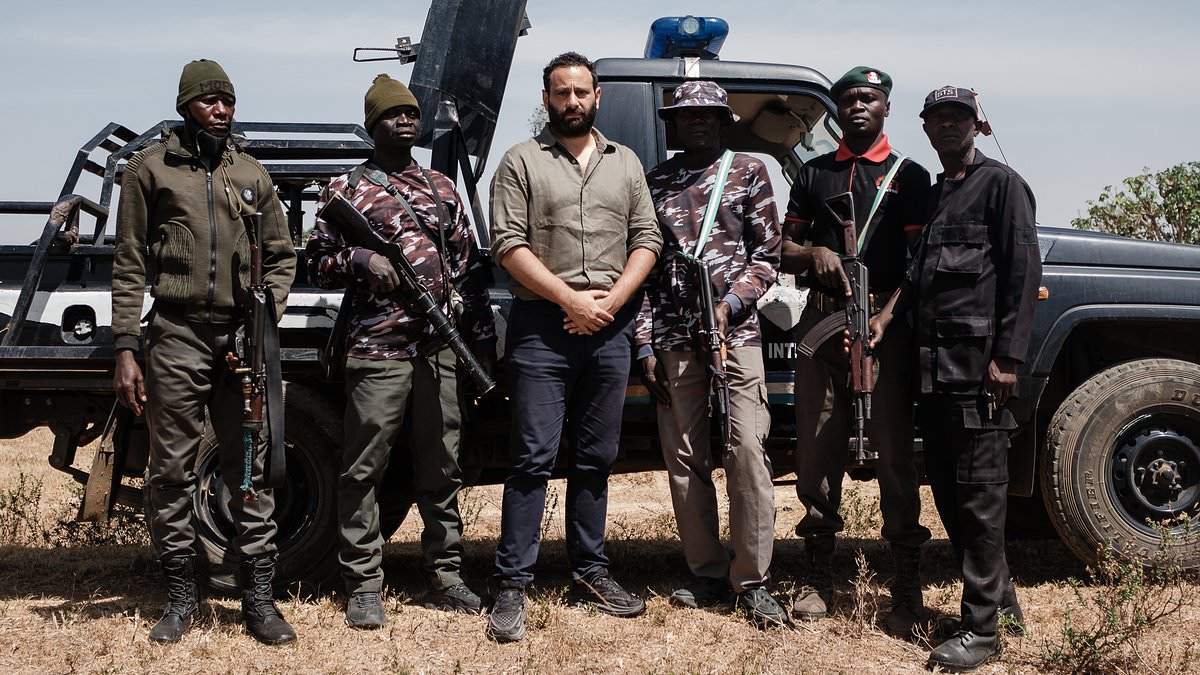
David Patrikarakos, centre, with his security escort in Gwet, in the Plateau State of Nigeria
According to the Armed Conflict Location & Event Data Project, thousands have been killed in one state alone since the early 2000s. Nigeria’s Security Tracker estimates that more than 60,000 people have died nationwide in communal and insurgent violence since 2011.
Yet outside Africa, the carnage rarely holds attention. It pierced Western consciousness in 2014 when Boko Haram abducted more than 270 schoolgirls, sparking the global #BringBackOurGirls campaign and drawing figures such as Michelle Obama into the outcry – and then it faded. It flared briefly again last Christmas when Donald Trump ordered air strikes against jihadist targets in the region following renewed attacks on Christian communities, thrusting Nigeria into the centre of American political debate. Then it slipped from the headlines once more.
And yet the religious faultline running through Nigeria mirrors anxieties reshaping politics across Europe and America: identity, migration, demography, religious coexistence. In Nigeria, those tensions are simply sharper – and bloodier.
Nigeria is home to more than 220million people and is projected to approach 400million within decades, on course to become one of the world’s most populous nations.
Plateau State, roughly the size of Belgium, has around four million people wedged into a fragile mosaic of farming villages and grazing routes layered over fertile land and mineral deposits. Add rapid population growth, climate pressures, weak institutions and the long shadow of the jihadist group Boko Haram’s insurgency – which has killed tens of thousands – and the combustible mix becomes clear.
In the face of all this, calling the violence here merely a ‘farmer–herder conflict’, as government officials try to do, begins to sound like a diplomatic euphemism. It’s true that land is in high demand and grazing routes are contested. But that explanation alone feels inadequate when you witness for yourself the ruins of so many churches – and hear the stories of so many slaughtered Christians.

Mobs attacked at least 17 rural communities in the Plateau areas of Bokkos and Barkin Ladi (pictured), murdering at least 200 and injuring 500 more
We arrive in the village of Gwet, parking by a collection of abandoned houses, destroyed fields and another ruined church. In truth, we’re not exactly welcome. The people who committed these atrocities – Muslim Fulani herdsmen – can be seen in the distance: the new, unchallenged masters of this once devoutly Christian area.
I’m told that they’d normally slaughter any stranger who dared to come – but unfortunately for them, earlier this morning I met the honourable Dachahat Tongpan, secretary general of the Local Government Area (LGA). This part of the Plateau State has a troubled history. In 2024, a sickening video circulated online of a Muslim mob beheading a young Christian man here and killing a family of five, including three children. The people remember. After he learned that I had come to investigate violence against Christians, the Secretary General insisted on providing an armed escort.
‘You need to see ground zero,’ he told me.
The truck-mounted heavy machine gun would ensure the Fulani left us unmolested.
But word spread. Some Christians who once lived here took the chance to return to their homes for the first time since they were driven out. Reverend Iliya Ayuba Fwangle is the local area chairman of the Christian Association of Nigeria. As we stand together amid the devastation, he turns to me. His immaculate, pinstriped suit clashes with the devastated landscape.
‘We are being displaced,’ he says. ‘Our people cannot farm. Our children cannot go to school. We pray you go back and tell the world about the genocide we Christians are experiencing here.’
The pattern has been identical across the years and locations. Night raids. Armed, baying men descending on sleeping Christian communities. Houses torched; men, women and children cut down or slaughtered in their beds; churches set ablaze. By dawn, whole settlements are smoking ruins.
‘Jonas’ is 29 years old. He cradles his metal machete like a comfort blanket. ‘For firewood,’ he says, ‘but also’, he adds, looking at the Fulani in the distance, ‘for protection.’ We stand in the blackened remains of his family home. This is the first time he’s dared to come back since May 16, 2023: the day his world was destroyed.
He starts to remember. Early that morning, Fulani families had been seen nearby gathering cattle and belongings, moving in unusually large numbers. Within hours they stormed his village screaming ‘Allahu Akbar’ and calling the Christians living there infidels. They fired into homes, chased families out and burned everything they could. They were methodical in their savagery. ‘We were terrified,’ he tells me. ‘We ran and hid in the bush and then fled.’

‘We cannot forget what they did to us,’ says Patricia, left. The Fulani shot her husband dead in front of her
Ten people once lived in his home: his parents, wife and younger brothers. They were farmers. Now the Fulani cattle graze the family’s field beyond their ruined church.
The Islamists murdered Jonas’s father: he shows me the very spot. ‘I shouted to him to run,’ he says. ‘Then I turned around and saw they had shot him. He was lying in his own blood.’ Thirteen people were killed in this village of around 800.
‘The churches are always their main target,’ he says. It is an attack at the heart of their faith. A message written in fire. Christian advocacy group Open Doors reported that the vast majority of Christians killed for their faith globally (between October 2024 and September 2025) were murdered in Nigeria. Government sources reject the claim, arguing the violence is driven by competition over land, farming and resources rather than religion.
Yet when the killing comes, it is often Christian villages that burn.
To drive between villages in Plateau State is to run a gauntlet of checkpoints. These range from official military installations with guard-huts and sandbags to a tree branch dragged across the road. Many are manned by men wearing ‘Special Forces’ emblazoned across faded uniforms – a promiscuous term out here.
We have to be careful, my fixer Abdullahi warns, because bandits erect fake checkpoints to rob travellers – especially at night. We round a bend and another checkpoint comes into view. An armed man leans into our window, looking intently at me. I brace for an interrogation. Then he puts his hand to his mouth: asking for money to eat.
‘Not so Special Forces,’ Abdullahi mutters.
The following morning, we pull into a churchyard smothered in the yellow dirt characteristic of the region. I’m here to meet several ‘internally displaced persons’ (IDP), in the humanitarian jargon – yet more victims of Muslim violence. We are going to discuss one of the worst atrocities in living memory: the Christmas Massacres of 2023.
In 48 blood-spattered hours between December 23 and Christmas Day, mobs attacked at least 17 rural communities in the Plateau areas of Bokkos and Barkin Ladi, murdering at least 200 and injuring 500 more. Although no group claimed responsibility, residents insist it was the Fulani.

In Jos, Plateau’s state capital – at the centre of Nigeria’s religious divide, where church crucifixes stand just streets away from minarets
They also insist the date was deliberate. In the days before the attacks, warnings had circulated: ‘Be careful how you celebrate Christmas – or you may not celebrate at all.’
Inside a surviving church in Bokkos, I take a chair by the stage alongside a lectern and a drum kit. Music is important to Nigeria’s Christians.
Reverend Silas Caleb Dang takes up the story. As Christians across the world prepared to celebrate the birth of their Saviour, gunfire ripped through the hills here. Houses were already burning when one pastor ran inside his church, locked the door and knelt at the altar.
‘He went inside the church to pray to Jesus,’ he tells me. ‘And they burned him alive.’
In nearby Muong village, the horror was repeated. At around 5pm on Christmas Eve 2023, gunshots were heard in neighbouring villages. By 6.30pm, the attackers were closing in. Sunday B. Randong, a retired civil servant now also displaced, went to the Special Task Force office in Bokkos to raise the alarm, but the officers just laughed and said they lacked personnel.
Soon after, the mob arrived. ‘They torched a house with the pastor’s wife and her five children trapped inside,’ he says, sitting across from me in a mustard-coloured kaftan.
‘They were Fulani. We know this because we heard their names as they shouted to each other: “Burn this house! Burn that house!”
‘It was an anti-Christian attack, no doubt,’ he concludes. ‘They screamed, “Allahu Akbar!” as they fired, calling us all infidels.’
Women and children fled toward a nearby stream, hoping the darkness would hide them, but the Fulani were already there, waiting, Reverend Silas says. ‘They butchered 23 women, children and elderly.’

‘Jonas’ is 29 years old. He cradles his metal machete like a comfort blanket. ‘For firewood,’ he says, ‘but also for protection’
Across the surrounding villages, local leaders say more than 64 were killed over several days. More than 1,300 houses were destroyed. Churches were gutted. Food stores were looted. Later, cattle were driven into Christian irrigation fields to destroy their crops.
Reverend John Dakwat believes that, apart from any disputes over land or cattle rustling, Christian communities are attacked because of their religion. ‘Any village they enter, they make sure they burn the church and kill our holy men,’ he says.
‘They tell us, “If you build a new church, one day we will make it a mosque.”’
In Jos, Plateau’s state capital – at the centre of Nigeria’s religious divide – I see church crucifixes just streets away from minarets. The call to prayer echoes above the corrugated shacks, while the occasional peal of worship music carries in the air.
And, I am repeatedly told, there can never be peace among Christians and Muslims here.
‘We cannot forget what they did to us,’ says Patricia, as her infant children sit beside her in an IDP camp, staring emptily into space. The Fulani shot her husband dead in front of her. Patricia has been in the camp for three years now, with little hope of either returning home or improving her life.

David with IDP children in Mangu, in the Plateau State
Each morning, she sends her tiny children to the rubbish tip to scavenge for anything they can sell to buy food.
I want to hear the other side of the story. Muslim communities have long claimed Christians rustle their cattle and attack their villages. The Christians say these attacks are only ever reprisals for Muslim violence.
Back in Jos, we drive through narrow streets filled with hawkers aggressively peddling their wares: for a while, a man sprints alongside our car brandishing a dead chicken.
I meet Sheikh Sani Yahaya Jingir, chairman of a national Salafi (the strict, orthodox branch of Sunni Islam) organisation. The community here, he tells me, faces discrimination at every level: especially politically.
‘We are the majority in Plateau,’ he says. ‘Yet we have never had a Muslim governor. We have no voice.’ He speaks of earlier crises – going all the way back to 1960 – and of repeated attacks where hundreds of Muslims were killed, mosques burned and markets destroyed.
‘What surprises us,’ he says, ‘is that America and Britain talk about “human rights”. But when Muslims are killed, they are silent.’
He leans forward. Boko Haram, the Nigerian jihadist group, he tells me, is no mere home-grown insurgency. ‘There are people who say America and Israel created Boko Haram to destabilise Nigeria.’ He offers no evidence. But it’s clear that he, and his followers in the room, believe it sincerely.
When I raise the killings of Christians in Plateau, he doesn’t deny them. He simply insists the story is not one-sided. He recounts an alleged attack on Eid prayers in 2011, claiming worshippers were killed and cars burned. He barely escaped with his life. ‘We chose the law,’ he says. ‘We did not retaliate.’
Both sides believe they are the victims. Neither is inclined to yield.
As we drive away from this troubled region for the last time, I find myself thinking about something that happened the previous day in Jos’s city centre.
We had paused at a traffic light. On the pavement nearby, a small boy clutching a battered toy stared at me through the car window and followed my gaze to the church across the intersection. Then, he slowly lifted his fingers and, smiling, made the sign of the cross.