
Share this @internewscast.com
In the wake of escalating tensions across the Middle East, European gas prices have surged by 40% since Friday, amid the conflict involving Iran.
Global stock markets experienced a downturn today, while oil prices spiked and gold prices rose, following Iran’s intensified retaliatory actions. These actions came after the U.S. and Israel conducted attacks that resulted in the death of Iran’s Supreme Leader, Ayatollah Ali Khamenei.
Having achieved record highs last week, the FTSE 100, the leading index of the UK stock market, dropped 163 points, or 1.5%, reaching 10,747 by 2:30 PM.
Analysts express concerns about a potential surge in inflation, driven by disruptions in the energy markets. Iran has reportedly cautioned that no tankers will be permitted to pass through the Strait of Hormuz, prompting insurers to retract policies and hike coverage costs. Meanwhile, Brent Crude Oil prices soared 8.6%, reaching $79.37 by midday.
This volatility extends to gas prices, with the EU’s natural gas index experiencing a 40% increase since Friday. This follows Qatar’s decision to halt liquefied natural gas (LNG) production after Iran launched drone strikes targeting its facilities.
Neil Wilson from Saxo Markets remarked, “While we’re not yet at 2022’s pricing levels, if Hormuz remains closed to LNG shipments to Europe for an extended period, we could face severe disruptions. My primary concern lies more with European natural gas prices than oil prices at this point.”
Gold climbed 2.2 per cent to $5,393, as investors sought assets considered safe havens and feared a fresh wave of inflation off the back of higher oil prices.

European gas prices have rocketed 40% since Friday, as this forward contract data shows
The Footsie’s decline was tempered by its energy, commodities and defence stocks. However, nervous investors will be watching markets closely, amid fears that the conflict could send shares tumbling.
German’s Dax was trading down 2.7 per cent and France’s CAC down 2.2 per cent, with traders set to take their lead from US markets now they are open. The S&P 500 was down 0.7 per cent shortly after trading began.
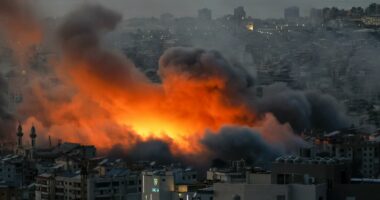
A wave of reprisal attacks on Middle Eastern nations by Iran continued yesterday after the US and Israel hit targets across Iran on Sunday, following the killing of Supreme Leader Ayatollah Ali Khamenei.
The FTSE 100’s relatively muted fall comes as the index is bolstered by its substantial weighting to energy companies, miners and defence.
These were buoyed by a higher oil price, greater demand for gold, and expectations of a continuing increase in defence spending.
Among the stocks that rose on the FTSE 100 this morning were BAE, up 5.3 per cent, Shell, up 2.6 per cent, and BP, up 2.6 per cent.
Airlines and banks were among the biggest fallers, with Barclays down 5.8 per cent, BA-owner IAG tumbling 5.4 per cent, , HSBC down 5 per cent, and easyJet down 3.6 per cent. Intercontinental Hotels also fell 4.5 per cent.
Gas prices leapt after Qatar’s state-run energy firm halted liquefied natural gas production.
In a statement, it said: ‘Due to military attacks on QatarEnergy’s operating facilities in Ras Laffan Industrial City and Mesaieed Industrial City in the State of Qatar, QatarEnergy has ceased production of liquefied natural gas (LNG) and associated products.’
European gas prices remain far below levels seen during the 2022 energy crisis but have risen beyond the level their level in early January, when they are typically high due to cold winter weather.
A prolonged spike could trigger a fresh bout of energy bill inflation, which will worry central bankers and could stall cuts to interest rates.
US gas prices are less exposed to global turmoil due to domestic production and rose around 5 per cent today.

The FTSE 100’s biggest risers at 1.30pm on Monday 2 March

The FTSE 100’s biggest fallers at 1.30pm on Monday 2 March
Richard Hunter, head of markets at Interactive Investor, said: ‘The sinister developments over the weekend have unsurprisingly had a debilitating effect on many asset classes, not least of which is uncertainty around the escalation and duration of the conflict.
‘At the eye of the storm was the potentially inflationary spike of the oil price at a time when central banks are still hoping that any further price rises could be contained.
‘Despite oil, defence and mining stocks providing a strong prop, the FTSE 100 was hit by a stronger wave of investor pessimism.’
The FTSE 100 had been flying high before the turmoil, hitting a series of record highs and knocking on the door of 11,000 points.

The FTSE 100 had been flying high before conflict with Iran erupted
Susannah Streeter, chief investment strategist at broker Wealth Club, said: ‘Investors are scuttling towards safe havens, seeking shelter as conflict widens in the Middle East.
‘Precious metals prices have ratcheted up again, with gold and silver increasingly sought after in these turbulent times.
‘Gold has reached a one-month high, after recording its seventh consecutive monthly gain in February – the best winning streak since 1973. Back then, a severe oil shock led to a flight to safe havens.
‘While oil prices have increased sharply, this is not yet mirroring the 1970s surge, when prices effectively quadrupled in just a few months after Gulf countries retaliated against US support for Israel in the Yom Kippur War.
‘However, with tensions escalating and uncertainty so high, it is far from clear how this current conflict will evolve, and prices could climb even higher.
‘This time around, other worries are also colliding to push up precious metals prices, including high debt levels, concerns over the Federal Reserve’s independence, and questions about the sustainability of the artificial intelligence boom.’
DIY INVESTING PLATFORMS
AJ Bell
AJ Bell
Easy investing and ready-made portfolios
Hargreaves Lansdown
Hargreaves Lansdown
Free fund dealing and investment ideas
interactive investor

interactive investor
Flat-fee investing from £4.99 per month
Freetrade

Freetrade
Investing Isa now free on basic plan
Trading 212

Trading 212
Free share dealing and no account fee
Affiliate links: If you take out a product This is Money may earn a commission. These deals are chosen by our editorial team, as we think they are worth highlighting. This does not affect our editorial independence.