
Share this @internewscast.com
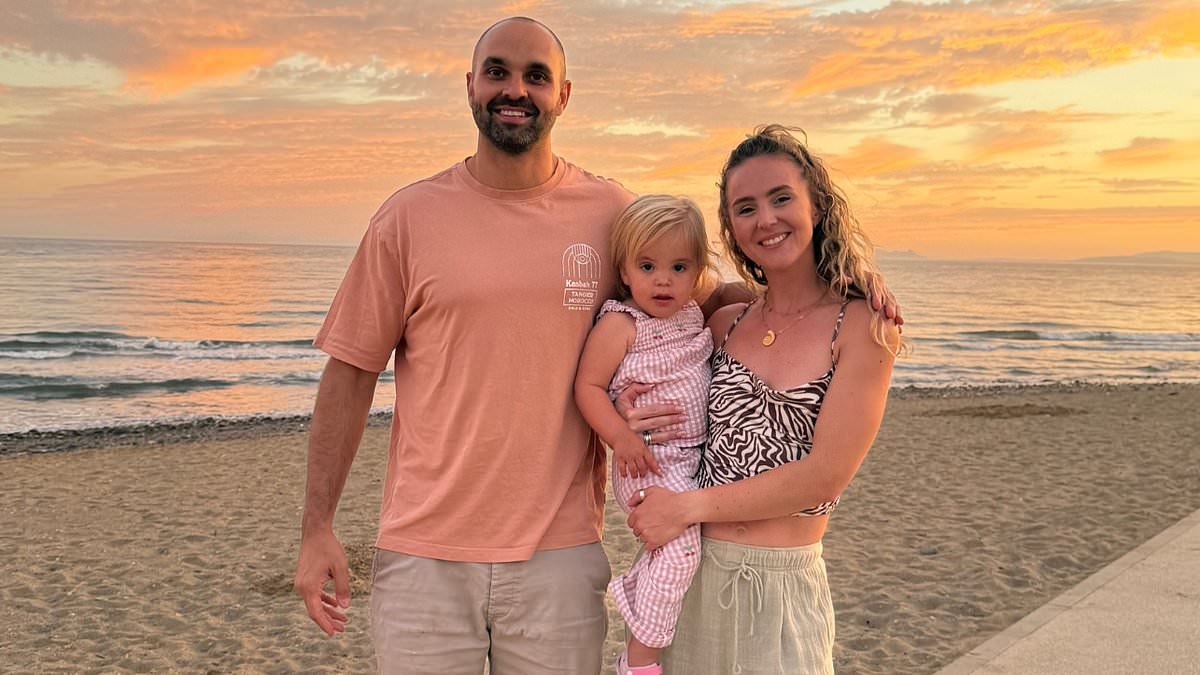
Facing a heart-wrenching challenge, the parents of a two-year-old girl diagnosed with a rare form of childhood dementia are in a desperate rush to find a cure.
Gus and Emily Forrester’s daughter, Leni, has been diagnosed with Sanfilippo syndrome, a neurodegenerative disorder that affects roughly one in every 70,000 births.
This condition arises from a deficiency in a specific enzyme that prevents the body from effectively breaking down certain molecules.
Initially, children with Sanfilippo syndrome may seem healthy, but as these molecules build up, they progressively damage the brain.
By around age three, this irreversible damage typically begins, leading to a gradual loss of abilities such as speaking, walking, eating, and drinking.
Currently, there is no cure or approved treatment available in the UK. However, hope is on the horizon with a clinical trial for a potential treatment set to commence in the United States later this year.
Leni’s parents, who have set up a GoFundMe page in the hopes of raising money for treatment, are urging the government to help fund the research so the trial could also include patients in the UK.
She told ITV: ‘Early treatment is key for these children. The damage cannot be reversed once it’s done.

Gus and Emily Forrester’s two-year-old daughter Leni has Sanfilippo syndrome, a neurodegenrative disease that affects only one in 70,000 children

Children with Sanfilippo frequently appear healthy in early childhood, with irreversible damage not usually begining until around the age of three – when they gradually lose the ability to talk, walk, eat and drink. Pictured: Leni sitting in her toy car with her Teletubbies dolls
‘If she has to wait six months, that could mean she can no longer talk. If she waits 12 months, that could mean she loses the ability to walk.
‘It’s extremely frustrating because the science is there. The data is there. It’s proven to be effective, and yet we cannot access it.’
Leni received her diagnosis five months ago, an experience Emily described as ‘every parent’s worst nightmare.’

Everyone experiences dementia differently. Use this checklist to help you make a note of your symptoms before you talk to your GP.
‘All your dreams for your child’s future are taken away,’ Emily said. ‘To be told that she has this condition, and there is no treatment and no cure and no support… it’s completely earth-shattering.’
Despite her condition, smiling toddler Leni is described by her parents as ‘a bundle of energy’ who loves to make people laugh.
But while Gus and Emily celebrate each new developmental milestone she hits, they know that time is not on their side.
‘Every day that passes without treatment, this toxic waste is building up in our child’s body,’ Emily said.
‘If we can’t get treatment, she will suffer the most awful physical and mental decline you can imagine and then die in her early to mid-teens.’

Smiling toddler Leni Forrester (pictured) is described by her parents as ‘a bundle of energy’ who loves to make people laugh
Professor Brian Bigger, based at the University of Edinburgh, has developed a gene therapy approach aimed at tackling childhood dementia.
The method delivers a missing gene into patients’ blood stem cells, but getting started on the clinical trials requires a large injection of funding.
‘We’re racing against time,’ he said. ‘She will start to lose brain cells and when that happens we’re not going to get them back.’
Professor Bigger called for the government to provide the vital support needed to help kids like Leni who are dealing with childhood dementia – which affects around 240 children born in the UK each year.
‘Charities typically can’t fund this kind of thing,’ he said. ‘It would be really good if we could see more commitment from government towards these kinds of therapies.

‘There are hundreds of kids like Leni out there who don’t have any therapy, and these treatments have the potential to be transformative.
‘All of us have a family member who’s been affected by dementia. Childhood dementia is no different. It’s just much, much worse – because it’s your kid.’
Leni’s parents are also calling for newborn screening to help detect rare genetic conditions earlier and for more funding to accelerate treatments.
While conditions like Sanfilippo syndrome affect a relatively small number of people, Gus says that taken in aggregate ‘rare’ diseases have a much broader impact than many realise.
‘When you group all these rare conditions together, they suddenly don’t become that rare. They affect a lot of people and a lot of families,’ he said.

There is currently no cure and no approved treatment available in the UK, but a clinical trial for a potential treatment is expected to begin in the United States later this year
Leni’s parents face an uncertain future as they battle to get their her the treatment she needs – and at times can’t help feeling frustrated at their daughter’s lot.
‘We shouldn’t have to fight for our child’s life,’ Emily said. ‘She is as valuable as any other child. But no one is fighting for her.’
‘As parents, your role is to protect your children and provide every opportunity you can,’ Gus added.
‘Without any treatment, her future and her reality is very, very dark.’
A Department of Health and Social Care spokesperson told ITV News: ‘Our thoughts are with all those living with dementia and rare conditions including Sanfilippo syndrome.
‘We are making sure patients with rare diseases, like Sanfilippo syndrome, get a definite diagnosis faster, while improving access to specialist care, treatment and drugs.
‘At the same time we are working hard to find new ways to slow down the progress of the dementia, speed up diagnosis and improve our understanding of the disease.’
The full report will be available to watch on ITVX and ITV Evening News on Monday March 23.