
Share this @internewscast.com
A factory in Ohio, operated by a Chinese company, faces allegations of exploiting undocumented labor, giving it an edge over American rivals.
Located in Moraine, a part of the Dayton metro area between Columbus and Cincinnati, Fuyao Glass America established its presence in a former General Motors facility in 2016, supported by public funds.
Fuyao, a major force in the glass industry, caters to various automobile manufacturers. Its Ohio operation was intended to revitalize the declining U.S. automotive sector.
However, competitors argue they cannot match the Chinese firm’s allegedly inequitable business and labor strategies.
In 2024, federal agents conducted a raid on the Fuyao Glass America plant in Moraine and several related entities, claiming the employment of undocumented workers.
The company’s pricing, reportedly about 10% lower than its competitors, poses a significant threat to a longstanding American glass factory that has been in business since the 1950s.
Vitro, the firm that owns the factory in Crestline, Ohio, has been considering closing the facility for the past year, putting 250 American jobs at risk.
The company announced plans to close the plant at the end of 2026, but last month, employees were told that it would continue operating.

The Fuyao Glass America plant, located in Ohio and operated by the Chinese company Fuyao, is undercutting US competition

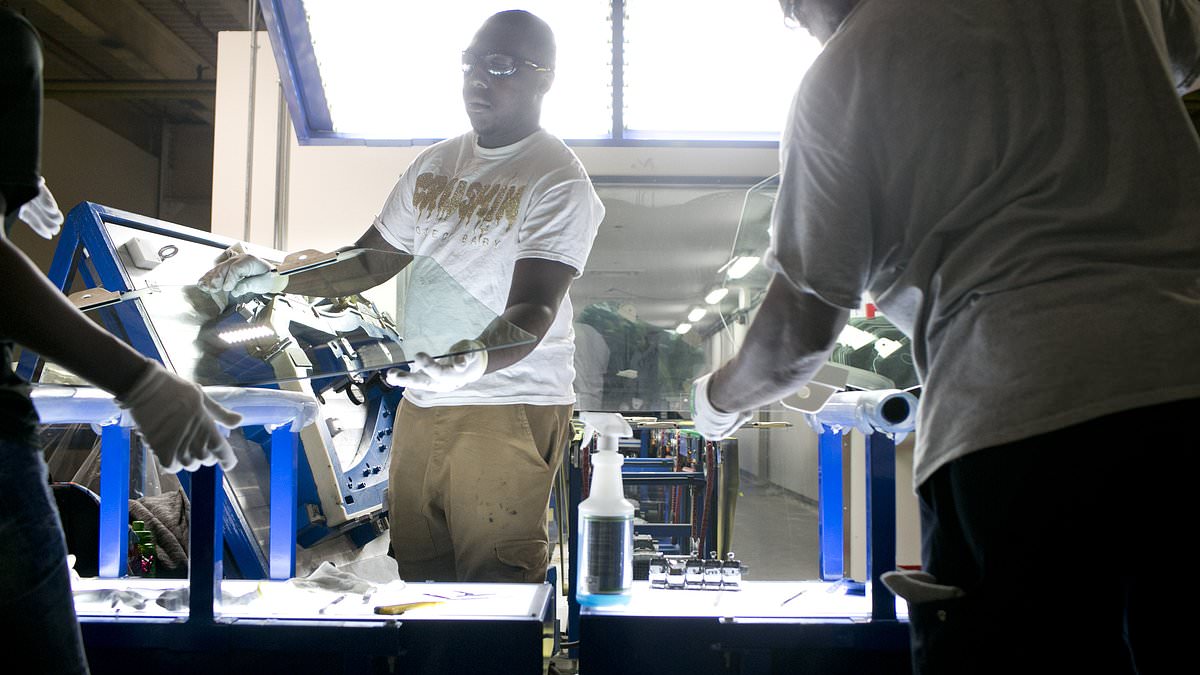
Fuyao has been accused of benefiting from employing undocumented workers. Employees are pictured working in the company’s Ohio factory in 2016, the year it opened

Fuyao Glass America moved into a closed General Motors plant, and it was meant to help revamp America’s withering domestic automotive industry

Fuyao’s low prices are threatening a competing glassmaking factory owned by the American company Vitro in Crestline, Ohio, that has been operating since the 1950s
Even so, the factory’s future remains deeply threatened, and the loss of 250 jobs would be a heavy blow to Crestline, a small town with a population of just 4,500.
Since 2019, Vitro has closed three of its auto-glass factories in Pennsylvania, Michigan and Indiana. The company has cited Chinese competition as one of the main reasons for those closures.
The threat to American businesses was likely unforeseen, as when Fuyao moved into Ohio a decade ago, it was welcomed by state officials, including the governor at the time, John Kasich.
When the company expanded its Moraine location in 2020, it was once again supported by Kasich’s successor, Governor Mike DeWine, and then-Lieutenant Governor Jon Husted.
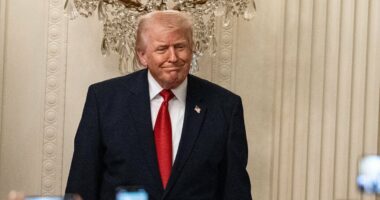
Chinese investment in US manufacturing is also generally supported by the Trump administration, despite ongoing trade tensions with Beijing.
At a meeting of the Detroit Economic Club last month, the president said: ‘If they want to come in and build a plant and hire you and hire your friends and your neighbors, that’s great, I love that. Let China come in.’
But Vitro’s head of automotive glass, Carlos Bernal, told the Wall Street Journal that the presence of Chinese automotive firms in the US ‘threatens the safety and security of domestic supply chains.’
The US government has accused Fuyao and its affiliate businesses of creating a system to import illegal workers, house them and transport them to various factories.

Fuyao’s opening and expansion were supported by Ohio officials. The state’s governor, Mike DeWine (center left), and then-Lieutenant Governor, Jon Husted (center right), at the factory’s expansion in 2020 alongside Fuyao Chairman Tak Wong (left)

Chinese investment in American manufacturing is generally supported by Trump and his administration

The Fuyao Moraine plant’s manufacturing and assembly floor. Federal authorities raided the factory and more than a dozen affiliated businesses in 2024
According to a civil forfeiture complaint filed by federal authorities last year, the US accused Fuyao of spending $126 million on the scheme, though no one has been criminally charged in the case.
The complaint alleged that the affiliated companies were created to ‘conceal the multi-million-dollar income generated as a result of the business owners conspiring to harbor, transport, and employ a workforce made in part of illegal aliens.’
The complaint also noted that some of the employees interrogated by law enforcement agents said they were trafficked across the US-Mexico border.
Nearly all of those directly employed by Fuyao had documentation to work in the US, but many of the employees at the company’s affiliates who were named in the investigation did not show up for work on the day of the raid, the complaint alleged.
None of those absent workers had proper documentation to work in the country, the complaint also said.
Stella Zhang, a Fuyao spokesman, told the Wall Street Journal that all of the company’s employees in the US were authorized to work in the country and that the vetting process for affiliate hires has been revamped.
Zhang said the federal investigation was targeting only the affiliates.
Fuyao has denied any wrongdoing and has said its competitive prices result from using the same production strategies and economies of scale that have made China a manufacturing powerhouse.