
Share this @internewscast.com

Analysis reveals a staggering increase in worklessness due to long-term sickness across parts of Britain, with figures soaring six-fold since the pre-Covid era.
Government estimates indicate that currently 2.8 million people are on sick leave, marking an increase of about 700,000 from before the pandemic disrupted the nation.
The surge in mental health issues has been a significant contributor to what is being termed an ‘economic inactivity crisis.’ In response, the Labour party has pledged to address this issue as part of a broader strategy aimed at revitalizing the economy and reducing the burden on taxpayers through welfare savings.
Interestingly, young people now face the same likelihood of being sidelined by long-term illness as those in their 40s, according to findings from the Resolution Foundation.
In Dover, for instance, MailOnline’s examination of official statistics uncovers that over 14 percent of the working-age population, equating to around 9,700 individuals, are deemed ‘economically inactive’ due to prolonged illness.
To put this in perspective, this figure was nearly 2.5 percent during the 2019-20 period.
Cambridge saw the second biggest rise, following Dover. It went from almost 1.5 per cent of 16- to 64-year-olds off work due to long-term sickness in 2019/20 to 6 per cent in 2023/24.
About one in 15 local authorities have seen rates at least double over the same time-frame, according to data from the ONS Labour Force Survey.
The figures are estimates, based on self-reported cases of long-term illness.
Blackpool, meanwhile, has the highest rate across Britain, with 16 per cent – 12,900 out of 80,800 people – of its residents unemployed due to illness.
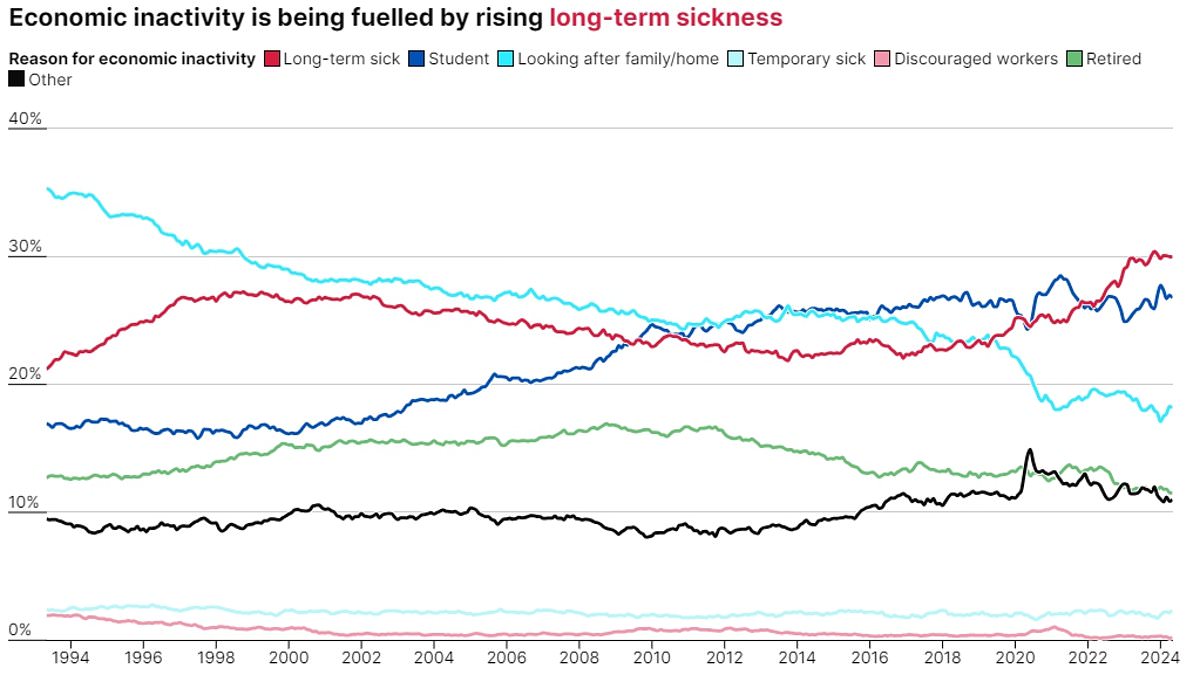
Millions more are out of work across the country for other reasons, such as studying at university, being retired or looking after their family.
Total economic inactivity in Britain now exceeds 9.5m, according to the ONS. Before the Covid pandemic it stood at around 8.4million.
Being a student used to be the leading cause of economic inactivity, but long-term sickness overtook it in late 2021.
Nearly 30 per cent of economically inactive people are so because of long-term sickness, up from 25 per cent before the pandemic.
Across England, Scotland and Wales the number of people out of work because of a long-term illness rose by nearly 20 per cent between 2019 and 2024.
Of those economically inactive due to long-term illness, depression, bad nerves or anxiety has consistently been the most common primary or secondary cause.
The numbers rose by nearly 390,000 or 40 per cent, from around 965,000 in 2019 to around 1.35million in 2023, ONS figures show. This is the greatest total rise of all reported conditions.
Louise Murphy, senior economist at the Resolution Foundation think-tank, said: ‘This lays bare the scale of the economic inactivity crisis Britain is facing, with rising ill-health blighting too many people’s jobs and career prospects.
‘But the ill-health problems we face today are different to those of the past.
‘Mental health problems are driving much of the recent rise in inactivity and are concentrated among young people, who are now just as likely to be out of work due to long-term sickness as people in their 40s.’
Labour’s health advisor this week suggested workers on long-term sick leave should face benefit sanctions if they fail to seek employment.
Alan Milburn, who was health secretary under Tony Blair, said that getting millions of people who are economically inactive on medical grounds back into work would cut welfare costs.
Mr Milburn said ‘scrutiny, conditionality and sanctions’ would be needed to get those who refuse to work into a job.
But he also criticised the UK’s ‘perverse’ welfare system, which ‘pays to be classified as incapable of work rather than actively seeking it’.
Mr Milburn said: ‘Those who are classified as officially seeking work are offered some support to do so but also face harsh conditionality and lower benefit payments than those who are classified as unable to work.
‘By contrast, the latter economically inactive group get little support to find work but face no conditionality and receive higher payments than those actively seeking work.
‘Solving this problem will require action across public services from schools, colleges and the NHS to job-centres.’
A survey included in the report also concluded that the most common barrier to work for those who want to was a disability or health issue, with 62 per cent saying this was an issue for them.
Half said a barrier was family or caring commitments and more than two in five said there was too much competition and that they lacked recent experience.
Labour Work and Pensions Secretary Liz Kendall this week promised she would get two million more people into work.
In her first speech in the role, she slammed the ‘dire’ situation that meant Britain is ‘the only G7 country whose employment rate still hasn’t returned to pre-pandemic levels’.
But she indicated the Government would abandon the tough approach of the Tories – and vowed to end ‘divisive rhetoric about strivers versus scroungers’.
Ms Kendall said the Department for Work and Pensions needed ‘fundamental reform’ to ‘shift from being a department for welfare to being a department for work’.