Share this @internewscast.com
The origins of hummus remain a mystery, with its invention claimed by several Middle Eastern countries, including Lebanon, Egypt, Syria, and Turkey. Historical references to this beloved dish stretch back to the 13th century.
Fast forward about 800 years, and hummus has firmly established itself as a favorite in Britain, filling shopping carts and fridges across the nation. Its popularity has grown to the extent that its cost is sometimes used to gauge inflation.
Hummus, crafted from a blend of chickpeas, tahini, lemon juice, garlic, and olive oil, is celebrated for its adaptability. It serves as a delightful dip for crunchy carrots and cucumbers, a spread for sandwiches and wraps, or a complement to salads and grilled meats.
However, despite its nutritious profile, some dieters shy away from hummus due to concerns about its calorie and fat content.
This raises the question: Is hummus truly a healthful choice?
“For the most part, I would classify it as a nutritious option,” Jenna Hope, a nutritionist and author, shared with the Daily Mail. “It’s an excellent source of protein, fiber, and iron, particularly because of the tahini.”
‘The healthy fats in there helps to keep you fuller for longer, and the fibre is important for gut health which is a big conversation at the moment,’ she added.
So what exactly does hummus deliver nutritionally, where does it fall short – and how should we eat it if we want it to work harder for our health?

Hummus is one of the most popular items in shopping trolleys and fridges across Britain today
What is in hummus?
At its very essence there are just five main ingredients in hummus: chickpeas, garlic, lemon, tahini – a paste made of finely ground sesame seeds – and olive oil.
A basic 100g serving of the dish contains around 170 calories, consisting of 8-10g of fat, 11-14g of carbohydrates, 6g of fibre and between 6-8g of protein.
Less than 2g of saturated fats – the type if eaten to excess that are linked to poor heart health – are typically found in a 100g serving.
With the NHS recommending that a woman eats no more than 70g of fat per day and that a man eats no more than 95g, a 100g serving of hummus fits the bill for a standard diet.
‘The fats are healthier fats, more monounsaturated, polyunsaturated fats and generally they’re associated with better heart health and can help to support cognitive function as well,’ Ms Hope says.
Is hummus healthy?
Each ingredient in a standard recipe of hummus brings its own nutritional benefits.
Chickpeas are packed full of plant proteins, tahini is rich in antioxidants – linked to reducing illnesses such as cancer and Alzheimer’s – and garlic has been associated with lowering blood pressure and cholesterol.
Lemon is rich in Vitamin C, which has long been associated with maintaining healthy skin, while olive oil – a key part of the Mediterranean diet – has been linked with better heart health.
The Vitamin C in the lemon juice also enhances the body’s ability to absorb the iron from the tahini.
Ms Hope did note, however, that people should be aware of the preservatives and artificial additives found in supermarket offerings of the dish.
She said: ‘I appreciate we’re living in times where cost of living and price of food is challenging, but I would say if possible it’s best to reach for those ones which don’t have a whole list of additives and really stick to the basics – chickpeas, garlic, lemon juice, oil, tahini and salt.’

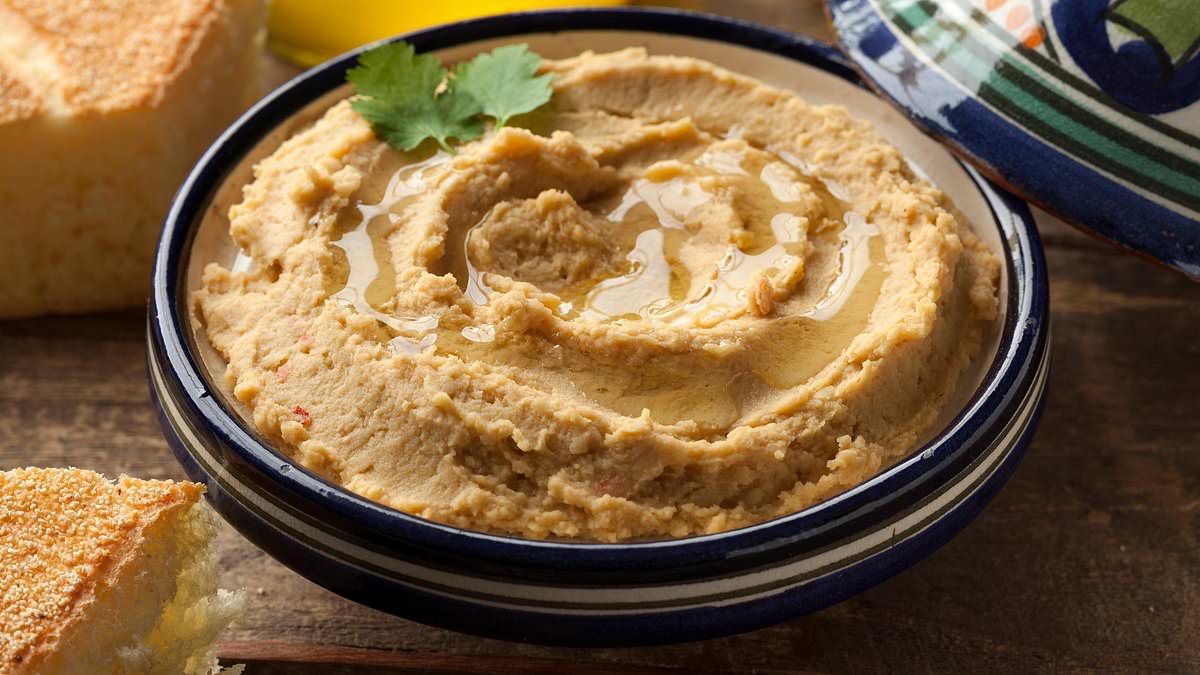
Each ingredient in a normal recipe of hummus (above, centre) brings many nutritional benefits
Is hummus high in protein?
While hummus may not be the most protein-dense option available, it remains a valuable source of plant-based protein.
In a standard supermarket tub, you can expect to find between 6g and 9g per 100g.
As a result, many vegans and vegetarians have made it a staple in their diets.
‘It’s not a very high protein food but it’s a good way to get extra protein into the diet,’ says Ms Hope.
‘Particularly for people on a plant-based or vegetarian diet who generally might find it a little bit more challenging – it can be a good way to get extra protein.’
The NHS recommends that we eat 75g of protein per kilogram of body weight, which is around 45g–55g per day for an average adult.
Is hummus high in fat?
At around 20 per cent fat per supermarket tub, hummus can’t be described as a low fat food.
‘The calorie content and the fat content of different brands of hummus does vary significantly,’ Ms Hope says.
‘One thing to think about with hummus is that it does contain fat but generally it’s the good type of fat and it can be slightly higher in calories.’
The fat in hummus comes from the olive oil and tahini, which are both rich in monounsaturated fat, which is linked to good heart health due to its cholesterol-lowering properties.
Olive oil also contains between 70 to 85 per cent oleic acid and antioxidants, while tahini is rich in Omega-6 and Omega-3 fatty acids, which are needed for good eyesight and healthy skin.
If you’re following a low-fat or calorie controlled diet, Hope advises looking out for reduced fat options which often have replaced some of the oil with water.
Can hummus lower cholesterol?
Last summer, a study linked eating a 160g portion of cooked chickpeas a day with lower cholesterol levels.
The study – which is yet to be peer reviewed – was led by a team from the Illinois Institute of Technology who monitored 72 people who were prediabetic.
They found that eating a cup of chickpeas over the course of 12 weeks lowered their cholesterol, without affecting their blood sugar levels.
The British Heart Foundation also includes hummus among its list of foods that can help reduce reliance on products linked to high cholesterol.
Is hummus suitable for IBS sufferers?
Chickpeas are classed as a high FODMAP food which can trigger digestive issues or inflammatory bowel conditions such as IBS.
FODMAPs – fermentable oligosaccharides, disaccharides, monosaccharides and polyols – are types of carbohydrates found in certain foods that can cause digestive upsets including bloating, gas and diarrhoea.
‘Generally speaking, a very small amount, sort of one to maybe two tablespoons is ok for IBS sufferers,’ says Ms Hope.
‘I would say if you fall into that category then you’re much better off to make it at home and use things like steamed carrots alongside the chickpeas to bulk out the hummus, reducing the total FODMAP of your serving.’
She adds that the levels of garlic in hummus ‘can also be challenging for some people with IBS’ so to consider using garlic oil rather than whole cloves.

Hummus contains chickpeas (pictured) as well as tahini, lemon juice, garlic and olive oil
Is hummus gluten free?
In its simplest form, hummus is gluten free and suitable for people with coeliac disease.
However, it is always advisable to check the labels of hummus sold in supermarkets due to the risk of any additives containing gluten.
What are the healthiest ways to eat hummus?
From warm pitta bread to fries and even chicken strips, there is no shortage of foods that taste even more delicious after a dip in hummus.
But experts claim the healthiest options are fresh fruits and vegetables such as carrots, cucumbers, broccoli and sugar snap peas.
Peppers are also a great way of absorbing the iron in chickpeas due to its high vitamin C content.
Which high street brand of hummus healthiest?
A Daily Mail analysis of supermarket hummus this month found that the below Waitrose and Marks and Spencer offerings were the healthiest:
Waitrose No.1 Extra Virgin Olive Oil Hummus 170g – £2.95
INGREDIENTS: Cooked chickpeas (42 per cent) (water, chickpeas), extra virgin olive oil (24 per cent), water, tahini (13 per cent) (sesame seed paste), concentrated lemon juice, salt, garlic.
M&S Collection Extra Smooth Hummus 170g – £3.15
INGREDIENTS: Cooked chickpeas (46 per cent) (water, chickpeas), extra virgin olive oil, tahini (sesame seed paste) (11 per cent), water, concentrated lemon juice, garlic, salt.
According to nutritionist Alexa Mullane, this is because they ‘both contain extra virgin olive but also contain ‘no preservatives or acidity regulators’.
Many of the hummus brands found to be ‘not the real deal’ used cheaper ingredients such as rapeseed oil or sunflower oil rather than extra virgin olive oil.
Why not try this simple hummus recipe?
Ingredients:
- One can of chickpeas (drained and rinsed)
- Two tablespoons of tahini
- Two tablespoons of lemon juice
- One small garlic clove
- Two-to-three tablespoons of olive oil
How to make:
- Put everything into a blender and blend until thick
- Add little drops of cold water and keep blending until smooth
- Taste and add a little bit of salt or extra lemon if required
Serve:
- Add a drizzle of olive oil or some paprika for some extra flavour