Share this @internewscast.com
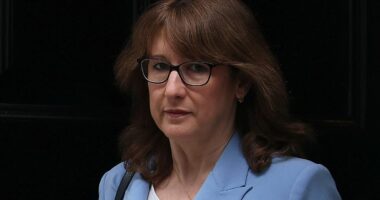
Veteran British Airways pilot Alastair Rosenschein remembers his most harrowing brush with turbulence as if it happened yesterday.
Back in 1988, he piloted a Boeing 747, loaded with 400 passengers, from London to Nairobi when the aircraft experienced a violent jolt flying over the mountains in northeastern Italy.
‘It felt like a massive fist had punched the aircraft in the nose,’ said Rosenschein, now 71.
‘We were hanging in our seatbelts.’
The crew battled to control the aircraft during 15 terrifying minutes that brought the jet dangerously close to stalling.
Rosenschein recounted his experience to the Daily Mail following another frightening mid-flight incident — this time onboard a Delta Air Lines journey from Salt Lake City to Amsterdam, which encountered severe turbulence, resulting in 25 hospitalizations.
The Airbus A330-900, which had 275 passengers along with 13 crew members, had to make an emergency landing at Minneapolis-St. Paul International Airport at about 7:45 pm on Wednesday.
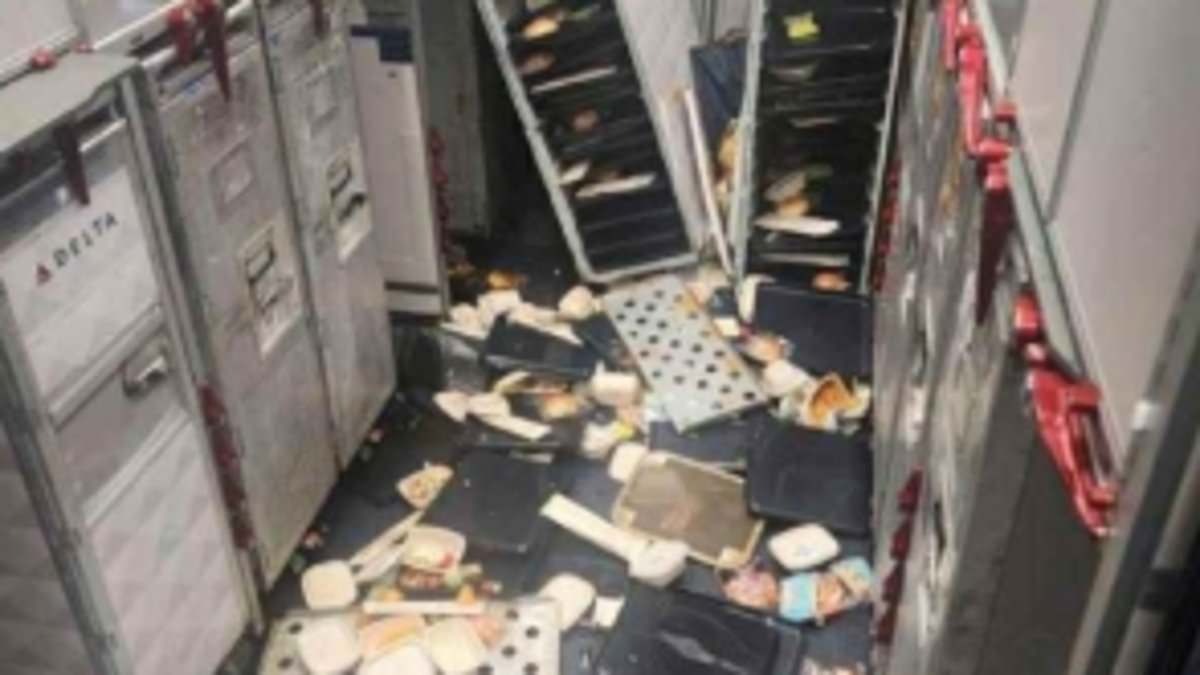
Passengers reported being thrown into the ceiling and slammed to the floor as food trolleys and serving carts flew through the cabin.

Veteran British Airways pilot Alastair Rosenschein (above) remembers his most harrowing brush with turbulence as if it happened yesterday

Rosenschein recounted his experience to the Daily Mail after another mid-flight scare — on a Delta Air Lines trip from Salt Lake City to Amsterdam (depicted above) that ran into severe turbulence, leading to 25 people being hospitalized.

Injuries from turbulence are rare but are terrifying when they occur, as Singapore Airlines passenger Kerry Jordan discovered in 2024
Air travel has long endured its share of bumpy rides — but specialists now warn that turbulence is intensifying, causing more injuries, and the smooth flights we once expected may become less frequent.
Climate change is widely believed to be fueling more violent air pockets and storm activity, creating chaotic skies that aircraft can’t always avoid.
“Air space is becoming more congested due to rising commercial air traffic, making it challenging to reach the desired flight level,” explained Rosenschein, noting that pilots are having a harder time finding smooth air routes.
The Delta shocker is yet another wake-up call, he added, a sign that airline safety procedures must evolve to keep pace.
‘The number of people injured is usually directly proportional to the number not wearing seat belts,’ said the married father-of-two.
‘They should change the rules now and make wearing seat belts compulsory whenever you’re in your seat.’
Most airlines advise passengers to keep their seat belts fastened, even when the fasten seat belt sign is off. Singapore Airlines went further, tightening its policy after a fatal turbulence incident last year.
A National Transportation Safety Board (NTSB) study found that seat belts significantly reduce the risk of injury during turbulent conditions. But Rosenschein acknowledges there’s no perfect solution. Long-haul passengers will always need bathroom breaks, and some must move around to avoid blood clots.
Crashes caused directly by turbulence are extremely rare — the last such calamities occurred back in the 1960s. Since 1981, only four deaths have been attributed to turbulence worldwide.
Still, the number of serious injuries is rising fast. Since 2009, some 207 people in the US alone have suffered serious turbulence-related injuries, according to the NTSB — many of them cabin crew.
There are currently around 5,000 cases of severe or extreme turbulence globally each year, out of more than 35 million commercial flights.

Turbulence is rarely the cause of a crash: a tragedy that has not affected a major passenger airline since the 1960s

Ambulance personnel assist passengers off an Air Europa Boeing 787-9 Dreamliner that made an emergency landing in northern Brazil in July 2024 after seven people were injured in strong turbulence
But that number could skyrocket. Professor Paul Williams, an atmospheric scientist at the University of Reading, predicts a doubling or even tripling of severe turbulence in the coming decades.
Clear-air turbulence — the most dangerous kind — is invisible, can’t be detected by radar, and hits without warning.
It is caused by sudden changes in wind direction and speed, often around the jet stream, a high-altitude air current where planes cruise at more than 500 mph.
As climate change causes the atmosphere to heat unevenly, these air currents become more unstable — and more hazardous.
The North Atlantic corridor — connecting the US, Canada, the Caribbean and the UK — is already known as a turbulence hotspot, with a 55 percent rise in severe turbulence over the last 40 years.
New danger zones are now emerging, including parts of East Asia, the Middle East, North Africa, and even inland North America.
This week’s Delta scare is one of several serious turbulence incidents in recent months.
- In June, five passengers were hospitalized in North Carolina after an American Airlines flight from Miami hit turbulence en route to Raleigh-Durham.
- Earlier that month, nine people were injured when a Ryanair flight from Berlin to Milan was rocked by storms over southern Germany.
- In March, a United Airlines flight from San Francisco to Singapore hit severe turbulence over the Philippines, injuring five.
- On March 3, multiple flights were diverted to Waco, Texas, due to storm turbulence — with five people injured aboard a United Express flight from Missouri to Houston.
- In May 2024, a Singapore Airlines passenger died when turbulence struck a flight from London to Singapore — the first turbulence-related death on a major airline in decades.

The interior of Singapore Airlines flight SQ321 is pictured after an emergency landing at Bangkok’s Suvarnabhumi International Airport in May 2024
Despite the growing risks, Rosenschein believes air travel will remain safe, thanks to new technology and smarter procedures.
Forecasting has improved: clear-air turbulence predictions are now 75 percent accurate, up from 60 percent two decades ago.
Some airlines have begun ending cabin service at higher altitudes to get crew and passengers seated earlier. Korean Airlines has even banned serving noodles in economy, citing a doubling of turbulence since 2019 and the risk of burns.
Looking ahead, artificial intelligence may help aircraft adjust in real time to atmospheric conditions, although this tech remains in early stages.
And while turbulence often causes panic, Rosenschein says it rarely results in serious damage — even during that near-stall incident over the Dolomites.
He recalled how he and the flight crew remained shellshocked even as the air outside suddenly calmed down.
‘The cockpit door opened, and the stewardess walked in with a tray of tea,’ he said.
‘She said: “Gentlemen, I brought some tea. You probably want it. This is the only china that’s not smashed.”