
Share this @internewscast.com
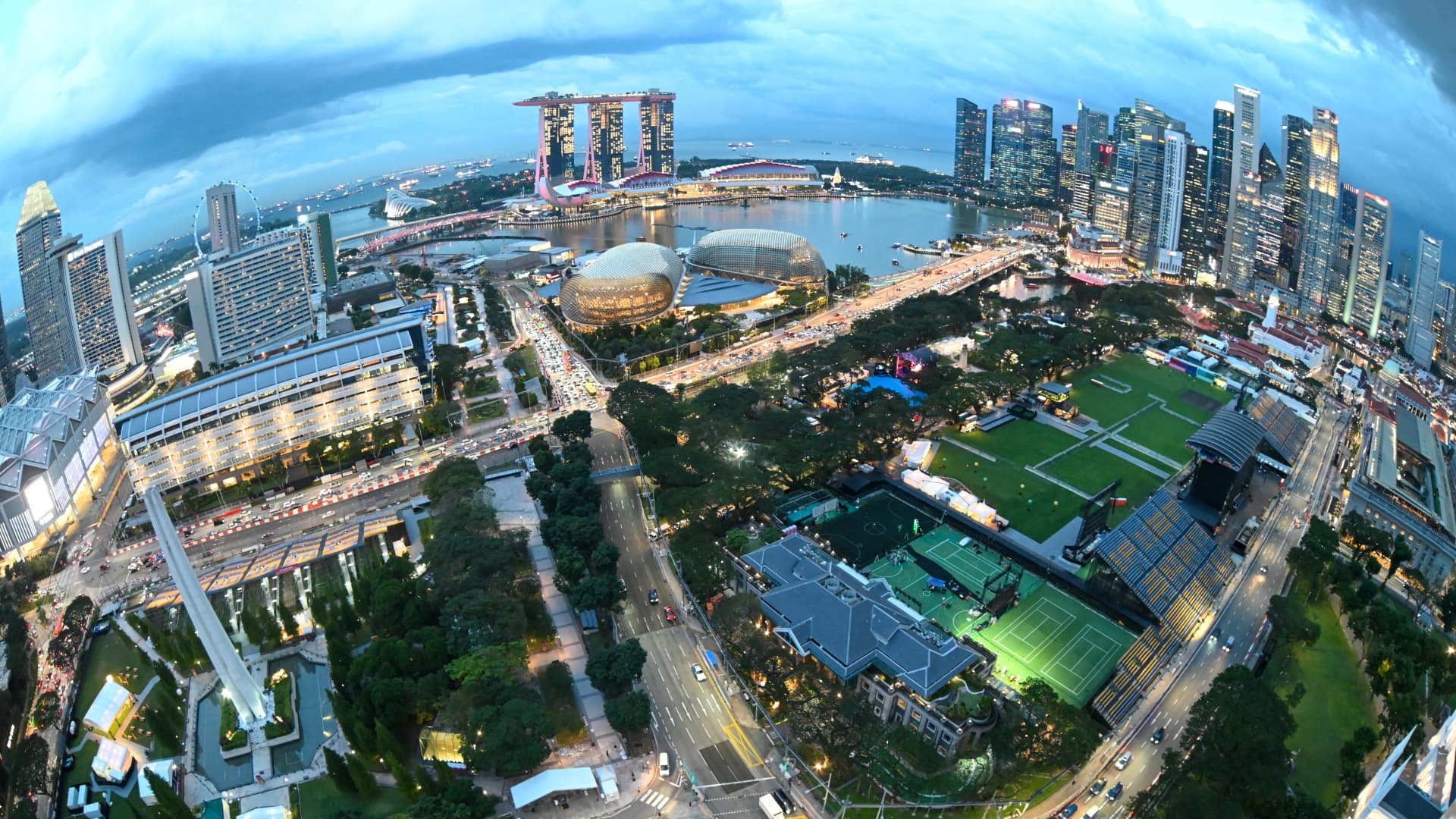
Captured from above, the Marina Bay Street Circuit in Singapore presents a striking sight on September 17, 2024.
Photo courtesy of Roslan Rahman via AFP and Getty Images.
In November, Singapore’s inflation rate held steady at 1.2%, falling short of predictions, as an uptick in service prices was counterbalanced by a sharper drop in electricity costs.
This figure was below the median forecast of 1.3% set by analysts surveyed by Reuters.
Core inflation, which excludes costs for private transport and housing, matched the overall inflation rate at 1.2%, again falling short of the anticipated 1.3%.
The rise in services inflation to 1.9% stemmed primarily from increased expenses in point-to-point transport options—such as taxis, ride-hailing, and car-sharing services—along with health insurance.
In contrast, inflation for retail and other goods slowed as the prices of clothing and footwear, as well as personal-care appliances declined, in addition to the fall in electricity costs.
Core inflation is forecast to be around 0.5% in 2025, before rising to 0.5%–1.5% in 2026. Headline inflation is expected to average 0.5%–1.0% in 2025 and 0.5%-1.5% in 2026, MAS said in a statement.
“Supply shocks, including those stemming from geopolitical developments, could lift some imported costs abruptly. However, a sharper-than-expected weakening in global demand could keep core inflation lower for longer,” the statement said.
The inflation reading comes after better-than-expected economic data from Singapore, with non-oil exports surging 11.6% year on year in November, beating estimates of a 7% rise.
Singapore’s economy grew at 4.2% in the third quarter, also beating expectations of 4% expansion.
Last month, the Singapore’s ministry of trade and industry upgraded the country’s annual GDP forecast to “around 4%,” and about 1%-3% for 2026, a sharp revision from April’s forecast, when it had warned that zero growth was also a possibility. The ministry said that the global environment had proved more resilient than anticipated, with manufacturing and export demand remaining strong in the third quarter.
MAS has held its monetary policy steady for the last two meetings, after easing it in January and April meetings amid the threat of tariffs over the global economy.