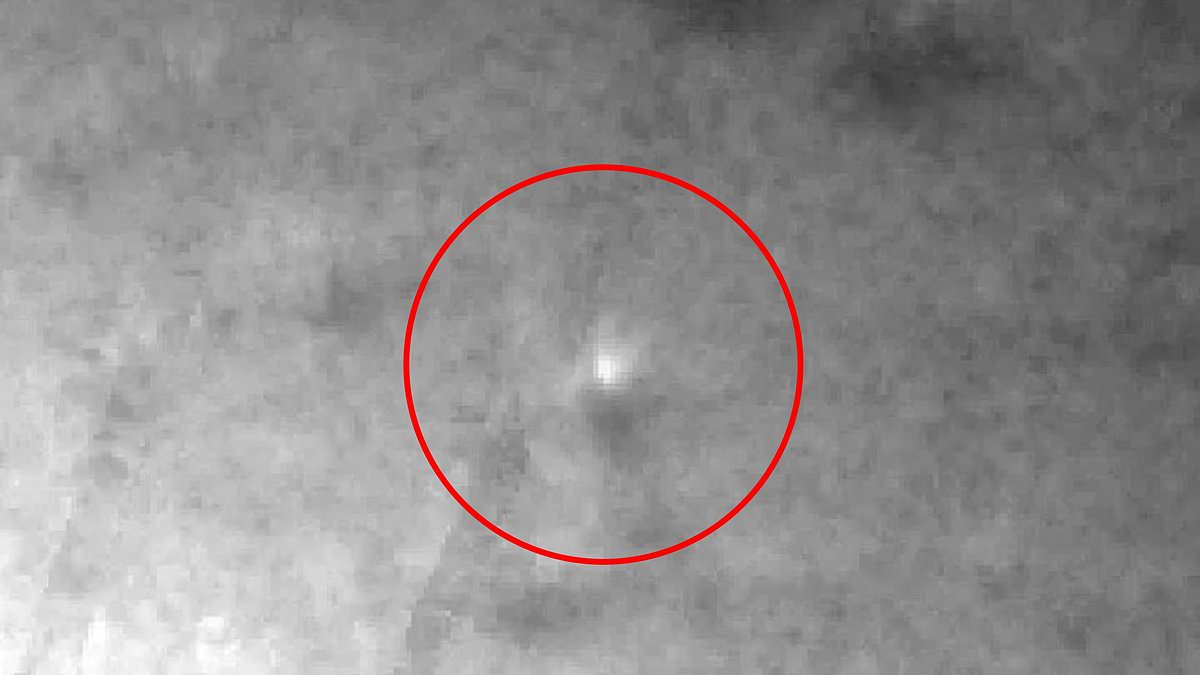

The intrigue surrounding an interstellar visitor to our solar system has intensified following an unexpected twist in its journey. As this mysterious object neared the sun, scientists observed a surprising behavior that has left many scratching their heads.
NASA’s Jet Propulsion Laboratory (JPL) documented this celestial traveler, thought to be a comet, exhibiting what they termed ‘non-gravitational acceleration’ when it approached its closest point to the sun on October 29.
In layman’s terms, this phenomenon suggests the comet was propelled by an unknown force, deviating from its anticipated path as it orbited the sun. This deviation couldn’t be attributed to gravitational forces alone, hinting at another factor accelerating the comet and altering its trajectory. Some speculate this could indicate the object is a spacecraft equipped with its own propulsion system.
Data from JPL indicated that the interstellar object, designated 3I/ATLAS, experienced two distinct phases in its enigmatic movement around our sun. One phase propelled it away from the sun, while the other gave it a slight sideways push.
Despite the buzz of speculation, the scientific community largely maintains that this is an ordinary comet from a far-off solar system. Its unusual chemical composition likely distinguishes it from other space rocks formed within our own solar neighborhood.
Most scientists have continued to call it an ordinary comet from a distant solar system with a unique chemical makeup that makes it appear different from space rocks that formed inside our solar system.
Harvard physicist Avi Loeb noted that most comets get a little push when their ice turns to gas and shoots out like a jet as they approach the sun, called the ‘rocket effect.’
However, 3I/ATLAS is showing way more of a push than expected, adding to the growing list of strange occurrences astronomers have witnessed as the visitor swings around the sun.

The comet has been seen accelerating beyond the natural power of gravity as it moves around the sun

It made its closest approach to the sun on Wednesday, as seen by NASA spacecraft
The object has also been getting much brighter as it nears the sun, and did it approximately 7.5 times faster than normal comets.
Moreover, most comets turn red because their surface is so cold that they absorb blue light and bounce back mostly red light, just like a cold piece of metal glows red when you start heating it.
In the case of 3I/ATLAS, however, astronomers have watched the alleged comet turn bluer than the sun as it reached perihelion, its closest point to the star.
There still could be a natural explanation for these abnormalities, as Loeb said the comet might be losing a huge amount of mass as ice boils off violently during its journey.
To create this kind of color change, 3I/ATLAS would need to have lost about 10 percent of its weight in just one month, causing a giant cloud of gas around it, which telescopes should see in November and December.
However, Loeb said that the non-gravitational push and blue coloring could also come from a hot engine and artificial light beaming from inside the object.
‘The observed features are surprising but could be explained in both natural or artificial scenarios,’ Loeb told the Daily Mail on Friday.
‘The blue color could be a signature of ionized carbon monoxide or a hot engine. The non-gravitational acceleration could be a result of cometary evaporation or technological propulsion,’ the professor explained.

3I/ATLAS is expected to make its closest approach to Earth on December 19

3I/ATLAS is widely thought to be a comet, but scientists like Professor Avi Loeb maintain that unusual clues point to the object being a spacecraft
Loeb has called the latest strange readings from 3I/ATLAS the ninth anomaly detected as the object makes its way through our solar system.
The scientist said his first clue that something wasn’t adding up was the sheer brightness of the object while it was still far away from our planet and the sun.
It also developed a backward ‘anti-tail’ that was facing the sun before it reached perihelion.
However, it then swiftly shifted to a normal tail behind the supposed comet as it moved closer, which some have suggested could be a sign of a spacecraft engine reversing thrust.
Its strange course taking it close to three planets and its unique chemical combination of nickel and carbon dioxide have all contributed to a growing belief that 3I/ATLAS is not a floating space rock.
Before discovering the ninth oddity, Loeb calculated that the odds of all these strange occurrences happening at the same time were one in 10,000,000,000,000,000 (that’s ten quadrillion).
Loeb previously told the Daily Mail that those in the scientific community who have dismissed the more extraordinary possibilities are more concerned with being right and avoiding criticism than alerting the public to a potentially world-changing event.
‘Here we are talking about a potential for something that could affect humanity in the future in a dramatic way, and so you shouldn’t apply the same approach of being as conservative as possible,’ Loeb explained.