
Share this @internewscast.com
Concerns over a potential escalation in Middle Eastern tensions have reached the United Kingdom, following Iran’s indication that it might target military installations linked to the UK.
Seyed Ali Mousavi, Iran’s ambassador to London, has expressed that military bases associated with the U.S. military efforts could become targets if the situation continues to deteriorate.
U.S. forces have already utilized facilities at RAF Fairford and Diego Garcia to conduct operations against Iran since conflicts intensified last month.
Initially, the UK government hesitated to permit these actions, with Keir Starmer initially denying a request from then-President Donald Trump. However, this stance changed when Iran threatened to block the crucial Strait of Hormuz.
In response, Tehran has issued a firm warning.
“This is a critical issue we are evaluating,” Mousavi stated in an interview with Times Radio. “It is significant for our self-defense, and the military arm of our government will make appropriate decisions.”
‘It depends on your activities. It depends on the British decision about this matter. Every option should be considered. We are very careful and delicate [about] how to defend ourselves.’
The chilling remarks come amid mounting alarm over Britain’s vulnerability to missile strikes, with experts warning the UK lacks sufficient defences.

Iran’s ambassador to London, Seyed Ali Mousavi, warned that bases connected to the US war effort may fall within reach if tensions continue to spiral

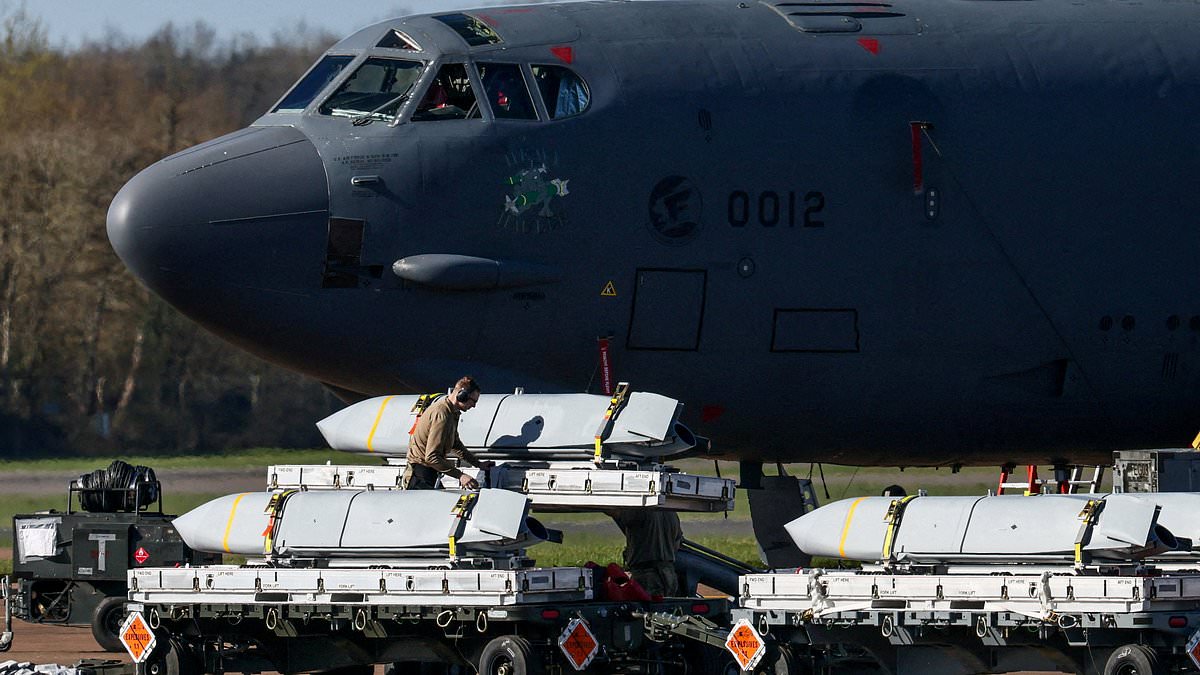
A member of a ground crew works to load cruise missiles into a US Air Force Boeing B-52 Stratofortress at RAF Fairford airbase, used by United States Air Force

This image released by the U.S. Navy shows an aerial view of Diego Garcia in the Chagos Island group
Last month, Iran fired two missiles towards Diego Garcia – one intercepted, the other failing mid-flight – marking its first confirmed use of long-range ballistic weapons in the conflict.
‘Iran’s reckless attacks, lashing out across the region and holding hostage the Strait of Hormuz, are a threat to British interests and British allies,’ a spokesperson for the UK’s Ministry of Defence said at the time, confirming the unsuccessful strike.
Despite pledging £1billion to bolster air defences, delays inside the Ministry of Defence have stalled progress, leaving Britain reliant on NATO allies.
Meanwhile, the economic fallout is intensifying.
Iran’s blockade of the Strait of Hormuz has driven up global energy prices, prompting President Trump to urge allies to act.
He signalled out Britain, telling Sir Keir Starmer to ‘get your own oil,’ while the Prime Minister cautioned reopening the route was ‘easier said than done’.
In a post on Truth Social, the US president aimed at countries, ‘like the United Kingdom’, which have ‘refused to get involved in the decapitation of Iran’, telling them to either buy US fuel or get involved in the rapidly escalating war.
‘You’ll have to start learning how to fight for yourself, the U.S.A. won’t be there to help you anymore, just like you weren’t there for us.
‘Iran has been, essentially, decimated. The hard part is done. Go get your own oil!’ he said.
Earlier, US defence chief Pete Hegseth also highlighted the UK’s reticence about joining the war, saying that ‘last time I checked, there was supposed to be a big, bad Royal Navy that could be prepared to do things like that as well’.
UK Defence Secretary John Healey addressed the criticism, insisting during a trip to Qatar that his country remained a key ally of the US.

Six B-2 bombers seen on the apron of the US military base on Diego Garcia island, April 2, 2025
In a separate post on Truth Social, Trump had also hit out at France for being ‘VERY UNHELPFUL’, in particular in not letting ‘planes headed to Israel, loaded up with military supplies, fly over French territory’.
President Emmanuel Macron’s office noted that its position, including not authorising the use of French bases for attacks on Iran, had been clear from the get-go.
‘We are surprised by this tweet. France has not changed its position since day one [of the conflict], and we confirm this decision,’ it said.
The transatlantic alliance has also come under strain, with Sir Keir criticising US strikes as not ‘thought through’ or ‘credible’ – a stance that drew a sharp personal rebuke, with Trump declaring he is ‘not Winston Churchill’.