
Share this @internewscast.com
There are alarming reports that hundreds of demonstrators may have lost their lives at the hands of Iranian security forces over the weekend, as the nation’s authoritarian regime fiercely clings to power amidst widespread unrest.
Amidst the ongoing surge of anti-government protests across Iran, the country’s zealot leaders have issued a chilling declaration, stating that participants will be deemed ‘enemies of God,’ a charge that carries the death penalty.
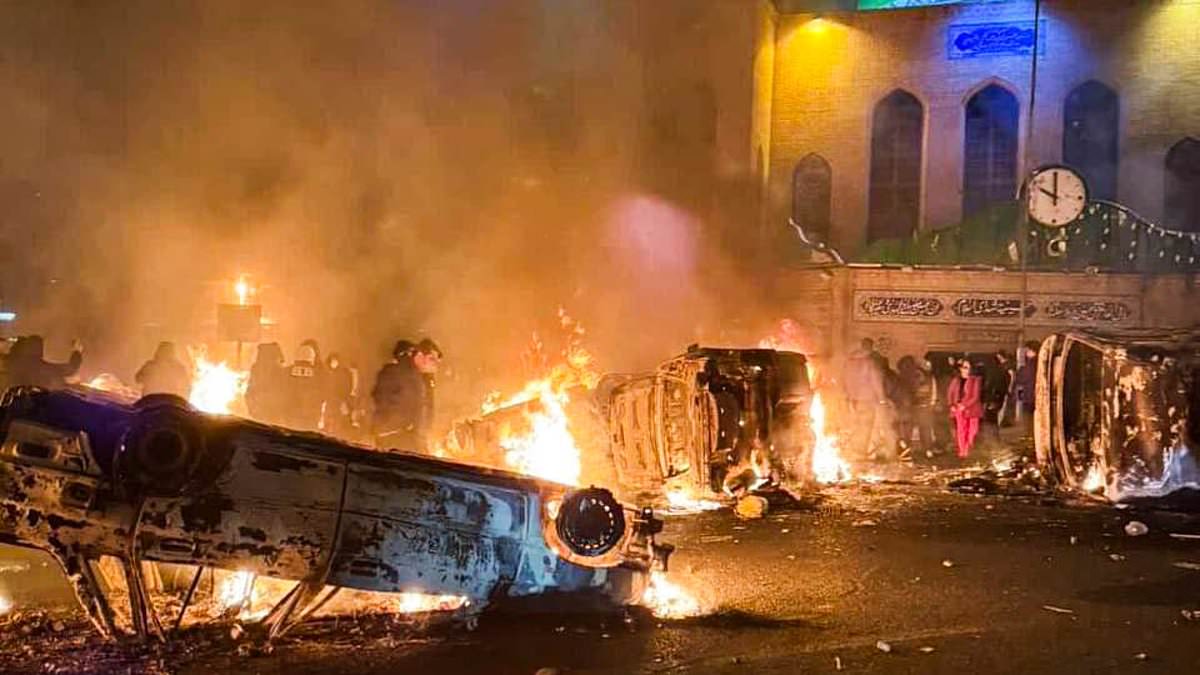
The demonstrations reportedly extend across all 31 Iranian provinces. Scenes of chaos have emerged, with buildings engulfed in flames, vehicles toppled, and chants of ‘death to the dictator’ echoing through the streets.
Remarkable footage surfaced online last night, allegedly capturing new demonstrations erupting in various Tehran neighborhoods as well as in cities like Rasht in the north, Tabriz in the northwest, and Shiraz and Kerman in the south.
In Karaj, near Tehran, images appeared to show a massive blaze engulfing a government building. Despite the regime’s near-total internet shutdown, mounting evidence suggests that Iran’s notorious security forces are conducting violent crackdowns.
Three hospitals have reported being inundated with casualties, both dead and injured. A hospital staff member disclosed to the BBC that the influx of wounded was so overwhelming that there wasn’t sufficient time to administer CPR to all.
Masih Alinejad, an Iranian activist and journalist, said ‘hundreds of protesters’ had been killed by security forces.
A doctor in Tehran told Time magazine that just six hospitals in the capital had recorded at least 217 protester deaths, ‘most by live ammunition’.
Staff at three hospitals last night told the BBC that their facilities were overwhelmed with dead or injured patients. One medic at a Tehran hospital said there were ‘direct shots to the heads of the young people, to their hearts as well’. The killing of protesters raises the possibility of a military intervention by the US.

Images appeared to show a huge fire ripping through a government building in Karaj, near Tehran

This image shows protesters once again taking to the streets of Tehran despite an intensifying crackdown

A police station is set on fire during the protests

Picture shows a building on fire during the protests in Tehran

A masked demonstrator holds a picture of Iran’s Crown Prince Reza Pahlavi during a protest in Tehran

Iranian Supreme Leader Ali Khamenei waves during a gathering of the people of Qom in Tehran. On January 8, 2026
President Donald Trump last week warned Iran would ‘get hit very hard’ if it repeated the mass killings of previous uprisings.
In a new post on his Truth Social network last night, President Trump said: ‘Iran is looking at FREEDOM, perhaps like never before. The USA stands ready to help!!!’ It was reported last night that the White House has held ‘preliminary discussions’ on plans for a potential strike against Iran.
Citing unnamed sources, the Wall Street Journal reports said one option on the table is to launch a ‘large–scale aerial strike’ against Iranian military targets.
The UK Government last night said: ‘We are deeply concerned by reports of violence against protesters in Iran who are exercising their legitimate right to peaceful protest and are monitoring the situation closely.’
Rumours swirled that Iran’s Supreme Leader Ayatollah Ali Khamenei was making plans to leave and that other mullahs had fled.
Protests first erupted on December 28 in response to soaring inflation but quickly turned political, with protesters demanding an end to clerical rule.
Tehran’s mayor claimed that 25 mosques, 26 banks and the headquarters of Basij, a feared branch of Iran’s Revolutionary Guard Corps, were attacked.
Iran’s leaders severed internet connections and telephone lines just after 8pm on Thursday – disconnecting its 85 million people from the rest of the world.
The regime even turned off public lighting last night, plunging huge crowds of protesters into darkness. Demonstrators were said to be using mobile phones to provide light.
A doctor in north–western Iran said that since Friday, large numbers of injured protesters had been brought to hospitals. Some were badly beaten.

Protesters gather as vehicles burn, amid evolving anti-government unrest, in Tehran, Iran

Iranian protesters demonstrate in Tehran, Iran. The nationwide protests started in late December at Tehran’s Grand Bazaar in response to worsening economic conditions

Extraordinary videos posted online last night purported to show fresh protests in a number of neighbourhoods in Tehran and several other cities

The protests are said to span all 31 of Iran’s provinces, with reports of buildings on fire, cars overturned and cries of ‘death to the dictator’ in the streets

Protesters gather as vehicles burn, amid evolving anti-government unrest, in Tehran
Mohammad Movahedi Azad, Iran’s prosecutor–general, yesterday suggested that all protesters faced the death penalty.
Meanwhile, Iran’s Revolutionary Guards’ intelligence wing said it had arrested a foreigner suspected of spying for Israel.
Exiled crown prince Reza Pahlavi, who fled to the US with his father, the deposed Shah, after the Islamic Revolution in 1979, told The Mail on Sunday he is spearheading regime change by offering members of Iran’s hated Revolutionary Guard and military the chance to secretly switch sides using a secure QR code.
In exclusive comments to the MoS, the 65-year-old prince pleaded with Prime Minister Keir Starmer to support the uprising saying: ‘The Iranian people are moving forward with great courage and determination.
‘In the last few days they have responded to my calls to action in their millions. I hope the UK Government will stand with the people in their hour of need and work with me to support a stable and responsible transition to democracy.
‘The time is now. Do not simply observe the birth of a new Iran, work with us to ensure that it is peaceful, stable, and worthy of the sacrifices its people are making.’
He continued: ‘A key pillar of my strategy and to ensure a stable and peaceful transition lies in working with those inside the regime who choose to break from it and stand with the people.
‘My team has established a secure channel and platform for members of the military and other institutions who wish to defect from the clerical system and stand with the Iranian people.
‘Tens of thousands have already reached out through these secure channels – clear evidence that dissatisfaction within the regime’s ranks is deep and widespread, and that many inside Iran’s military are prepared to play a constructive role in a democratic future.’