
Share this @internewscast.com
Iran remains steadfast in its commitment to uranium enrichment, a position underscored by Foreign Minister Abbas Araghchi on Sunday, in defiance of mounting pressure from Washington. Araghchi made it clear that Iran would not back down from this right, even under the threat of war.
Speaking at a forum in Tehran, Araghchi emphasized, “Iran has paid a very heavy price for its peaceful nuclear program and for uranium enrichment.” He questioned why Iran remains so firm on this issue, asserting that no one has the authority to dictate the nation’s actions, a statement that came just days after his meeting with U.S. envoy Steve Witkoff in Oman.
Araghchi further highlighted what he believes to be the core of Iran’s strength. “The secret of the Islamic Republic of Iran’s power,” he stated, “lies in its ability to stand against bullying, domination, and pressures from others.” This resolve, he suggested, is what truly concerns global powers.
He dismissed fears of Iran pursuing an atomic bomb, arguing that their true ‘atomic bomb’ is the power to resist major world powers. “They fear our atomic bomb, while we are not pursuing an atomic bomb,” Araghchi explained. “Our atomic bomb is the power to say no to the great powers.”
Araghchi also addressed concerns regarding U.S. military presence in the Gulf, asserting that Iran is not intimidated by the naval deployment, underscoring the nation’s resilience in the face of external pressures.
Araghchi also says that his country is not intimidated by the US naval deployment in the Gulf.
‘Their military deployment in the region does not scare us,’ he says.
While Iran has long maintained its nuclear programme is peaceful, the West and the International Atomic Energy Agency say Tehran had an organised military programme to seek the bomb up until 2003.

‘Iran has paid a very heavy price for its peaceful nuclear programme and for uranium enrichment,’ Abbas Araghchi told a forum in Tehran

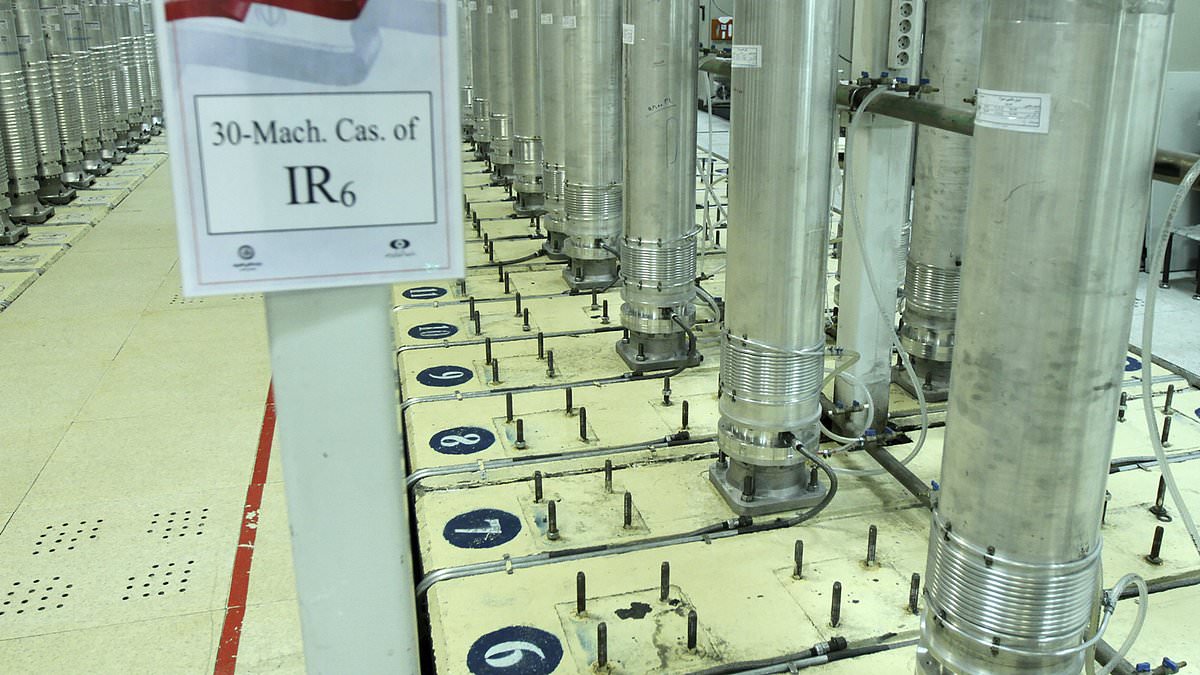
This file photo released Nov. 5, 2019, by the Atomic Energy Organisation of Iran, shows centrifuge machines in the Natanz uranium enrichment facility in central Iran
US President Donald Trump has repeatedly threatened to use force to compel Iran to reach a deal on the nuclear program, after starting a build-up of troops in the region over Tehran’s crackdown on nationwide protests that killed thousands and saw tens of thousands of others detained in the Islamic Republic.
Iran had been enriching uranium up to 60 per cent purity, a short, technical step to weapons-grade levels of 90 per cent, the only non-weapons state to do so.
Iranian officials in recent years had also been increasingly threatening that the Islamic Republic could seek the bomb, even while its diplomats have pointed to Iranian Supreme Leader Ayatollah Ali Khamenei’s preachings as a religious edict, that Iran would not build one.
While Iranian President Masoud Pezeshkian praised the talks Friday in Oman with the Americans as ‘a step forward’, Araghchi’s remarks show the challenge ahead.
Pezeshkian, who ordered Araghchi to pursue talks with the Americans after likely getting Khamenei’s blessing, also wrote on social media on Sunday about the talks.
‘Dialogue has always been our strategy for peaceful resolution. The Iranian nation has always responded to respect with respect, but it does not tolerate the language of force,’ the president wrote.
The UN nuclear watchdog, the International Atomic Energy Agency, has said Iran is the only country in the world to enrich to that level that wasn’t armed with the bomb.
US Secretary of State Marco Rubio said last week that the talks between his country and Iran needed to address Tehran’s nuclear program, its ballistic missiles, support for proxy terror groups around the region, and ‘treatment of their own people.’
Araghchi said Washington’s continuation of sanctions on Iran and its recent military deployments ‘raise doubts about the other party’s seriousness and readiness to engage in genuine negotiations.
‘We are closely monitoring the situation, assessing all the signals, and will decide whether to continue the negotiations,’ he said.
It comes just days after the US Vice President, JD Vance, said in a wide-ranging exclusive interview with the Daily Mail that Trump does not believe Iran is capable of producing a nuclear bomb, but fears the Ayatollah could acquire the technology once the President leaves office.
‘What I feel quite confident about is that Iran could not develop a nuclear weapon in the Trump administration,’ Vance told the Daily Mail.
‘That’s how much damage we did to their program,’ he added, referring to Operation Midnight Hammer which devastated Iranian uranium enrichment facilities in June.
The Vice President then suggested Trump’s real fear is that a ‘crazy person’ will succeed him in the Oval Office and appease the Islamic Regime which is hellbent on the destruction of Israel and deeply hostile to its allies abroad, including the US.
‘Donald Trump is not always going to be president, right? Constitutionally, he’s got another few years. Maybe we change the Constitution,’ Vance joked.
‘But fundamentally, three years down the road, the president is likely, as he said, to leave the Oval Office. Who is the next president? Maybe you get a crazy person in there who doesn’t care about Iran having a nuclear weapon.’
The Vice President said that Trump wants ‘to create the long term situation that ensures and confirms Iran doesn’t get a nuclear weapon.’

Iran’s former president Hassan Rouhani is seen inspecting nuclear facility components in 2021
Vance, an Iraq War veteran, defined his early political career with anti-interventionist rhetoric, railing against regime-change military conflicts in the Middle East.
The Daily Mail pressed Vance on how he squares his crusade against regime change in the Middle East with the Trump administration’s move to topple one of the region’s most entrenched regimes, and following the capture of Venezuela’s Nicolas Maduro.
‘Well, look, it would obviously be in America’s best interest if we were dealing with a rational regime in Iran rather than a group of religious fanatics,’ Vance replied. ‘That is obviously true.’
Vance then suggested the President would not try to overthrow the Ayatollah if Iran ended its nuclear weapons program.
‘The President’s main goal in Iran, it’s not this or that regime. It’s Iran cannot have a nuclear weapon,’ Vance told the Daily Mail.