
Share this @internewscast.com
Concerns are mounting regarding Iran’s capability to reach deep into European territory using suicide drones and missiles, following alarming reports suggesting the Islamic Republic might launch an offensive against California.
On Wednesday, the FBI issued a warning to law enforcement agencies in California, highlighting the potential threat of Iranian drone attacks on the West Coast. These attacks are perceived as possible retaliation for U.S. military actions against Iran.
According to the alert, which was shared by ABC News, Iran is suspected of planning a surprise assault using unmanned aerial vehicles. These drones could potentially be launched from an unidentified vessel located near the U.S. coastline, specifically targeting sites in California, should the U.S. initiate strikes against Iran.
The FBI’s bulletin stated, “Currently, there is no additional information regarding the timing, methodology, targets, or those responsible for the proposed attack.”
This alert was issued amid the Trump administration’s continued aggressive stance towards Iran.
The development is part of a broader pattern of rising tensions in the Middle East, where Tehran has increasingly relied on drone warfare as a method of retaliation.
Drones have emerged as one of the most influential weapons, allowing forces to carry out long-range attacks at relatively low costs while overwhelming air defences.
On March 1, an Iranian Shahed kamikaze drone struck a British RAF base in Cyprus, just days after Ayatollah Ali Khamenei was obliterated in joint US-Israeli air strikes.
The following day, Iran launched its second attack on the British base, but the two unmanned suicide drones were shot down just in time by RAF Typhoons from RAF Akrotiri.
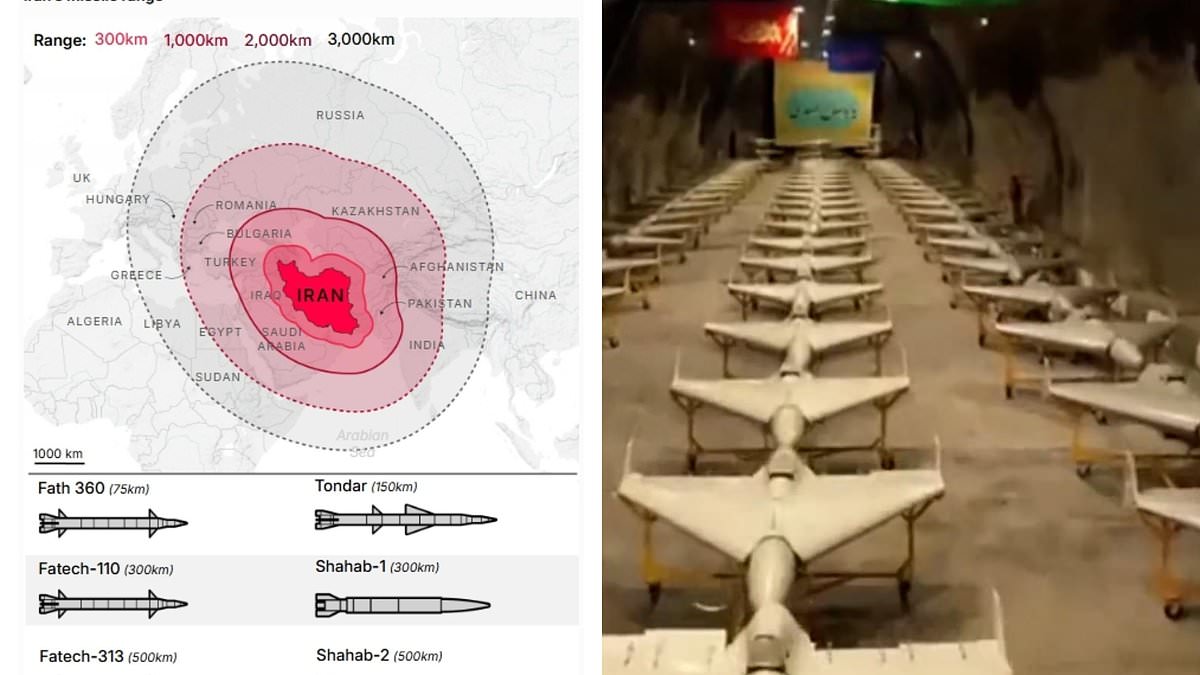
Iranian Shahed suicide drones have a range of 2,500km, and have extensively been used by Russia to attack Ukraine, causing extreme destruction and civilian deaths.
They come in swarms, containing a warhead which weighs between 30-50kg and are designed to overwhelm air defences and knock out power grids over entire regions.
If launched towards Europe from Iran, they could hit countries such as Moldova, Bulgaria and Ukraine.
At its maximum extension, the drone could reach tourist hotspots such as Athens, Greece and Bucharest, Romania.
And if launched from Hezbollah hubs in Lebanon, the projectiles could enter the continent even further.
However, experts say the concern doesn’t lie in swarm attacks on cities, but rather on smaller, more targeted strikes.
Brett Velicovich, a defence expert and the founder of drone company Powerus, told the Daily Mail: ‘Shahed-136 loitering munition drones absolutely have the range and capability to threaten parts of Europe, and are far more plausible than missile strikes because they operate below the threshold of open war with NATO.’
‘The real risk is smaller, deniable strikes launched by proxies or covert networks targeting infrastructure like airports, energy facilities, or transportation hubs,’ he added.
Iran also recently unveiled a stealthier version of its infamous Shahed ‘kamikaze’ drone, potentially making it harder for western air defence systems to detect.
Images of the modified Shahed-101 loitering munition were shared Tuesday by Middle East security analyst Mohammed al-Basha, who highlighted several structural changes suggesting the drone may operate more quietly than earlier variants.
Unlike most Shahed drones, which rely on rear-mounted gasoline engines that produce a distinctive buzzing sound during flight, the new version appears to feature a nose-mounted propeller powered by an electric motor.
This configuration pulls the aircraft through the air rather than pushing it from the rear, a design change that could reduce both acoustic and thermal signatures and potentially make the drone more difficult for radar and infrared detection systems to detect.
The Shahed-101 is an autonomous, electric-powered loitering munition designed to carry a high-explosive warhead.
It can remain in the battlespace while searching for targets before striking by flying directly into them and detonating, using a rocket-assisted launch system to take off.
Slower than missiles but easier to launch in large numbers, Iran’s one-way attack drones may be used in repeated waves to wear down air defences.
Iran’s advantage also lies in scale, according to data gathered from open source intelligence and defence analysts.
Rather than a few thousand long range drones, its total Shahed fleet is estimated at between 80,000 and 100,000 across all variants.
Combined with an ongoing production rate of around 500 a month, if used at full capacity, those numbers could translate into waves of more than 2,500 drones a day for a month.
If launched at Europe, this could greatly overwhelm air defences and wreck havoc across the region.

Iranian-made Shahed-136 ‘Kamikaze’ drone flies over the sky of Kermanshah, Iran

Modified Shahed-101 loitering munition launching with a rear-mounted rocket booster, showing its fixed-wing design and X-shaped tail stabilizers during flight
At the same time, for a drone or missile to reach Europe, it would have to cross airspace over Iraq, Syria, and Jordan, where many drones have been intercepted on their way to Israel
Once reaching European airspace, the interception of these projectiles would rely on US defence architecture, such as the Aegis Ashore site in Deveselu, Romania, equipped with SM-3 interceptors.
Arleigh Burke-class destroyer vessels deployed in the Mediterranean could provide more coverage as well as Germany’s newly-acquired Arrow 3 system.
In addition to Shahed drones, Iran also possesses of a large stockpile of missiles, the most lethal being the Khorramshahr 4 missile, with a range of 2,000-3,000km and a a 1,500kg warhead.
It can be launched in volleys, and if used, the missiles could reach a large swathe of Europe, including Greece, Italy, Germany, Poland and Denmark.
Dr. Sidharth Kaushal, a senior research fellow at RUSI, told the Daily Mail that the Khorramshahr is a ‘derivative’ of a North Korean ballistic missile.
He said: ‘It was always speculated that this would have been the delivery vehicle for a nuclear warhead if the Iranians had ever developed one.’
Iran is believed to possess the largest and most diverse missile arsenal in the Middle East, but the exact count is difficult to pinpoint due to the Islamic Republic’s so-called ‘missile cities’ and lack of transparency.
In a propaganda video released last week by the Fars News Agency, Iran showed off a sprawling underground network of tunnels filled with row after row of drones and rockets.
However, drones and missiles are not the only threat alarming the continent. Fears are also bubbling that Iran will call on its sleeper terror cells to attack targets across Europe.
A sleeper cell is a covert group of operatives affiliated with a state or non-state actor, such as a terrorist group, who infiltrate a country or community, essentially hiding in plain sight for a prolonged period of time before they are activated to carry out acts of terrorism, spying or sabotage.
And according to an alert intercepted by the US earlier this week, Iran may already be activating its sleeper cells outside the country.
The encrypted communications, believed to have come from inside Iran, was sent as an ‘operational trigger’ for ‘sleeper assets,’ according to ABC News.
The message was transmitted across multiple countries shortly after Khamenei killed in Tehran on February 28.
The increasing danger towards the west comes after the UK moved to review its terror threat level last week.
Defence Secretary John Healey said there was a risk of ‘increasing Iranian indiscriminate retaliatory attacks’, which required a review of the threat level.
This currently stands at ‘substantial’ – meaning a terror attack is judged to be ‘likely’. There are two higher levels – ‘severe’ and ‘critical’.
MI5 warned last year that Iran had been behind 20 potentially deadly plots in the UK in the last 12 months.
Speaking on Sky News, Healey said: ‘When you have some of [Iran’s] proxies capable of other actions on their behalf, then of course our force protection in the region is at its highest. Our alert and vigilance in the UK is also high.’
Worries over Tehran’s ability to unleash chaos beyond the Middle East are understood to be rooted in efforts by the IRGC to coordinate clandestine intelligence operations, such as assassinations and cyber attacks, across the West, according to The i.
There is also increased concern that the IRGC could act alongside the Lebanese militia group Hezbollah, which is believed to have a support network of sleeper agents in Europe.
Velicovich said the west must begin to seriously prepare for retaliatory strikes and sleeper cell attacks.
He said: ‘We need to hunt the IRGC Quds Force officers that Iran had running around Europe for years, these are the special operations guys who have armed proxy militias behind the scenes for years. We should unleash our own special operations units in the UK and US to find them and stop them.’
The drone expert said that Europe and the US also must begin treating drones like cyber threats, ‘persistent, unpredictable and capable of appearing anywhere,’ he added.
‘That means expanding counter-drone defences around critical infrastructure, increasing intelligence sharing across Europe and the United States, and disrupting supply networks that provide components to hostile actors.’
On Thursday, US President Donald Trump addressed the California drone threat, saying that federal law enforcement was investigating.
‘It’s being investigated. You have a lot of things happening and all we can do is take them as they come,’ he told reporters at Joint Base Andrews.
Trump blamed Joe Biden’s immigration policies for the sleeper cell threat – calling him ‘the worst president in the history of our country’.
‘I have been [briefed] and a lot of people came in through Biden with his stupid open border,’ he told the group of reporters traveling with him for a two-stop jaunt in Ohio and Kentucky on Wednesday.
‘But we know where most of them are. We’ve got our eye on all of them, I think,’ he added.
The Daily Mail exclusively reported last year how the existence of sleeper cells in and around the US was on the rise due to Iranian and Venezuelan cooperation. The threat, experts explained, was exacerbated by border policies that allowed illegal immigrants to enter the US.
And on Wednesday, Iran launched a cyber offensive against one of the world’s leading medical technology companies based in Michigan.
Stryker experienced a global outage, saying thousands of employees have lost access to work systems.
The company is a leading provider in advanced medical technologies that improve healthcare outcomes, including joint replacements, robotic-assisted surgical systems, trauma and neurotechnology products.
The Tehran-aligned Handala group issued a statement on Telegram, saying it wiped more than 200,000 systems and extracted 50 terabytes of data in retaliation for military strikes on Iran.
The group claimed it shut down Stryker offices in 79 countries and that all extracted data is ‘now in the hands of the free people of the world’.
Stryker is active in over 100 countries around the world.
‘Our major cyber operation has been executed with complete success,’ Handala said in a statement, describing the attack as retaliation for what it calls ‘the brutal attack on the Minab school’ and for ‘ongoing cyber assaults against the infrastructure of the Axis of Resistance’.