
Share this @internewscast.com
Iran has issued a stark warning, threatening to target American university campuses situated in the Middle East. This comes as a response to recent US-Israeli military actions against Iranian educational institutions.
The Islamic Revolutionary Guard Corps has given the Trump administration a deadline: by noon on Monday, they must publicly denounce the bombings of Iranian universities, or Iran will consider retaliating against US students studying in the region.
Officials from the Iranian regime have advised individuals connected to American academic institutions, including employees, professors, and students, to maintain a distance of at least one kilometer from their campuses.
According to Iranian reports, recent strikes targeted the Tehran University of Science and Technology, causing damage to nearby structures but thankfully sparing lives.
The Iranian authorities have conveyed through local media that unless the US government officially condemns the bombings by the specified deadline, American educational institutions in the Middle East might face retaliatory actions.
Several US universities have established campuses abroad, drawing thousands of students, often with financial backing from the governments of their host countries.
New York University has a campus in Abu Dhabi, in the United Arab Emirates, while Georgetown, Carnegie Mellon, Northwestern and Texas A&M each have satellite campuses in Qatar’s Education City, a research hub based in Doha.
Texas A&M said it closed its Qatar campus, moving to remote learning and with most international staff returning home amid the war.

Regime officials warned that employees, professors, and students affiliated with American universities in the region should stay at least one kilometer away from their campuses

Numerous American universities operate campuses abroad, where thousands of students often study with financial support from host governments

Since the start of the war, deadly missile strikes have hit Iranian education facilities, including an elementary school attack on February 28 in the city of Minab that killed 175 people, most of them children

The elementary school attack sparked a US military investigation with preliminary findings concluded that American forces were likely responsible due to outdated intelligence.
Around 5,000 Americans studied in the Middle East and North Africa in the last academic year, with around half in Israel and roughly 1,000 in the UAE, according to the State Department.
Since the start of the war, deadly missile strikes have hit Iranian education facilities, including an elementary school attack on February 28 in the city of Minab that killed 175 people, most of them children.
The attack sparked a US military investigation whose preliminary findings concluded that American forces were likely responsible due to outdated intelligence. The building was once part of a regime naval base.
Reports have also emerged suggesting that a newly made US missile was used in an attack on a sports hall and a nearby elementary school in southern Iran, according to The New York Times.
Local officials have told Iranian media that the strike in the city of Lamerd killed approximately 21 people.
The recent threat to attack US schools in the region comes as Trump weighs greenlighting a highly complex and potentially explosive military operation to send US special operations forces deep inside Iran to seize its stockpile of enriched uranium.
The move could drag American troops into hostile territory for days – or even a week – and risk a dramatic escalation of the war. It was reportedly one of many being proposed by the Pentagon.
US officials say the stealth plan would target nearly 1,000 pounds of uranium at either one or two nuclear sites in Natanz and Isfahan.

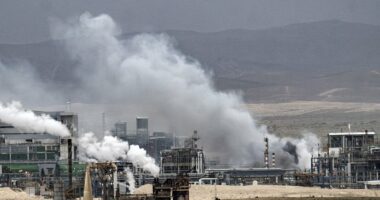
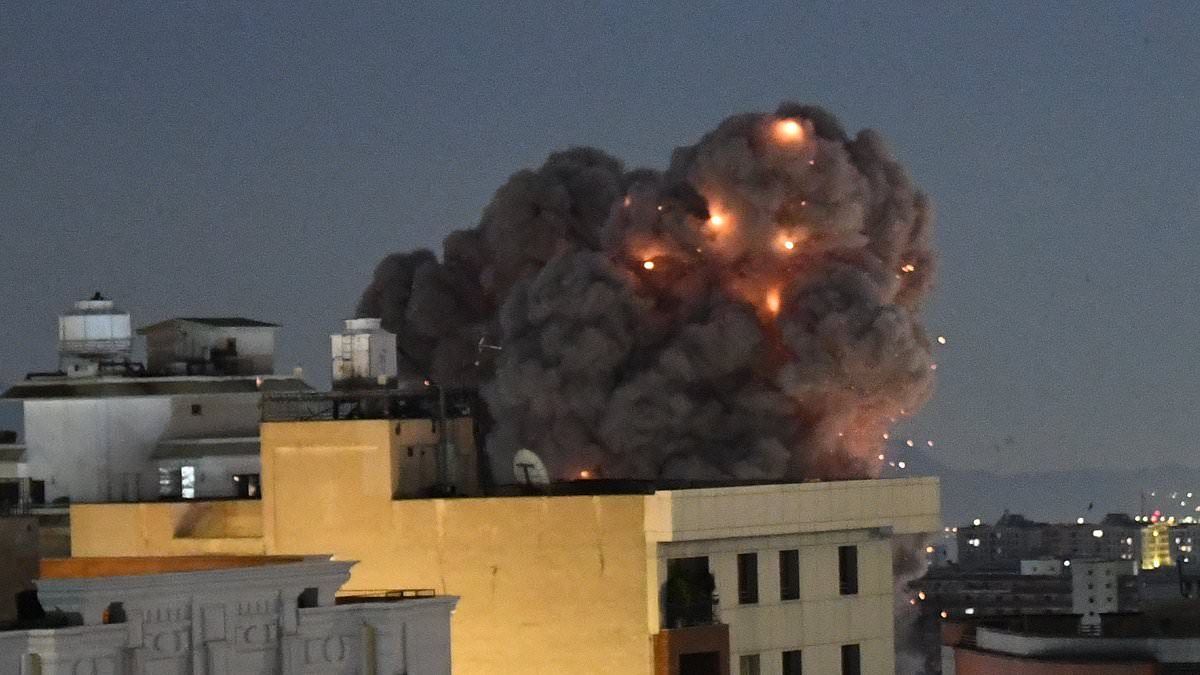
Smoke and flames rise at the site of airstrikes on an oil depot in Tehran on March 7

Iran has responded to US-Israeli strikes by launching suicide drone and ballistic missile assaults against oil infrastructure and civilian areas in the Middle East

Israeli strikes in Gaza earlier last week
The objective would be to remove the radioactive substance entirely from Iranian control, eliminating any pathway to a nuclear weapon.
The proposal remains under review, and Trump has not signed off on it. But officials told The Wall Street Journal he is seriously considering the option, even as advisers warn of the dangers to American forces and the possibility of a broader conflict.
Military experts say the operation would be among the most difficult missions the US could undertake.
American forces would likely need to fly into heavily defended territory, potentially under fire from Iranian air defenses and drones, before securing the nuclear sites believed to house the material.
Once on the ground, combat troops would be tasked with locking down the perimeter while specialist teams locate, secure and prepare the uranium for transport.
‘This is not a quick in and out kind of deal,’ retired Gen. Joseph Votel, a former commander of U.S. Central Command and U.S. Special Operations Command, told the Journal about the potential mission.
Trump’s recent rhetoric, however, appears to have improved his standing, according to a the latest Daily Mail/JL Partners poll.
The President approval’s rating stands at 46 percent, a three-point jump on ten days ago.
The newest poll was conducted March 23 and 24, as Trump began floating the idea that the US was in talks with Iran to reach a peace deal.