
Share this @internewscast.com
The Strait of Hormuz stands as a vital artery in global maritime routes, serving as a crucial juncture for the world’s energy distribution.
Despite the turmoil that has gripped the Middle East over the past three weeks, the embattled Iranian government continues to exert firm control over this key 24-mile-wide passage.
Recently, Austrian researchers have shed light on the potential global impact should the Strait of Hormuz be shut down, emphasizing the vulnerability of international supply chains.
Their studies suggest that if Iran were to close the Strait for a prolonged period, it could disrupt exports valued at up to $1.2 trillion (£893.5 billion).
While brief interruptions of about two weeks might have minimal effects, those extending beyond four weeks could unleash a series of ‘cascading issues’ across global markets.
Alarmingly, the research highlights that the United Kingdom is the most susceptible in Europe to these potential supply chain disruptions.
Britain imports $12billion (£8.9billion) worth of goods through the Strait of Hormuz each year, with Qatari liquefied natural gas (LNG) and propane alone totalling $5.9 billion (£4.4billion).
The researchers say that this creates a ‘genuine vulnerability’ that Britain won’t be able to substitute its LNG supply in the short term, driving up prices for consumers.

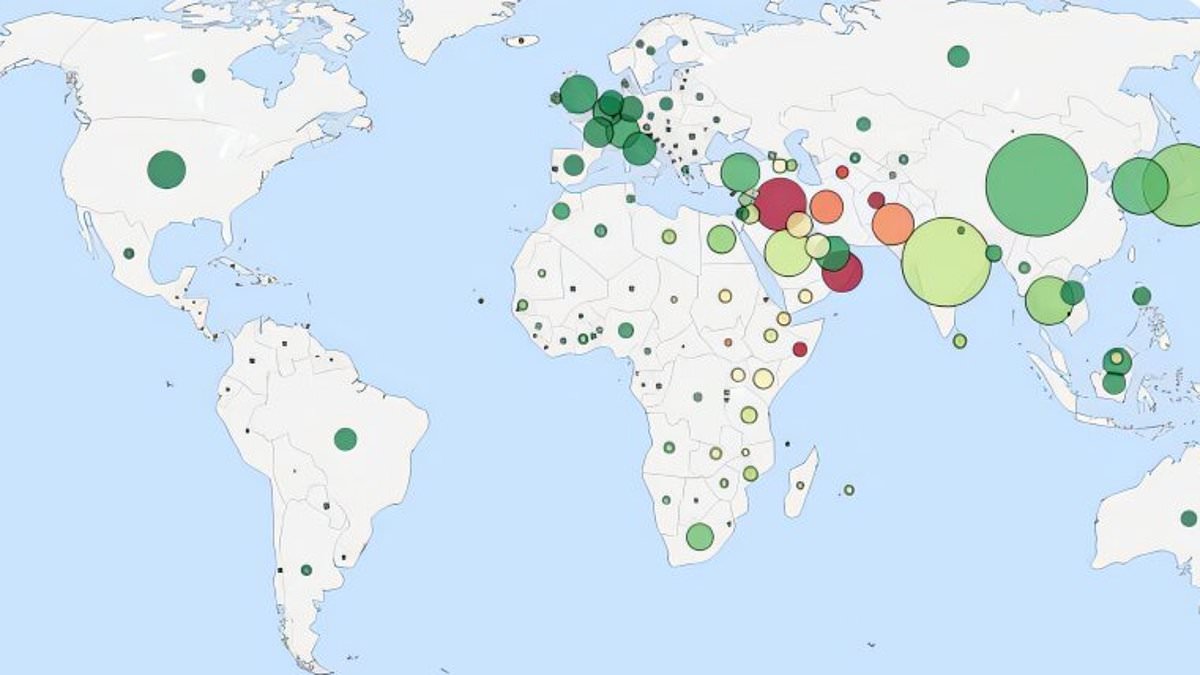
Researchers have revealed that Iran’s blockade of the Strait of Hormuz could be devastating for global supply chains, affecting $1.2trillion (£893.5billion) of goods

Britain is the most exposed country in Europe, importing $12billion (£8.9billion) worth of goods through the Strait of Hormuz each year
Running between the Persian Gulf and the Gulf of Oman, the Strait of Hormuz is flanked by Iran to the north and the United Arab Emirates (UAE) to the south.
Its extreme importance to the world economy comes from the fact that it is the only sea route connecting the oil–rich Gulf states to the open sea.
The study focused on five Gulf countries – Iran, UAE, Qatar, Kuwait and Bahrain – that ship entirely through the Strait.
Using a simulation, the researchers modelled how a blockage would affect 10,000 tankers travelling between 1,315 ports around the world.
Co–author Dr Jasper Verschuur, of Delft University of Technology, told the Daily Mail: ‘What is unique about the Strait is that there are no alternatives to reroute goods.
‘This makes it distinct from other strategic maritime passages like Suez, Malacca and Taiwan that “handle” large volumes, but have rerouting alternatives.’
Currently, about 20 per cent of the world’s oil is shipped through this narrow gap, making it the ‘energy artery’ for many countries.
However, after Israel and the US began their aerial bombardment, Iran has brought this traffic to a standstill.

This map shows trade dependencies on Hormuz-dependent Gulf exporters. In the EU, Italy is the biggest importer of Gulf goods, followed by Belgium, and France

Besides liquefied natural gas and oil, the Strait of Hormuz is also a key chokepoint for goods like iron and steel (as shown in the graph), rare gases and fertiliser
Days after the assassination of Supreme Leader Ali Khamenei on February 28, Iran declared control of the Strait, trapping hundreds of ships in the Gulf.
Since the start of the war, only a handful of vessels have managed to slip through, with at least 16 ships coming under attack, according to the UK Maritime Trade Organisation (UKMTO).
This has already triggered spiking oil prices and sent shockwaves through the global economy, but the researchers warn that the situation could get worse.
Dr Verschuur says that their modelling had pointed to the risk of a closure, but they ‘certainly did not expect something so quickly and escalating as we see now’.
The longer that Iran keeps the Strait closed, the deeper and more complex the disruption to supply chains will become.
Co–author Stefan Thurner, president of the Complexity Science Hub, told the Daily Mail: ‘The Strait has been closed for about three weeks. Our study finds that a closure of two weeks is practically not relevant, but after that, the effects will become noticeable.
‘After four weeks, cascading effects in the supply chains due to disrupted shipping in the Strait will appear. And this leads to disproportionate losses.’
In their modelling, after 56 days of closure, delays in tanker traffic intensify significantly due to missed port slots, port congestion and rescheduled shipping routes.

Big Asian economies such as China will be the most affected by the closure. Short delays of two weeks will produce limited effects, but blockages up to four weeks or longer could cause serious damage to global supply chains
The most affected areas will be the big Asian economies of China, India and Japan.
China imports approximately $97billion (£72.3billion) of goods through the Strait of Hormuz, India $74billion (£55.2billion) and Japan $63billion (£46.9billion).
This is largely made up of LNG and petroleum products, but the five Gulf states analysed also account for 8 to 10 per cent of global fertiliser production.
The researchers predict that a long closure will lead to persistently higher energy prices and rising production costs.
The long–term consequences are hard to predict, but Dr Thurner suggests that the impacts of a four–week closure could last months.
This comes as Donald Trump calls for US forces to open a new front in Iran as jets pound Iranian ships in an all–out battle to reopen the Strait of Hormuz.
American forces have sent low–flying A–10 Warthogs and Apache attack helicopters to shoot at Iranian ships and drones.
Meanwhile, a Pakistani–flagged ship, the Karachi, became the first non–Iranian vessel to pass through the Strait with its automatic identification system (AIS) signal turned on since the war began.