Share this @internewscast.com
A groundbreaking study has revealed that engaging in a straightforward brain training activity for just over a month may lower the risk of dementia by up to 25%.
With projections indicating that two million people could be affected by dementia by 2050, researchers have long explored the benefits of brain training as a preventive strategy.
In a 20-year investigation involving more than 2,000 individuals aged 65 and older, scientists have identified a particular exercise focusing on divided attention as a potential shield against dementia.
Professor Marilyn Albert, a neurobiologist from Johns Hopkins University and the principal author of the study, stated, “There was considerable doubt about the effectiveness of brain training interventions, but our research provides evidence that they are indeed beneficial.”
“This marks the first time we have a gold standard insight into actions we can take to lower the risk of developing dementia,” she added.
During the study, participants were randomly divided into three groups, each undergoing a specific brain training regimen, while a control group did not. Each participant engaged in hour-long sessions twice a week over the course of five weeks.
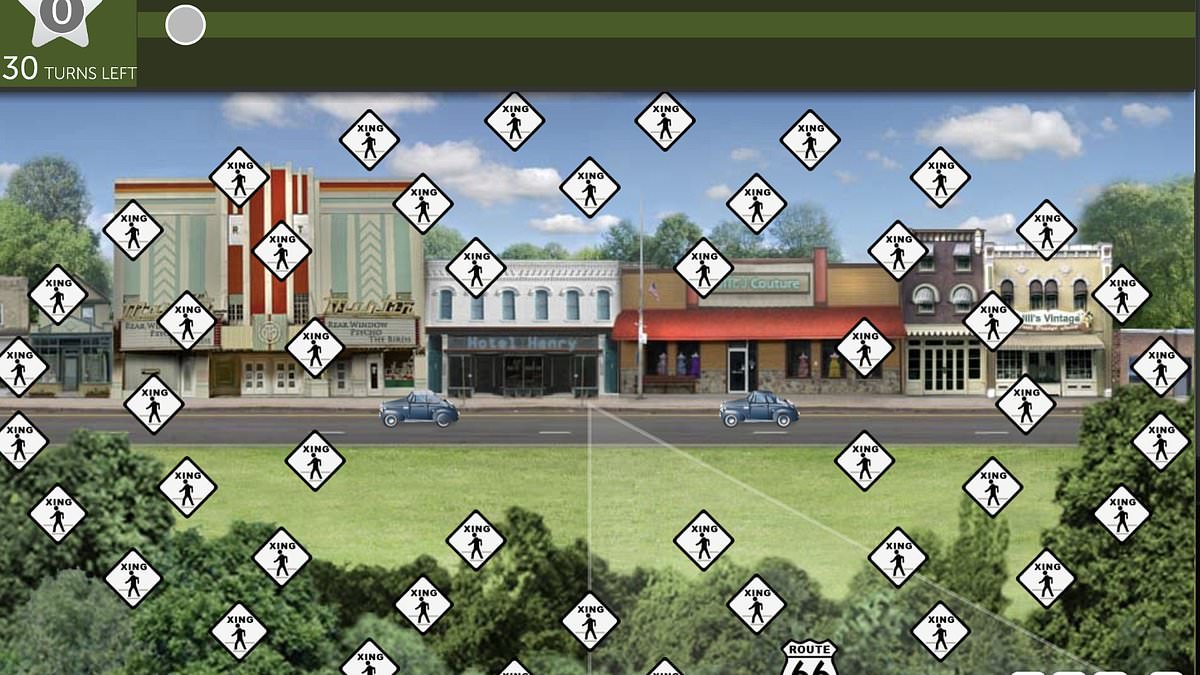
One group engaged in speed training using a computer-based task called Double Decision which briefly shows a car and a road sign within a scene before they disappear from the screen.
Participants must then recall which car appeared and where the sign was located.

At the hardest level of the game, the task is a lot harder with other distractors as well as the road sign appearing. The central cars also get more similar making it harder to choose the right one and the backgrounds get more complex
Crucially, the task was adaptive, meaning it became harder as an individual’s performance improved, potentially resulting in broader brain activation.
The other two groups took part in memory or reasoning training, which focused on improving verbal recall and problem solving abilities.
Around half of the participants were then randomly selected to receive booster sessions – four additional hour-long training sessions at the end of the year, and another four around three years later.
After 20 years, the researchers found that those who completed the speed training with top-up sessions had a 25 per cent lower risk of dementia diagnosis, compared with the control group.
No other group, including speed training without the follow-up sessions – showed a significant change in dementia risk.
‘The size of the effect is really quite astonishing,’ Prof Albert said.
‘The benefit of the booster sessions for the speed-training arm is notable,’ she added.
‘The usefulness of repetitive task training in neurorehabilitation is well established in other neurological conditions such as stroke.’

Everyone experiences dementia differently. Use this checklist to help you make a note of your symptoms before you talk to your GP.
This could be either because more training leads to better outcomes, or that booster sessions strengthen the training by adaption to the improving abilities of the participant, as the task difficult increases, the team suggested.
They concluded: ‘This may suggest that cognitive training needs to be repeated over time in a specific manner to reduce dementia risk.
‘The findings underscore the potential benefits of cognitive training involving speeded, dual attention, adaptive tasks for delaying the diagnosis of dementia.’
During the course of the study, nearly half of the control group developed dementia, which the researchers highlighted is close to real world estimates.
However they did acknowledge that their study had some limitations, including the fact the the participants tended to be healthier as a group, which could have biased the results.
Dr Baptiste Leurent, a professor of medical statistics at University College London, who was not involved in the study added the evidence supporting the researchers claims is ‘questionable’.
He said: ‘The main limitation is that the only valid randomised comparisons did not show significant differences in dementia diagnoses.
‘None of the primary analyses found significant differences in dementia risk between the training groups and the control group.

‘Although one subgroup analysis produced a significant result, this single finding is not generally regarded as strong enough evidence to demonstrate the intervention’s effectiveness.’
Dr Susan Kohlhaas, executive director of research and partnerships at Alzheimer’s Research UK, welcomed the studies findings saying: ‘This long-term study provides a valuable and encouraging contribution to an area where long-term evidence is rare.
‘However this research does not show that brain training can prevent dementia,’ she cautioned.
This is because diagnoses were identified through health records rather than clinical testing, so it is impossible to say whether the brain training changed the underling diseases that cause dementia.
Both experts agreed future research is now needed to understand how this type of training might work, who could benefit most, and ‘how it fits alongside the strongest evidence we already have for protecting brain health, including staying physically active, managing heart health and keeping socially connected.’
It comes as a new report by Alzheimer Europe has estimated the number of people living in Europe with dementia will increase by almost two thirds over the next 25 years, with the surge largely driven by Alzheimer’s disease.
If AE’s forecasting proves to be correct it will heap extra pressure on health services – and makes finding a cure more vital than ever before.
New figures have also revealed dementia is killing people at a faster-than-expected rate in the UK, with 2,500 excess deaths from the condition in England last year.
As cases continue to rise, experts outlined 56-evidence based recommendations aimed at cutting dementia risk last month, including better control of high blood pressure and stronger public health messaging.
WHAT IS DEMENTIA?

Dementia is an umbrella term used to describe a range of neurological disorders
A GLOBAL CONCERN
Dementia is an umbrella term used to describe a range of progressive neurological disorders (those affecting the brain) which impact memory, thinking and behaviour.
There are many types of dementia, of which Alzheimer’s disease is the most common.
Some people may have a combination of different types of dementia.
Regardless of which type is diagnosed, each person will experience dementia in their own unique way.
Dementia is a global concern but it is most often seen in wealthier countries, where people are likely to live into very old age.
HOW MANY PEOPLE ARE AFFECTED?
The Alzheimer’s Society reports there are more than 900,000 people living with dementia in the UK today. This is projected to rise to 1.4 million by 2040.
Alzheimer’s disease is the most common type of dementia, affecting between 50 and 75 per cent of those diagnosed.
In the US, it’s estimated there are 5.5 million Alzheimer’s sufferers. A similar percentage rise is expected in the coming years.
As a person’s age increases, so does the risk of them developing dementia.
Rates of diagnosis are improving but many people with dementia are thought to still be undiagnosed.
IS THERE A CURE?
Currently there is no cure for dementia.
But new drugs can slow down its progression and the earlier it is spotted, the more effective treatments can be.
Source: Alzheimer’s Society