
Share this @internewscast.com
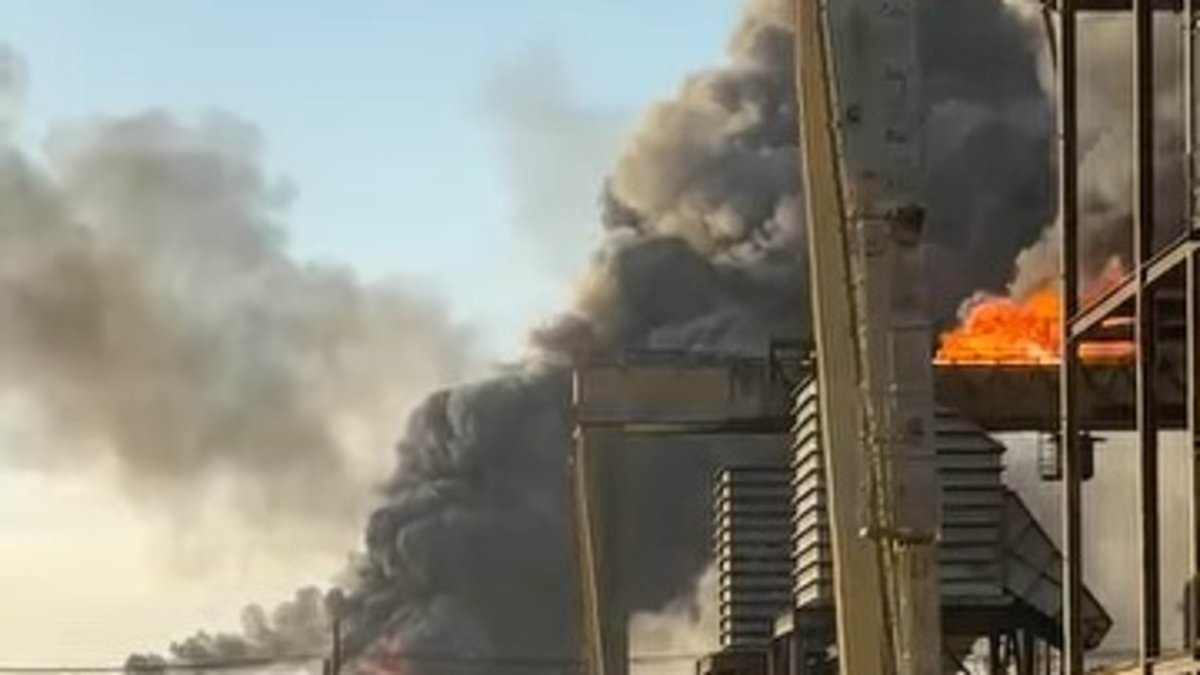
A significant fire erupted at a large oil refinery in Texas on Monday night, sending thick smoke into the air.
Emergency responders swiftly arrived at the Valero refinery in Port Arthur after numerous local residents reported hearing a loud explosion that shook their homes, as detailed by KPLC.
Dark smoke rose high above the facility, which converts crude oil into gasoline, diesel, and jet fuel, with a daily processing capacity of 435,000 barrels.
According to Jefferson County Sheriff Zena Stephens, an industrial heater is suspected to have triggered the blast, as reported by KDFM.
In response to the explosion, authorities have implemented a shelter-in-place order for the western part of the city, though fortunately, no injuries have been reported.
Residents in nearby areas have been advised to stay indoors, close windows, and heed all instructions from local authorities to ensure their safety.
It comes amid the closure of the Strait of Hormuz, a strategic waterway through which a fifth of the world’s oil is transported.
The shutdown has affected Americans at the pump especially, with the average price for a gallon of regular gas at $3.91, according to AAA.

A massive oil refinery in Port Arthur, Texas burst into flames, sending smoke billowing through the air Monday night

The refinery processes crude oil into gasoline, diesel and jet fuel at a rate of 435,000 barrels each day

The explosion has prompted officials to issue a shelter-in-place order for the west part of the city
That’s an increase of 25 percent from a year ago and a shock rise of 33 percent from one month ago, just before the start of the war in Iran.
The Wall Street Journal has since polled economists to see how high oil prices would have to rise – and how long they’d have to stay elevated – to push the US economy towards recession.
They said that oil would have to stay around $138 a barrel for about three months to push the US economy towards a recession.
‘I think that if oil were to hold above $100 for the next three months, we’d likely see very challenging economic conditions in the US,’ Tim Rezvan, managing director oil & gas equity research at KeyBanc Capital Markets, told the Daily Mail.
Rezvan emphasized that even if the war were to end in a week, the lasting economic damage from higher oil prices could pose long-term challenges for the US economy.
When asked how high oil prices would need to go to lift the probability of a US recession, responses ranged from $90 a barrel to $200 – with an average estimate of $138.
According to oil market expert Dan Doyle, founder of Reliance Well Services and Arena Resources, domestic US oil production will not save us.
‘The longer the war goes on, the greater the recessionary risk,” Doyle told the Daily Mail’

The shutdown has affected Americans at the pump especially, with the average price for a gallon of regular gas at $3.91, according to AAA
Economist Robert Fry said oil would need to be at $125 for eight weeks for the economy to be headed for recession.
‘My forecast is contingent on the assumption that the Strait of Hormuz will be fully open to tanker traffic by mid-April,’ Fry told the Wall Street Journal. ‘If it isn’t, oil prices will go much higher, and I will put a recession in my forecast.’
The economists see the probability of a US recession in the next 12 months at 32 percent – that’s up modestly from the 27 percent probability in the January survey.
However, President Donald Trump said Monday that the Strait would be open ‘real soon’ if a deal he’s teased with Iran works.
‘It’ll be jointly controlled,’ he said of the waterway.
When asked who would be jointly controlling it, Trump added, ‘maybe me, maybe me.’
‘Me and the ayatollah, whoever the ayatollah is, whoever the next ayatollah [is.],’ the President continued.
This is a breaking news story and will be updated.