
Share this @internewscast.com

The Trump administration’s cuts to climate research and federal weather forecasting agencies are “blinding” the U.S. to oncoming threats to its food supply and kneecapping efforts to protect it.
As Congress debates its own research and forecasting cuts, a study published Wednesday in the journal Nature suggests that fossil fuel-driven climate change poses an existential threat to key parts of the American food supply.
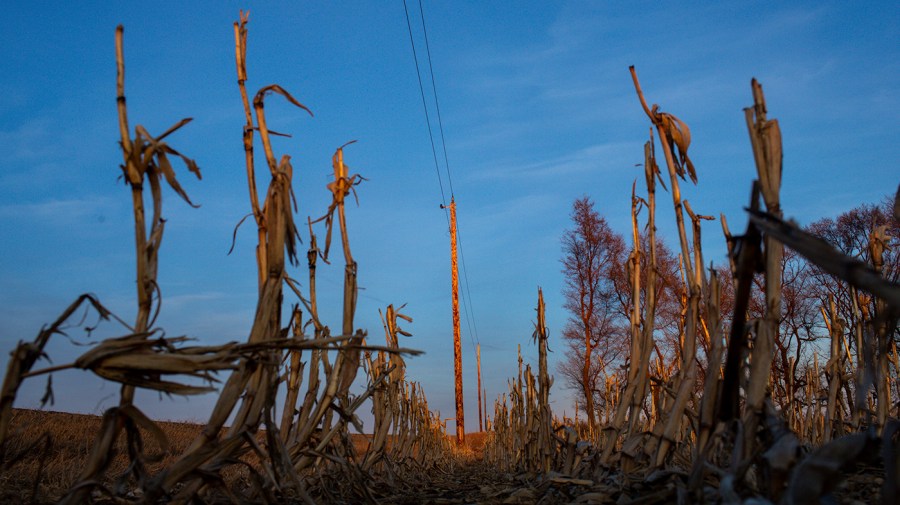
Heat waves and drought driven by fossil fuel burning could mean a collapse of Midwestern corn and soy yields later this century, said study co-author Andrew Hultgren of the University of Illinois Urbana-Champaign.
The region, Hultgren noted, is both one of the world’s richest breadbaskets and one of its most endangered. When temperatures routinely exceed 100 degrees Fahrenheit, he told The Hill, “It starts to become a question of how tenable it is to keep farming corn.”
“You do start to wonder if the Corn Belt is going to be the Corn Belt in the future,” he said.
Proper forecasting and adaptation could cut those crop failures almost in half, the study found.
But those corrective measures are under direct attack from President Trump’s mass staff reductions at federal agencies concerned with tracking weather and climate and the freezing of grants to any program or study that mentions climate.
The effect on U.S. forecasting will be “like losing your eyesight: slow and torturous,” said Jonathan Martin, a professor of atmospheric sciences at the University of Wisconsin.
Americans who have grown up amid the “unheralded revolution” of ever-more-precise weather forecasts will find themselves in a world growing blurrier even as the weather grows ever more volatile, Martin added.
Farmers choosing what crops to plant each season are effectively betting on the heat and rain, which determines what will survive to market a prediction that is both harder and more vital in an era of weather whiplash, where early-season heat waves can ripen crops only for late-season ice storms to kill them.
Those seasonal predictions rest on a vast, taxpayer-funded observation system that connects land, air and sea and which current budget proposals seek to scale back or eliminate.
Trump has sought, for example, to end a wide array of NASA programs that monitor changes to the atmosphere, oceans and land; eradicate the National Oceanographic and Atmospheric Administration (NOAA) office that serves as the “nerve center” of federal climate research; and cut by two-thirds the funding of the National Science Foundation (NSF).
Many of those cuts appear to be replicated in the House and Senate budget proposals, which excise billions of federal dollars and in particular target what Sen. Ted Cruz (R-Texas) called “climate change and environmental funding at NOAA.”
This policy is based on an “ideological” foundation, said Christopher Sellers, an environmental historian at Stony Brook University. The administration, he said, is convinced that “climate change isn’t that real or alarming, and that climate alarmism a species of ‘wokeism’ is itself the bigger problem.”
In addition to Wednesday’s Nature study on the oncoming corn crisis, which drew on NASA research, federal agencies have previously funded or provided data to studies that sought to create new tools to help farmers navigate a more uncertain future.
That included federally supported studies that modeled future declines in the ability to grow cotton in the Texas High Plains; investigations into how quickly the groundwater that feeds California agriculture can recover after drought; and projections that sought to forecast Midwestern floods a season ahead based on changes in the salt content of the ocean.
That last study depends on “good knowledge of the ocean state a season ahead,” said lead author Laifang Li of Pennsylvania State University which itself depends on NASA salinity-sensing satellites that are kept calibrated by the NOAA-funded Argo network, a web of 4,000 floating ocean buoys that monitor the salt and temperature of the ocean.
Both the satellites and buoys are at risk under the president’s budget, threatening weather forecasts for the whole U.S. and particularly the vital farm country of the Midwest and California.
Cuts to primary research and forecasting are exacerbated by cuts to the public-facing documents that make use of them and the farm adaptation programs the federal government funds or used to. In April, the president canceled the National Climate Assessment, which distilled research like Hultgren’s or Li’s into actionable insights that federal and local extension agents transmitted to farmers.
It also in defiance of a court order — froze billions in conservation funding that had already been awarded to farmers and ranchers to help prepare their lands to help resist heat, flood and drought.
Even if key Earth-monitoring programs survive, they will do so in an environment where staffing is dramatically reduced and where the executive branch is openly hostile to climate research. The Trump administration is aiming to cut NASA’s budget by 25 percent, or more than 5,000 people, which adds to cuts earlier this year of 7 percent at NOAA and 10 percent at the NSF.
The don’t-say-climate campaign goes beyond weather or agriculture. In the last five months, the administration has blocked the Department of Defense from considering the security risks posed by a heating world; kept the Centers for Disease Control and Prevention from modeling the northward march of tropical diseases; and yanked back funds from the Federal Emergency Management Agency aimed at making flood- and storm-prone communities less prone to disaster.
But cuts at NOAA pose an immediate threat because of their impact on agriculture, said John Sokich, former head of congressional affairs at the National Weather Service. With the proposed cuts, “we’re not going to be able to understand what’s happening, much less predict what’s happening.”
In addition to giving farmers insight on what to plant, seasonal forecasting built on the NOAA and NASA networks tells Western dam managers how much water to release downstream. It also warns when low rivers could raise shipping costs.
And beyond the seasonal forecasts, federally funded climate data and forecasting forms an essential element in the long-term decisions farmers make about how to use their land, said John Nielsen-Gammon, the Texas state climatologist and a professor at Texas A&M University.
Farmers know the climate is changing, Nielsen-Gammon said, “and they’re trying to adapt.”
But programs like the now-defunct National Climate Assessment, he said, had been essential to letting them know which changes are “natural variability, which ones are going to accelerate? Do we need to put in a new irrigation system or is the water going to run out anyway?”
Hultgren told The Hill that he had expected to find that the U.S., like other wealthy countries, offered farmers a relative harbor from global heating.
“I thought, oh, the corn belt farmers are going to be fully protected, right? They can make all the investments they need to make to mitigate these losses.” But the cost of those investments, and the sheer toll of extreme heat pushing ever earlier into the season, meant that “the people who have the most to lose are going to lose the most.”
Hultgren is “cautiously hopeful,” he said: He thinks that studies like his, which show how “climate change coming home to roost in these more developed economies like the US,” will help drive action to both slow it and adapt to it.
The long backlog to academic research this study was in the works for nine years means that such findings will continue to come out throughout Trump’s second term.
But if proposed cuts go through, the research pipeline that would provide the actionable insights of the 2030s risks getting cut off.
“Nature is pushing back on us,” Hultgren said. The nation risks “blinding our eyes” to the information that would let it push back.