
Share this @internewscast.com
NASA recently dropped a significant clue regarding the medical emergency that led to the unprecedented evacuation of astronauts from the International Space Station (ISS). In their first public appearance since returning to Earth, the astronauts highlighted the crucial role a portable ultrasound machine played during the incident.
Mike Fincke, a NASA astronaut who served as the pilot for the ill-fated Crew-11 mission, shared that the ultrasound machine became an essential tool when medical issues arose on January 7. “Having a portable ultrasound machine helped us in this situation; we were able to take a look at things that we didn’t have,” he stated, underscoring its importance in addressing the unforeseen crisis.
Although Fincke refrained from detailing the specifics of the medical emergency, the use of an ultrasound provides insight into two potential medical concerns. Ultrasound scans are commonly employed to assess the functioning of astronauts’ cardiac systems, particularly under the unique conditions of low gravity.
The incident underscores the importance of having advanced medical technology readily available on the ISS, highlighting NASA’s ongoing commitment to astronaut safety and health. As the space agency continues to explore the depths of space, ensuring the well-being of its crew members remains a top priority.
While Mr Fincke did not elaborate on the medical emergency, the fact that an ultrasound was used suggests two likely reasons.
Firstly, ultrasound scans are often used to examine how astronauts’ cardiac systems are functioning in low gravity.
The other main use for ultrasound in space is to monitor astronauts’ eye health.
However, ultrasound can also be used as a general diagnostic tool in a vast number of medical cases – so it remains unclear what the medical emergency was, or how ultrasound proved useful.

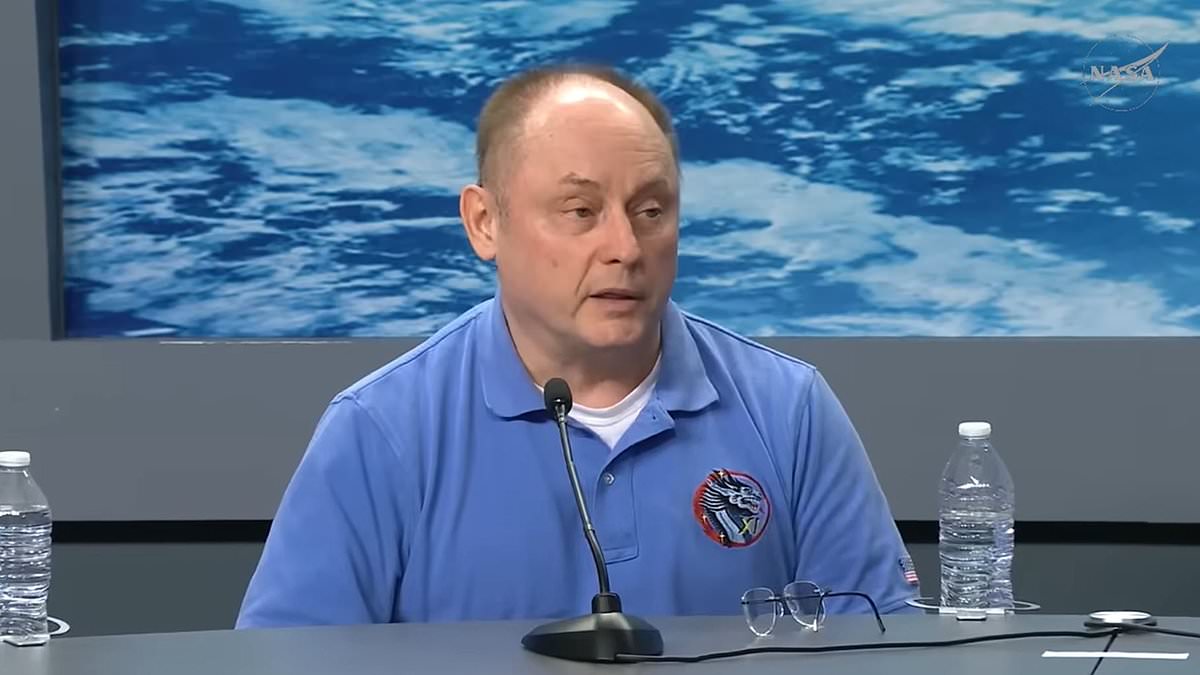
NASA astronaut Mike Fincke (pictured), pilot for the ill–fated Crew–11 mission, has shared a major hint as to why the space agency was forced to evacuate the ISS

The members of Crew–11 were forced to return to Earth a month ahead of schedule due to an unspecified medical emergency. Left to Right: Russian cosmonaut Oleg Platonov, NASA astronauts Mike Fincke and Zena Cardman, and Japanese astronaut Kimiya Yui
During the press conference, Mr Fincke explained that the crew had lots of experience using the ultrasound machine to track changes in the human body, so ‘when we had this emergency, the ultrasound machine came in super handy’.
The Crew–11 pilot even went so far as to claim that all future spaceflights should be equipped with portable ultrasound machines.
‘Of course, we didn’t have other big machines that we have here on planet Earth,’ he said.
‘We do try to make sure that everybody before we fly are really, really not prone to surprises. But sometimes things happen and surprises happen, and the team was ready … preparation was super important.’
The Crew-11 astronautas splashed back to Earth last Thursday, following NASA’s first medical evacuation in 65 years of spaceflight, and the first time that the ISS has ever been evacuated.
The medical issue was first reported on January 8, when a planned spacewalk was unexpectedly cancelled.
Just days later, on January 10, NASA had set the timeline to bring the crew home a month ahead of schedule.
That crew included NASA astronauts Zena Cardman, Mike Fincke, Japanese astronaut Kimiya Yui, and Russian cosmonaut Oleg Platonov.

The ISS is equipped with a modified off–the–shelf ultrasound machine called Ultrasound 2 that is primarily used for cardiac and ocular scans. Pictured: NASA astronaut Mike Fossum uses the Ultrasound 2 to scan the heart of crewmate Satoshi Furukawa
Prior to their departure, NASA’s chief health and medical officer, Dr James Polk, said that the astronaut was ‘absolutely stable’ and that this was not an ’emergent evacuation’.
Dr Polk added: ‘We’re not immediately disembarking and getting the astronaut down, but it leaves that lingering risk and lingering question as to what that diagnosis is, and that means there is some lingering risk for that astronaut onboard.’
NASA has remained extremely reticent to discuss any of the details of the medical emergency or which member of the crew it might have affected.
However, this latest update from Mr Fincke is the first clue as to what might have happened.
Ultrasound imaging sends a beam of soundwaves into the body and records how they bounce back to a receiver.
As the sound moves at different speeds through different types of tissue, you can ‘see’ inside the body without using any invasive methods.
Since 2011, the ISS has carried a modified off–the–shelf ultrasound machine called Ultrasound 2 that is used in both biomedical research and routine health checkups.
On Earth, sound has a huge array of uses, ranging from diagnosing gallbladder diseases and kidney stones to checking the health and gender of unborn babies.

One of the main uses for the ultrasound scanner is to monitor the cardiac and vascular health of astronauts, who are more at risk of conditions like blood clots, hardening arteries, and changes in blood pressure. Pictured: NASA astronaut Kevin Ford (right) trains with the Ultrasound 2 on Earth
However, on the ISS, Ultrasound 2 is generally used for two main medical issues – cardiac and ocular problems.
In a constant state of free–fall induced microgravity, blood tends to drift up from the astronauts’ feet and collect around their head and chest.
This creates a significantly increased risk of developing blood clots that can be life–threatening if they migrate into the heart or lungs.
In 2020, a NASA astronaut developed a large clot in their internal jugular vein during spaceflight and was forced to stretch the station’s dwindling supply of blood thinners to last more than 40 days until supplies could be sent.
The other main use for ultrasound in space is to monitor astronauts’ eye health.
As fluids build up in the head, they can cause swelling that triggers a collection of changes in the eye and brain called ‘spaceflight–associated neuro–ocular syndrome’.
Increased pressure around the optic nerve causes swelling in the connection between the eye and the brain, and flattening of the back of the eye.
This can lead to blurred vision and long–term damage to an astronaut’s vision.

NASA also uses the ultrasound scanner for monthly ocular health checks to ensure astronauts’ vision is not being damaged by the buildup of fluids in the head. Pictured: NASA astronaut Leroy Chiao performs an ultrasound examination of the eye on cosmonaut Salizhan Sharipov
Once a month, astronauts on the ISS are required to use Ultrasound 2 to perform ocular scans to keep track of this condition.
NASA’s Zena Cardman, who commanded the crew’s early return flight with SpaceX, said that the space station is set up as well as it can be for medical emergencies.
She added that NASA ‘made all the right decisions’ in cancelling the spacewalk, which would have been her first, and prioritising the crew’s well–being.
Likewise, Japan’s Kimiya Yui said he was surprised how well all the preflight training paid off in dealing with the health concerns.
Mr Yui said: ‘We can handle any kind of difficult situation. This is actually very, very good experience for the future of human spaceflight.’
The Daily Mail has contacted NASA for comment.
EXPLAINED: THE $100 BILLION INTERNATIONAL SPACE STATION SITS 250 MILES ABOVE THE EARTH
The International Space Station (ISS) is a $100 billion (£80 billion) science and engineering laboratory that orbits 250 miles (400 km) above Earth.
It has been permanently staffed by rotating crews of astronauts and cosmonauts since November 2000.
Crews have come mainly from the US and Russia, but the Japanese space agency JAXA and European space agency ESA have also sent astronauts.

The International Space Station has been continuously occupied for more than 20 years and has been expended with multiple new modules added and upgrades to systems
Research conducted aboard the ISS often requires one or more of the unusual conditions present in low Earth orbit, such as low-gravity or oxygen.
ISS studies have investigated human research, space medicine, life sciences, physical sciences, astronomy and meteorology.
The US space agency, NASA, spends about $3 billion (£2.4 billion) a year on the space station program, with the remaining funding coming from international partners, including Europe, Russia and Japan.
So far 244 individuals from 19 countries have visited the station, and among them eight private citizens who spent up to $50 million for their visit.
There is an ongoing debate about the future of the station beyond 2025, when it is thought some of the original structure will reach ‘end of life’.
Russia, a major partner in the station, plans to launch its own orbital platform around then, with Axiom Space, a private firm, planning to send its own modules for purely commercial use to the station at the same time.
NASA, ESA, JAXA and the Canadian Space Agency (CSA) are working together to build a space station in orbit around the moon, and Russia and China are working on a similar project, that would also include a base on the surface.