
Share this @internewscast.com
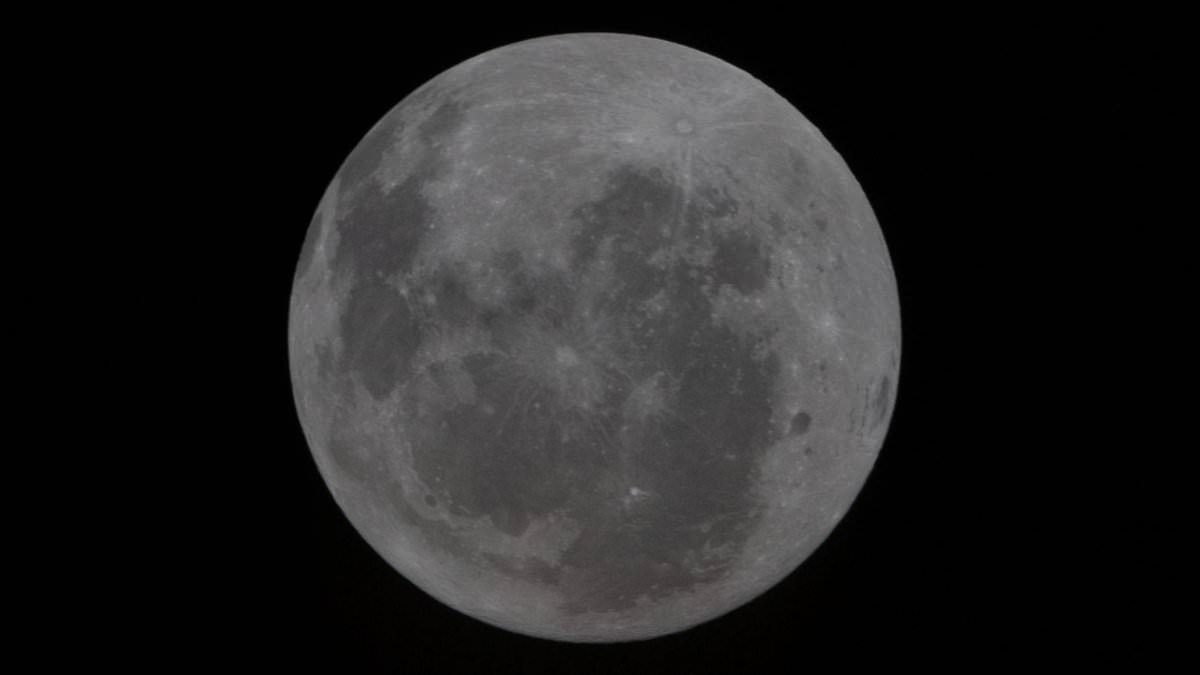
NASA’s astronauts have shared a groundbreaking image capturing the moon as they approach its surface for an unprecedented flyby, marking a significant moment in space exploration.
This image provides a unique glimpse of a long-concealed feature—the full stretch of the Orientale basin—offering an extraordinary new perspective. Positioned along the extreme right edge of the lunar disk, it is the first instance where human eyes have taken in its entire expanse.
The Orientale basin, a colossal impact crater stretching 200 miles across, was formed 3.7 billion years ago when an asteroid collided with the moon’s surface at a staggering speed of nine miles per second. The magnitude of this impact is astounding, with the asteroid being three times larger than the one speculated to have led to the extinction of the dinosaurs on Earth.
While Apollo astronauts glimpsed portions of the basin half a century ago, their vantage point was from a much lower altitude compared to the current Artemis II mission. This new perspective provides invaluable scientific insights and reignites human fascination with the mysteries of our celestial neighbor.
The destructive impact of the asteroid is hard to comprehend, as it is three times the size of the one believed to have wiped out Earth’s dinosaurs.
Apollo astronauts partially saw it half a century ago, but from a far lower altitude than Artemis II’s crew.
While it has been photographed by satellites, it usually appears as a shadowy smear.
‘This mission marks the first time the entire basin has been seen with human eyes,’ NASA said.

The Orientale basin is visible along the very right edge of the lunar disk, marking the first time it has ever been seen in its entirety by human eyes

The enormous impact basin, measuring 200 miles wide, formed 3.7 billion years ago by an asteroid smashing into the surface at nine miles a second. Until now, it has only been imaged in full by satellites. Pictured: A computer model of the basin, with gravity anomalies depicted in different colours
In an interview from the Orion space capsule, which is more than two-thirds of the way to the moon, mission specialist Christina Koch said: ‘What we are probably most excited as a crew about seeing on the moon would be an amazing feature called Orientale.
‘It is sometimes known as the Grand Canyon of the moon because it has all kinds of multi-layered crater rims and a lot of different land formations, and it has lava fields all throughout.
‘It’s very distinctive and no human eye previously had seen this crater until today, when we were privileged enough to see it, so we can’t wait to share more when we get closer to the moon.’
So far, the 685,000-mile (1.1 million km) round trip to the dark side of the moon and back has gone relatively smoothly.
But of all the issues the Artemis II crew have faced, the toilet has been the most persistent.
Shortly after launch the loo appeared to malfunction, with astronauts reporting a ‘blinking amber fault light’.
Luckily, after several hours of troubleshooting the issue, it emerged the toilet simply needed a while to ‘warm up’ and was cleared for use.
But the contraption has broken down a second time – and on this occasion a frozen vent was to blame.

The Artemis II crew (pictured from left) Canadian astronaut and mission specialist Jeremy Hansen, Commander Reid Wiseman, mission specialist Christina Koch and pilot Victor Glover


Within hours of launch, astronauts on-board Artemis II noticed issues with their toilet. Pictured (right): A training mockup of the toilet used to practice on Earth
Mission Control at NASA’s headquarters were able to orient the spacecraft so that the vent was facing the sun in an attempt to melt the blockage.
During this time, the crew were only allowed to use the toilet for ‘number twos’ and had to make use of a bag-and-funnel system called a Collapsible Contingency Urinal (CCU) for ‘number ones’.
Thankfully, after several hours of pointing the vent at the sun, whatever was blocking it melted and a waste dump was conducted.
The toilet then returned to full operational use.
Mission control told the crew: ‘Breaking news. At this time you are go for all types of uses of the toilet.’
The titanium toilet, which uses air suction to remove waste, is located in the ‘floor’ of the capsule, with a door and curtain for privacy.
The system collects urine and solid waste separately – urine is vented into space and ‘number twos’ are stowed for the return trip.
The loo is an upgraded version of an experimental toilet that launched to the International Space Station in 2020.
Compared to the toilet on the ISS, Orion’s lavatory has been modified to be more practical for female astronauts. NASA also found enough space on Orion to fit the toilet in its own tiny room.
On Apollo, astronauts had to simply float in a corner while doing their business, but Artemis II’s crew have the luxury of a tiny cabin in the ‘floor’ of the capsule.
Artemis II astronaut Jeremy Hansen previously described this as ‘the one place we can go during the mission where we can actually feel like we’re alone for a moment.’
Another new feature is the automatic start of air flow when the toilet lid is lifted, which also helps with odour control.
Tomorrow, on flight day six, Orion will reach its farthermost point from Earth as it sails 6,400 miles (10,299km) beyond the lunar surface before looping back and beginning its journey back to Earth.
It will take another four days to return, which the astronauts will fill by conducting key safety demonstrations, including testing procedures designed to shield the crew against dangerous radiation from solar flares.
As Orion approaches Earth, it will separate key components before plunging into the atmosphere at speeds of about 25,000mph (40,233kph) and splashing down in the Pacific Ocean.
The voyage aims to pave the way for a moon landing in 2028 which, if successful, will be the first time humans have set foot on the moon since December 1972.