
Share this @internewscast.com
NASA has revealed plans to bring home astronauts from the International Space Station following a crew member’s serious medical issue, sparking widespread curiosity and concern.
Experts have now shared insights into potential complications that can arise on the ISS, shedding light on what might have prompted this rare decision.
Perched 250 miles (400 km) above Earth, far from any hospital, even minor health problems can escalate in the challenging conditions of space.
Astronauts also contend with distinct hazards, including muscle and bone loss due to microgravity and the DNA-altering effects of space radiation.
NASA has yet to disclose details about the afflicted astronaut, maintaining a level of secrecy around the situation.
Dr. James Polk, NASA’s chief medical officer, reassured the public in a statement, noting that the astronaut’s condition is not linked to space operations or any injury sustained on the station.
‘It’s mostly having a medical issue in the difficult areas of microgravity,’ he revealed.
Now, experts have revealed what could have happened – including a blood clot or loss of vision – to prompt the decision to evacuate.

As NASA announces the first medical evacuation of the ISS in history, experts have revealed everything that might have gone wrong. Pictured: Crew 11 before launch (L to R), Roscosmos cosmonaut Oleg Platonov, NASA astronaut Mike Fincke, JAXA astronaut Kimiya Yui, and NASA’s Zena Cardman
Blood clots
Orbiting the earth at 17,500 miles per hour, astronauts on the ISS are in a constant state of freefall.
This creates microgravity, meaning the ISS only experiences a negligible fraction of the gravity felt back on Earth.
While floating around in space might look fun, this is actually one of the biggest health problems faced by astronauts.
In the absence of gravity fluids in the body shift from the legs to the upper body, creating major changes in the flow of blood through vessels in the head.
NASA found that this causes some astronauts to develop clots in the veins that collect blood from the head and neck, despite these crew members being in otherwise excellent health.
In a study conducted by Dr Anand Ramasubramanian of San Jose State University, NASA found that low gravity might be causing blood cells to get trapped in the tiny vortexes that surround valves in the veins.
This is made even more dangerous by the fact that these fluid shifts also reduce blood volume and lead to lower function of the heart and blood vessels, according to NASA.

Aboard the ISS, astronauts are in a constant state of freefall-induced microgravity. This causes fluids to move into the head and neck, creating a risk of blood clots

Studies have discovered blood clots in the heads and necks of astronauts in spaceflight. If they were to migrate to the lung, these clots could cause a life-threatening pulmonary embolism
Although these clots are not always dangerous, if one migrates to the lungs, it could cause a life-threatening pulmonary embolism.
Even relatively benign clots can become dangerous on the ISS due to a lack of regular medical care.
In 2020, a NASA astronaut developed a large clot in their internal jugular vein during spaceflight.
However, NASA were able to stretch out the station’s dwindling supply of blood thinners to last more than 40 days.
Bone and muscle atrophy
On Earth, our muscles and bones are constantly fighting against gravity to keep us from collapsing onto the ground.
But on the ISS, away from the Earth’s gravitational pull, astronauts’ bodies can give up on that constant struggle.
One of the biggest issues for astronauts is that this means their muscles and bones quickly begin to weaken due to a lack of work.

Outside the pull of Earth’s gravity, astronauts need to exercise for at least two hours a day to prevent muscle and bone atrophy


A loss of appetite is common in space due to frequent nausea, sometimes leading to astronauts losing dangerous amounts of weight. Previously, concerns were raised over the apparent weight loss of NASA astronaut Suni Williams
To combat the effects of living in low gravity, astronauts exercise for at least two hours per day on the ISS.
However, this isn’t enough to halt muscle and bone loss entirely.
Professor Jimmy Bell, of Westminster University, told the Daily Mail: ‘We know from long studies of astronauts that bone and muscle density atrophy (waste away) in microgravity.’
Research has shown that the changes to bone density can be severe and long-lasting, leading to a greater risk of bone fractures or skeletal issues.
These problems are often accentuated by the fact that astronauts struggle to maintain their weight in space.
Frequent nausea and a loss of smell and taste due to pressure in the sinuses means that astronauts lose their appetites.
Even with strict calorie-controlled diets, this means that astronauts are at an increased risk of a range of muscular and skeletal conditions.
While NASA says the evacuation is not related to an injury, complications caused by these factors could make a medical condition more dangerous.

The movement of fluid to the head can trigger a condition called ‘spaceflight-associated neuro-ocular syndrome’, which leads to blurry vision and long-term eyesight problems. Pictured: NASA astronaut Karen Nyberg studies her eyes while in orbit
Loss of vision
Since the body is roughly 70 per cent water, microgravity also causes massive fluid shifts in the body.
Just as if you were hanging upside down, NASA says that over 5.6 litres of liquid can migrate upwards through the body.
In some cases, this leads to an issue which NASA calls ‘puffy face syndrome’, which causes severe swelling of the tissues in the head.
More concerningly, this often leads to a collection of changes in the eye and brain called ‘spaceflight-associated neuro-ocular syndrome’.
Increased pressure around the optic nerve causes swelling in the connection between the eye and the brain, and flattening of the back of the eye.
This leads to blurred vision and can have serious long-term impacts on an astronaut’s eyesight.
NASA researchers suggest that approximately 70 per cent of all astronauts aboard the ISS experience some swelling in the back of their eyes, but the intensity of the effects varies significantly.

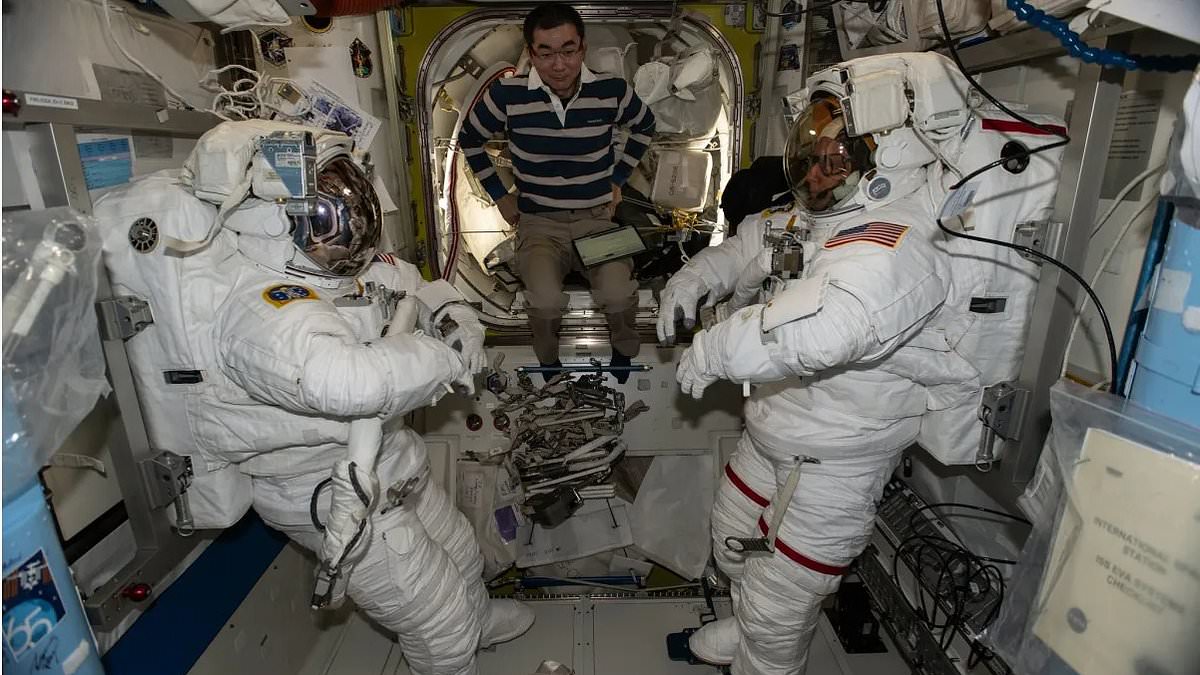
NASA’s evacuation plan comes after the space agency was forced to cancel a planned spacewalk on Thursday. JAXA astronaut Kimiya Yui (centre) was helping NASA astronaut Zena Cardman (left) and Mike Fincke prepare for the spacewalk before it was postponed
In an extremely severe case, the condition may have left an astronaut unable to conduct spacewalks or routine work on the station.
General health decline
As scientists study the effects of spaceflight on human health, research keeps finding more ways that leaving the planet can be harmful.
For example, Professor Bell points out that simply being inside Earth’s electromagnetic field appears to be extremely important for our health.
Professor Bell says: ‘Given that life evolved within this electromagnetic field, the question would be: “What happens if you remove it?”
‘People are beginning to show that growing cells, or even developing animals, without these fields face very significant biological effects which we don’t yet understand.’
Likewise, onboard the ISS, astronauts are ‘starved’ of the normal infrared radiation that we would get from the sun.
Although Professor Bell says that NASA has been aware of this problem for ‘quite a while’, the ISS doesn’t have any way to replace natural sunlight.

NASA administrator Jared Isaacman (Left) and NASA chief medical officer Dr James Polk (Center) revealed on Thursday that Crew-11 would be returning as soon as possible
New research is beginning to show that this may have a ‘fundamental’ effect on an astronaut’s health, affecting everything from their immune systems to their circadian rhythm.
Scientists are even starting to show that microgravity might have a profound effect on the functioning of the mitochondria, the powerhouse of the cell, which would have huge knock-on effects for astronauts’ health.
Most importantly, experts think that this could contribute to accelerated ageing during spaceflight, which could bring on health conditions that astronauts might expect to encounter later in life.
In fact, Professor Bell thinks a combination of these factors are the most likely reason for NASA’s sudden evacuation.
Professor Bell says: ‘All these effects, when you put them together, appear to have a very fundamental effect, to the point that there are some people who believe that humans will never be able to actually do long-term travel.
‘I think that it [the condition affecting the NASA astronaut] is an accumulation of all these factors that got to a point of criticality.’