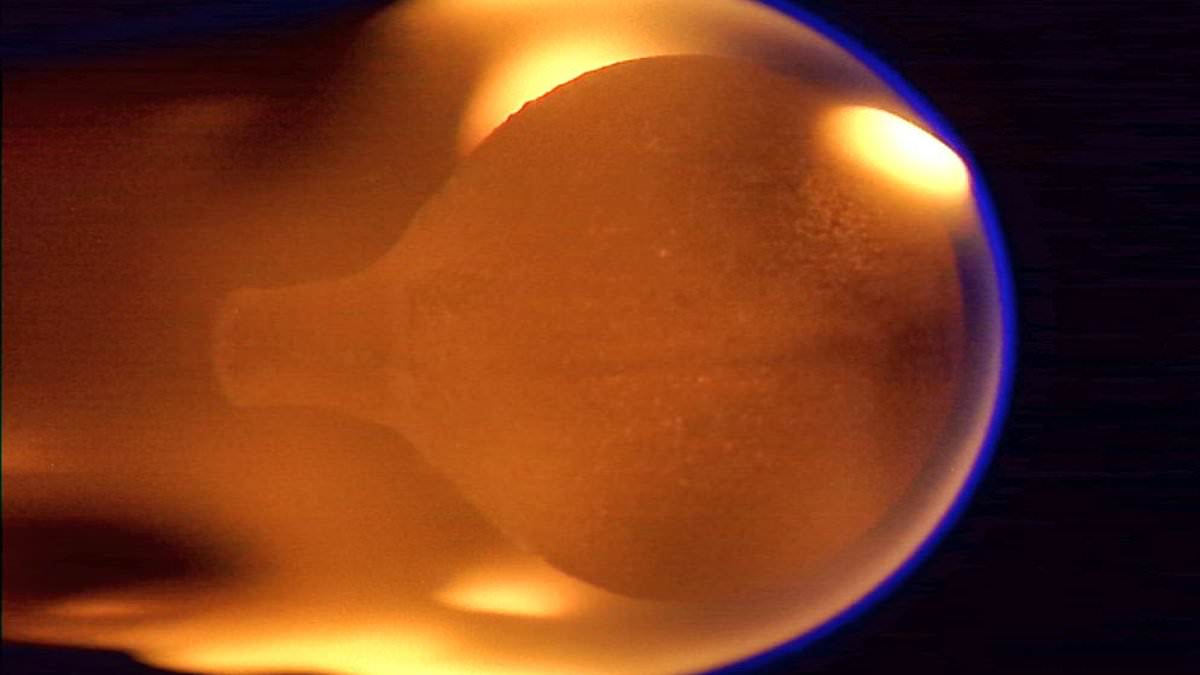

NASA is planning an unprecedented experiment by igniting a fire on the moon to study potential outcomes during emergency scenarios in future lunar missions.
While traversing the vast expanse of space, astronauts face numerous hazards, yet one of the most daunting is the threat of fire.
The reason for this is that fire behaves differently in environments with low gravity, such as on the moon or aboard the International Space Station (ISS), compared to its behavior on Earth.
This results in materials that typically do not ignite on Earth potentially sustaining prolonged burns in space.
To understand these risks better, NASA scientists are preparing to conduct the first-ever flammability test on the moon’s surface, targeting a launch later this year.
The experiment involves sending four fuel samples in a sealed chamber to the moon, as part of an uncrewed Commercial Lunar Payload Service (CLPS) mission.
These pieces of material will then be ignited while cameras and other sensors monitor how the flame spreads and how much oxygen it consumes.
As NASA prepares to return to the moon in 2028 with the Artemis IV mission, scientists say that these tests will be critical to ensuring the astronauts’ safety.

Scientists want to light a fire on the moon to see how a flame would spread in the event of a disaster during a lunar landing. Pictured: A fire burning during tests on the International Space Station (ISS)
On Earth, the shape and spread of a fire are determined by the influence of air currents and gravity.
But outside of the planet’s gravitational influence, these factors are wildly different.
Gravity means that hot, less–dense air rises away from the flame, drawing cool, oxygen–rich air in at the base.
This process can sometimes result in a phenomenon known as ‘blowoff’, in which the air current actually extinguishes the weak fire.
On the moon, where gravity is only one–sixth as strong, this process happens much more slowly.
That means the flow of oxygen can be strong enough to kindle a small flame, but not so fast that the fire is extinguished.
In fact, some studies suggest that the moon’s gravity might actually be a near–perfect environment for starting fires, with the required oxygen concentration at its absolute minimum.
Given that astronauts on the moon will be living in habitats filled with oxygen at pressures close to those found on Earth, fires on a lunar outpost or in landers are a genuine danger.

Scientists have created a combustion chamber that could be sent to the moon later this year to see how materials burn under lunar gravity

This is important because materials can actually be more flammable in space and NASA only has limited ways of testing this on Earth, such as dropping flames from ‘drop towers’ to simulate freefall (pictured)
In their paper, Dr Paul Ferkul, of NASA Glenn Research Center, and his co–authors write: ‘Early numerical and experimental evidence suggested that Lunar gravity could be more hazardous, since flame spread rate as a function of gravity peaks there.
‘Consequently, partial–g fire in an extraterrestrial habitat is a real hazard that is expected to be substantially worse than in 0–g and potentially worse than even 1–g.’
This is why NASA is so concerned to see how things burn on the moon before humans are sent back in 2028.
A big problem for NASA’s fire safety efforts is that it is very hard to test how fire spreads in microgravity.
Currently, the agency relies on a test known as NASA–STD–6001B to see if materials are safe to be used on missions.
This test involves holding a six–inch flame to the bottom of a piece of material; if it burns more than six inches up from the bottom or drips burning debris, it fails the test.
However, this doesn’t really capture the realities of how things burn in space.
In microgravity, fire doesn’t ‘point’ upwards since there isn’t any up or down and, instead, grows into spherical blobs that slowly spread outwards.

On the ISS, NASA has lit around 1,500 tiny fires in a device called the Combustion Integrated Rack, but there are obvious safety limits on how large these flames can be.

The best test so far has been the agency’s Spacecraft Fire Safety (Saffire) test, in which sheets of cotton, fibreglass, and acrylic were ignited inside an uncrewed Cygnus cargo capsule (pictured)
To try and replicate this on Earth, NASA drops burning material from high towers or lights small fires on parabolic flights to briefly simulate freefall.
But these tests can only recreate the conditions of microgravity for a few minutes at most.
Astronauts on the ISS have lit over a thousand tiny fires in a device called the Combustion Integrated Rack, but there are obvious safety limits on how large these flames can be.
The best test so far has been the agency’s Spacecraft Fire Safety (Saffire) test, in which sheets of cotton, fibreglass, and acrylic were ignited inside an uncrewed Cygnus cargo capsule before it burned up in Earth’s atmosphere.
This revealed some weird physics that NASA hadn’t previously expected, such as flames spreading in the opposite direction of the airflow and burning hotter on thinner materials.
Those unusual results were enough to convince NASA’s scientists that they needed a clearer picture of what could happen during a fire on a lunar mission.
When the Flammability of Materials on the Moon (FM) test is launched later this year, it will be the first time that NASA can take a long look at a large fire in space.
It will also be the first time that anyone has been able to light a fire on the lunar surface.