
Share this @internewscast.com
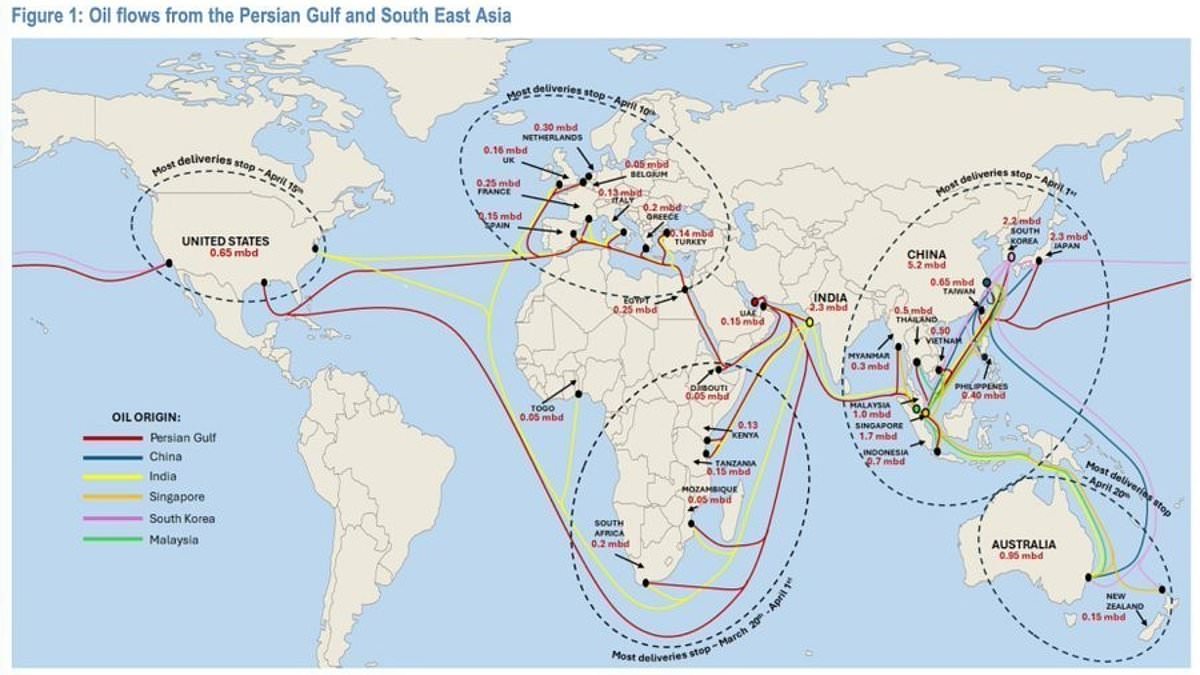
Investment bank JP Morgan has created a map forecasting the final arrival dates for Gulf oil shipments to various international markets.
According to the map, the majority of oil deliveries to Australia are expected to cease by April 20, with some regions in Africa and Asia likely experiencing disruptions earlier, starting on April 1.
For the United States, the anticipated cut-off date is April 15. However, due to its substantial domestic oil production, analysts predict the country will face price hikes rather than actual shortages.
Europe is expected to experience the effects by mid-April. Analysts suggest that the continent will contend with increased prices and heightened competition with Asia, rather than a lack of supply.
Australia’s fuel imports primarily originate from South Korea, Singapore, and Malaysia, which depend on Gulf oil transported through the Strait of Hormuz.
Even though six fuel shipments from Asia to Australia have been canceled, Energy Minister Chris Bowen assured that alternative sources have replaced these shipments.
Australia has now started importing fuel from the United States to make up the shortfall from Asia, with almost two million barrels of fuel due to arrive from mid-April through early May, according to shipping data from the London Stock Exchange Group.
The five shipments include 1.3 million barrels of petrol and nearly 600,000 barrels of diesel.

A map produced by investment bank JP Morgan lays out when the last shipments of Gulf oil will arrive at their destinations across global markets

According to the map, ‘most deliveries’ of Gulf oil to Australia will stop by April 20
JP Morgan analysts warned the global oil system is ‘shifting from a flow shock to a stock depletion problem’, meaning existing reserves are being steadily drained.
The map also shows the last tanker departing the Strait of Hormuz on February 28, the same day the US and Israel launched strikes on Iran, with traffic through the key shipping route largely halted since.
‘The global system is shifting from a flow shock to a stock depletion problems, where timing, not just volumes, drives the impact,’ analysts said.
It comes as Prime Minister Anthony Albanese announced a range of measures on Monday as the Middle East conflict increases prices at the bowser.
Australia’s fuel excise will be slashed by 26.3 cents per litre for three months, heavy vehicle road user charge will be cut for three months and the government will also defer the next scheduled increase in the road user charge by six months.
The Albanese government has also urged states and territories to consider matching the move through reduced heavy vehicle registration fees.
Fuel excise is a flat federal tax applied to every litre of petrol and diesel sold in Australia and is indexed twice a year, regardless of global oil prices.
While fuel prices fluctuate daily based on international markets, retail margins and transport costs, excise remains a fixed component, making it a powerful lever for short‑term relief.

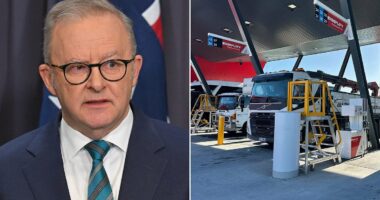
Anthony Albanese (pictured) announced the government would halve the fuel excise to 22.1 cents per litre
Treasurer Jim Chalmers said the package would cut the cost of filling a standard 65‑litre tank by about $19.
The measures are expected to cost the budget $2.55 billion, with a further $53 million in foregone revenue from delaying the road user charge increase.
‘So this relief is temporary, it’s timely, and it’s responsible,’ Chalmers said. ‘It’s all about taking some of the edge off these high petrol prices which are putting such extraordinary pressure on household budgets right around the country.’
The measures were agreed at Monday’s National Cabinet meeting, where a four-point National Fuel Security Plan was also established to coordinate the country’s response and avoid a fragmented approach.
The plan outlines four escalating levels of action, depending on how the crisis unfolds.
The first stage, ‘plan and prepare’, applies when supply is operating normally, a phase Albanese made clear Australia has already moved beyond.
The country is now in the second stage, ‘keeping Australia moving’, where supply is still functioning but localised shortages are emerging.
If conditions worsen, the government could shift to targeted action under level three, prioritising fuel for critical areas and encouraging Australians to cut back on usage.
The most severe stage, ‘protecting critical services’, would involve direct government intervention to ensure essential industries and services continue operating.