
Share this @internewscast.com
An octogenarian, alleged to have bragged about targeting civilians, faces accusations of being a ‘weekend sniper’ compensated for shooting individuals during Sarajevo’s siege in the 1990s.
The unidentified former metalworker and truck driver from Vento is the first person of interest in an investigation initiated in November. This probe looks into claims of ‘human safari’ sniper excursions during the Balkan conflicts.
Over 11,000 civilians perished in the siege from 1992 to 1995 when Bosnian Serb forces encircled Sarajevo, launching attacks from the surrounding hills.
The elderly suspect, charged with voluntary manslaughter, reportedly declared on Thursday, ‘I conducted a manhunt,’ boasting about targeting unarmed civilians in Sarajevo, including women, the elderly, and children.
On Monday, prosecutor Alessandro Gobbis plans to interrogate the suspect, seeking evidence that his repeated trips to the former Yugoslavia during the war were strictly for work and not for participating in ‘human safaris.’
Italian media reports describe the suspect as a firearm enthusiast, a claim supported by a police search of his residence, which uncovered two pistols, four rifles, and a carbine.
Survivors of the Sarajevo massacres in November have called for the death penalty for the sick tourists who allegedly paid to shoot at the civilians in Sarajevo.
Prosecutors acted after Italian journalist and writer Ezio Gavazzeni filed a formal complaint claiming that visitors from Italy, the United States, Russia, and other countries paid Bosnian Serb fighters between £70,000 and £88,000 for trips to sniper positions.

A Bosnian soldier returns fire as he and civilians came under fire in 1992. It has been alleged that tourists from Italy, the US, Russia, and other countries paid thousands to hunt innocent people

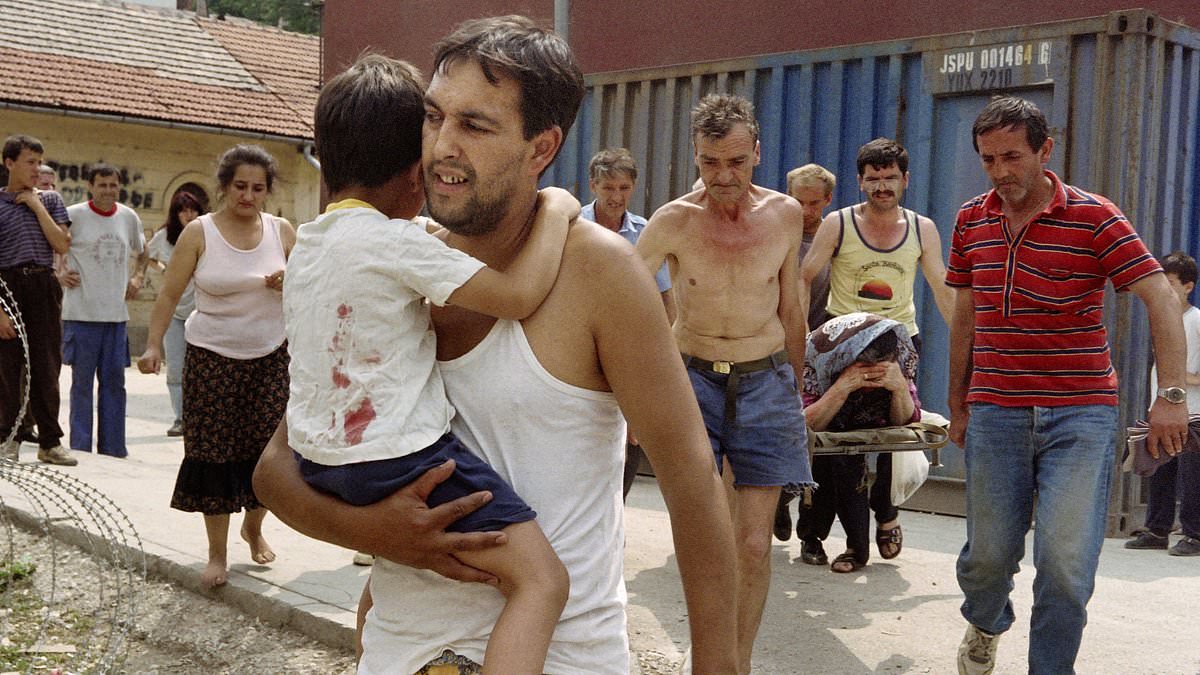
A man carries his injured son as others behind him carry a wounded person on a stretcher in 1993. The youngest members of families were often shot during the siege
The case also alleges that depraved tourists paid extra to hunt minors, in the long-rumoured ‘human safari’ scheme.
Gavazzeni said he had been inspired to investigate after watching ‘Sarajevo Safari,’ a 2022 documentary by Slovenian filmmaker Miran Zupanic.
The investigation in Italy has reopened painful memories for Sarajevo residents, but many say it could finally bring answers about one of the most disturbing allegations.
The allegations of human safaris were given further attention in 2007, when a former US Marine gave testimony at The Hague detailing the war crimes that were committed during the period.
He described how unarmed civilians were constantly under attack, with the youngest members of families under increased threats of violence.
He also claimed that Sarajevo was filled with tourists who would pay to shoot people.
He said: ‘I had witnessed on more than one occasion personnel who did not appear to me to be locals by their dress, by the weapons they carried, by the way they were being handled, i.e., guided around by the locals.’
The writer also claimed safari-goers dispatched their victims as dispassionately as big game hunters on the African plains and paid up to £200,000 for a weekend ‘shoot’.
In Zupanic’s documentary, a Slovenian man who worked as an intelligence officer for the US said he witnessed foreigners in high power committing crimes against innocent civilians.
He said: ‘These people were certainly not ordinary people. They were people in high positions, protected… people who, after having everything, seek another thrill, saying to themselves: ‘Why shouldn’t I now shoot a child or an adult in Sarajevo and gain another pleasure? I won’t only kill animals.’
Describing what he saw, he added: ‘I had my own binoculars so I could see. After the man fired, the person fell. Most were hit in the chest, because the head is harder.

An injured man being treated by doctors in 1995. Witnesses have come forward to give credibility to accounts that the horrors of the human safari did exist

A video of a Toyota allegedly used by militia leader Slavko Aleksic, with a human skull from a Bosnian corpse, during the siege of Sarajevo
‘But I also saw a hit to the head. From that, I saw they were very good hunters.’
In December, a key witness at the centre of the investigation died unexpectedly.
Slavko Aleksic, a Bosnian former militia leader, died in the city of Trebinje, despite having been in good health.
Aleksic, 69, commandeered a Jewish cemetery above Sarajevo used by snipers, and according to Serbian lawyer Cedomir Stojkovic, ‘he would have been a crucial witness’ because ‘he could have said who did the shooting and who organised it’.
Croatian investigative journalist Domagoj Margetic added: ‘In November, Aleksic was apparently in good health — and now he has suddenly, and very conveniently, died.’
In October, Serbian president Aleksandar Vucic was also accused of being involved in Sarajevo’s ‘human safari’ sniper trips, an allegation he denies.
A month later, Aleksic gave an interview on Serbian television and insisted the president had had no involvement in sniper activity.
‘Aleksic was alive and well then, did not announce a fatal illness and, on the contrary, said he would testify in favour of Vucic,’ Margetic said.

Serbian President Aleksandar Vučić has denied any involvement with the ‘human safari’ sniper trips during the Balkan wars of the 1990s, when wealthy tourists allegedly paid to shoot at unarmed civilians in the besieged city of Sarajevo
On December 12, Aleksic told a radio show that he was in a hospital in Belgrade, according to Margetic, after reportedly being taken from Bosnia to Belgrade’s military hospital by Serbia’s secret service.
Meanwhile, Stojkovic said: ‘It’s reasonable to think Aleksic’s death was linked to the ‘human safari’ probe and that Serbian intelligence was involved’.
Margetic appealed to war crimes prosecutors to stop any cremation or burial planned for Aleksic, and hold a post-mortem to check the body for poison.
His death also came shortly after a macabre video resurfaced of a car allegedly used by him featuring a human skull on the bonnet – said to be extracted from a Bosnian corpse – wearing a UN helmet.