Share this @internewscast.com
WASHINGTON – In a recent interview with The Wall Street Journal, President Donald Trump addressed concerns about his energy levels and health, clarifying that he underwent a CT scan rather than an MRI during a medical checkup in October. The White House had previously been vague about the details of this examination.
The interview, which was released on Thursday, saw Trump expressing regret over the decision to have this comprehensive imaging of his heart and abdomen at Walter Reed National Military Medical Center. He noted that the procedure sparked unnecessary public scrutiny regarding his health. A memo from his physician, shared by the White House in December, explained that the “advanced imaging” was a preventative measure appropriate for someone of his age.
Initially, Trump mistakenly referred to the procedure as an MRI but later acknowledged he was unsure about which part of his body was scanned. Unlike an MRI, a CT scan is faster, though it provides less detailed images of tissue differences.
According to a statement from Navy Capt. Sean Barbabella, the president’s doctor, released by the White House on Thursday, the October examination coincided with Trump’s visit to Walter Reed, where he was scheduled to meet with staff. Trump had previously completed his annual physical in April.
“During President Trump’s October visit to Walter Reed Medical Hospital, he was scheduled to engage with the staff and soldiers,” Barbabella explained. “To maximize the President’s visit, we recommended an additional routine health checkup to maintain his excellent health status.”
Barbabella further noted that he advised either a CT scan or MRI to conclusively eliminate any cardiovascular concerns. The results were reportedly “perfectly normal,” with no abnormalities detected.
White House press secretary Karoline Leavitt said in a statement Thursday that the president’s doctors and the White House have “always maintained the President received advanced imaging” but said that “additional details on the imaging have been disclosed by the President himself” because he “has nothing to hide.”
“In retrospect, it’s too bad I took it because it gave them a little ammunition,” Trump said in the interview with The Wall Street Journal. “I would have been a lot better off if they didn’t, because the fact that I took it said, ‘Oh gee, is something wrong?’ Well, nothing’s wrong.”
The 79-year-old became the oldest person to take the oath of office when he was sworn in as president last year and has been sensitive to questions about his health, particularly as he has repeatedly questioned his predecessor Joe Biden’s fitness for office.
Biden, who turned 82 in the last year of his presidency, was dogged by scrutiny of his age and mental acuity at the end of his tenure and during his abandoned attempt to seek reelection.
But questions have also swirled around Trump’s health this year as he’s been seen with bruising on the back of his right hand that has been conspicuous despite a slathering of makeup on top, along with noticeable swelling at his ankles.
The White House this summer said the president had been diagnosed with chronic venous insufficiency, a common condition among older adults. The condition happens when veins in the legs can’t properly carry blood back to the heart and it pools in the lower legs.
In the interview, Trump said he briefly tried wearing compression socks to address the swelling but stopped because he didn’t like them.
The bruising on Trump’s hand, according to Leavitt, is from “frequent handshaking and the use of aspirin,” which Trump takes regularly to reduce the risk of heart attack and stroke.
He said he takes more aspirin than his doctors recommend but said he has resisted taking less because he’s been taking it for 25 years and said he is “a little superstitious.” Trump takes 325 milligrams of aspirin daily, according to Barbabella.
“They say aspirin is good for thinning out the blood, and I don’t want thick blood pouring through my heart,” Trump said. “I want nice, thin blood pouring through my heart. Does that make sense?”
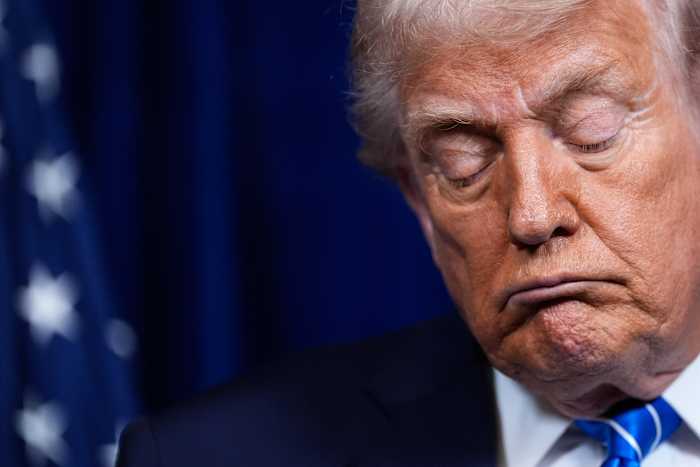
Trump, in the interview, denied he has fallen asleep during White House meetings when cameras have caught him with his eyes closed, instead insisting he was resting his eyes or blinking.
“I’ll just close. It’s very relaxing to me,” he said. “Sometimes they’ll take a picture of me blinking, blinking, and they’ll catch me with the blink.”
He said that he’s never slept much at night, a habit he also described during his first term, and said he starts his day early in the White House residence before moving to the Oval Office around 10 a.m. and working until 7 p.m. or 8 p.m.
The president dismissed questions about his hearing, saying he only struggled to hear “when there’s a lot of people talking,” and said he has plenty of energy, which he credited to his genes.
“Genetics are very important,” he said. “And I have very good genetics.”
Copyright 2026 The Associated Press. All rights reserved. This material may not be published, broadcast, rewritten or redistributed without permission.