Share this @internewscast.com
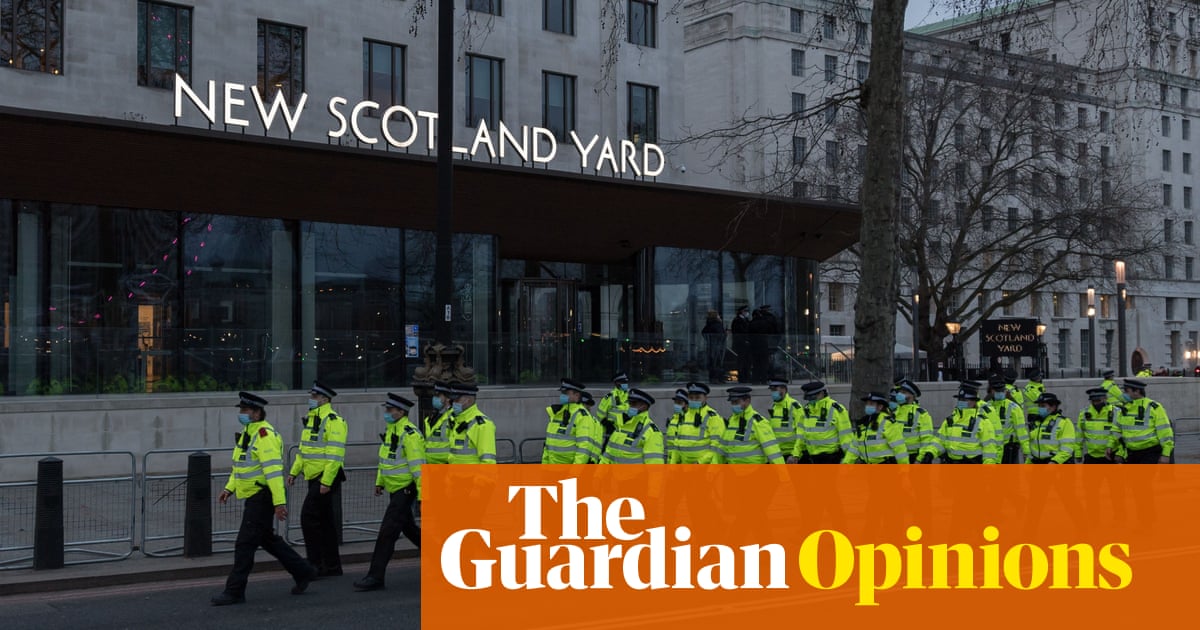
The revelation that a black schoolgirl was strip-searched by police at school in Hackney, east London, after teachers claimed that they smelt marijuana on her, is shocking. But the details of the search, the indignities inflicted on a 15-year-old girl, are truly distasteful.
She was made to strip naked, to spread her legs, to use her hands to spread her buttock cheeks and then to cough. She was menstruating. According to family members, the police insisted that she take off the bloody pad and would not let her go to the toilet to clean up. Then they made her reuse the same pad.
No drugs were found, yet the rumour spread around the school that this perfectly innocent girl was a drug dealer. Her mother told the local child safeguarding review that the experience had left her daughter traumatised. Her aunt added: “I see the change from a happy-go-lucky girl to a timid recluse that hardly speaks to me.” She said the girl was now in therapy and that she self-harms.
It would be easy to dismiss the 2020 incident as an aberration, to believe that the police officers involved were the proverbial “bad apples”. After the damning review, the Met has voiced public contrition, calling the strip search “truly regrettable” and apologising “to the child concerned, her family and the wider community.”
But there is a deeper truth here: although senior Metropolitan police officers are better media trained than ever, the racism and misogyny that has always characterised and blighted the force is still very much present. Recent incidents make that clear.
Start with the Independent Office for Police Conduct report on behaviour at Charing Cross police station that found a culture of toxic masculinity. Think then of the Met, again in Hackney, having to apologise and pay compensation to a completely innocent woman, Dr Konstancja Duff, for the use of “sexist, derogatory and unacceptable language” when she was arrested and strip-searched in 2013. She was only trying to help a 15-year-old black boy who the police were stopping and searching by giving him a know-your-rights card. Duff described what happened next: “I was pinned to the floor of a cell by three female officers. I had my hands cuffed behind my back and my legs tied together while they cut off my clothes with scissors. They ripped out my earrings, grabbed my breasts roughly while turning me over, and even touched me between my legs, apparently looking for genital piercings.”
It took Duff nine years to get an apology arising from the encounter. How many other women, black and white, are abused in this way and give up before getting justice?
People are all too aware of the tragedy of Sarah Everard, the young woman kidnapped on a London street, and raped and murdered by a serving police officer.
Then there is the case of Bibaa Henry and Nicole Smallman, two young black sisters from north London who went missing in June 2020. Their bodies were eventually found by family members in a nearby park after police seemed to show little interest in investigating. After the murders and a trial, two police officers were subsequently jailed for photographing the women’s bodies at the murder scene and sharing the photos on WhatsApp, including one group of 41 police officers.
A recent interview with Hampshire deputy chief constable, Maggie Blyth, who is now the national lead for violence against women and girls for the National Police Chiefs’ Council, is revealing in this context. She said the concept of a “few bad apples” is wrong and that policing, like other jobs with access to power, could attract people who wanted to “use their power in a corrupt and criminal way.”
She added: “There will be some attracted into working in policing because of the powers that it offers them, the powers to exert and coerce other people, particularly vulnerable individuals. I think we shouldn’t be naive to that.”
Obviously, not every police officer abuses their power, but too many do. And racial discrimination in the way the police exercise their power has been a statistically verifiable fact for far too long. The use of stop and search continues to increase: by some estimates, black people are nine times more likely to be victims.
How many of those are children? Look to Hackney again. According to the child safeguarding review, in 2020/21 in the central east basic command unit of the Met (which covers Hackney), 25 children under the age of 18 were strip-searched (or “further searched”) to use Met police terminology). Most of the searches (88%) were negative. And only two of the children searched were white.
The Hackney schoolgirl was failed in so many ways. The police abused her and no teacher thought to contact her parents, to ask the girl afterwards how she was: certainly they don’t seem to have grasped the gravity of this awful situation.
That’s dispiriting in itself, but the most dispiriting thing about all of this is that, after decades of marching, demonstrating, campaigning, police practice is as bad as ever – and now the government is changing the law to make it even harder to march and campaign, to highlight these injustices.
The conclusion to be drawn is stark: black schoolgirls are not safe from police abuse, even at school, supposedly a place of safety. What kind of society tolerates this?
Source: This post first appeared on The Guardian