
Share this @internewscast.com
According to the Foreign Office, Russian opposition figure Alexei Navalny was allegedly assassinated by the Russian government.
Navalny’s death was attributed to a toxin derived from the South American dart frog, known as epibatidine.
The political activist, who was 47, died at a secluded Arctic penal facility two years ago, where he was serving a lengthy sentence on what many considered to be fabricated embezzlement charges.
His passing was officially disclosed by Russian authorities on February 16, 2024. Navalny’s supporters have long claimed that the Kremlin orchestrated his death to eliminate a significant political adversary.
Epibatidine is reportedly 200 times more potent than morphine and is traditionally used by some indigenous South American tribes in hunting tools like darts and blowguns, affecting nerves to induce numbness and paralysis.
The method by which this toxin might have been administered to Navalny remains unknown, although indigenous methods include the use of blow darts or blowguns.
The UK and its allies Sweden, France, Germany and The Netherlands said the ‘barbaric’ act – using a neurotoxin that is classed as a chemical weapon – could only have been carried out by Vladimir Putin’s government.
In a statement released by the Foreign Office in conjunction with other European nations, a spokesperson said: ‘The UK, Sweden, France, Germany and The Netherlands are confident that Alexei Navalny was poisoned with a lethal toxin.
‘This is the conclusion of our Governments based on analyses of samples from Alexei Navalny. These analyses have conclusively confirmed the presence of epibatidine.
‘Epibatidine is a toxin found in poison dart frogs in South America. It is not found naturally in Russia.

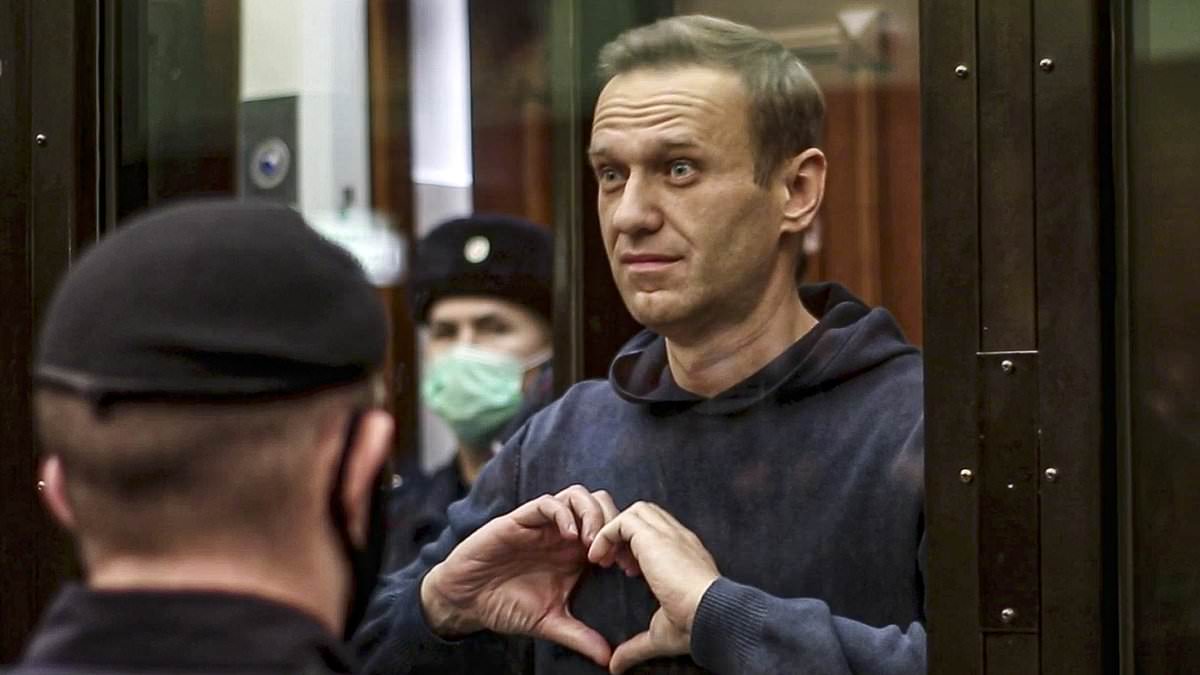
Russian opposition leader Alexei Navalny makes a heart with his hands as he appears in court in Moscow on February 2, 2021

Yulia Navalnaya, widow of Navalny, is seen in St Mary’s Church in Berlin after lighting a candle on what would have been her husband’s birthday in June 2024

Navalny is pictured with his wife after a rally in Moscow, Russia, in September 2013

The UK and its allies Sweden, France, Germany and The Netherlands said the ‘barbaric’ act – using a neurotoxin that is classed as a chemical weapon – could only have been carried out by Vladimir Putin’s (pictured) government
‘Russia claimed that Navalny died of natural causes. But given the toxicity of epibatidine and reported symptoms, poisoning was highly likely the cause of his death. Navalny died while held in prison, meaning Russia had the means, motive and opportunity to administer this poison to him.
‘Russia’s repeated disregard for international law and the Chemical Weapons Convention is clear.
‘In August 2020 the UK, Sweden, France, Germany, The Netherlands and partners condemned Russia’s use of novichok to poison Alexei Navalny.
‘This followed Russia’s use of novichok in Salisbury in 2018, which led to the tragic death of a British woman, Dawn Sturgess.
‘In both cases, only the Russian state had the combined means, motive and disregard for international law to carry out the attacks.
‘These latest findings once again underline the need to hold Russia accountable for its repeated violations of the Chemical Weapons Convention and, in this instance, the Biological and Toxin Weapons Convention.
‘Our Permanent Representatives to the Organisation for the Prohibition of Chemical Weapons have written today to the Director General to inform him of this Russian breach of the Chemical Weapons Convention.
‘We are further concerned that Russia did not destroy all of its chemical weapons.

It is not clear how the frog poison was allegedly administered to Mr Navalny (Pictured during his imprisonment)

Yulia Navalnaya attends the 2024 Munich Security Conference on the day Russia announced her husband’s death

Navalny’s death while in Russian detention was announced on February 16, 2024
‘We and our partners will make use of all policy levers at our disposal to continue to hold Russia to account.’
Navalny was serving a 19-year sentence on charges of extremism, having campaigned against official corruption and led major anti-Kremlin protests.
Last year his widow, Yulia Navalnaya said the Kremlin’s claim that he died of natural causes was a lie.
She said two independent laboratories had confirmed he was poisoned. Navalnaya did not provide details on the poison allegedly used, on the samples or on the analysis – but challenged the laboratories to publish their results.
In a video posted to social media at the time she said: ‘I will not stay silent. I assert that Vladimir Putin is responsible for the murder of my husband, Alexei Navalny.’
She added: ‘The killers worked carefully to erase traces, but we managed to preserve some evidence. We were able to obtain samples of Alexei’s biological material and securely smuggle them abroad. Labs in at least two countries examined these samples independently of each other. And these labs … reached the same conclusion: Alexei was killed. More specifically, he was poisoned.’
Denying allegations that he was murdered, the Kremlin blamed his death on a sudden spike in blood pressure and chronic diseases.
Previously, Navalnaya has accused unnamed western countries of trying to hush up the true cause of her husband’s death due to ‘political’ considerations.

Russian opposition leader Alexei Navalny’s parents Anatoly and Lyudmila, accompanied by Alla Abrosimova, who is the mother of Navalny’ widow Yulia Navalnaya, come to Navalny’s grave to mark the first anniversary of his death at a cemetery in Moscow in February 2025

Navalny takes part in a march at Strastnoy Boulevard in memory of Russian politician and opposition leader Boris Nemtsov in 2019
‘They wouldn’t want the inconvenient truth to come out at the wrong moment,’ she said. ‘I demand that the labs that conducted the analyses publish their results. Stop pandering to Putin on account of so-called higher considerations. You will not appease him. As long as you remain silent, he will not stop. I demand full public disclosure of the results showing exactly what poison was used against my husband.’
Joe Biden, who was US president when Navalny died, said shortly after his body was discovered that there could be no doubt that Putin was responsible.
Navalnaya, who has lived outside Russia for years, published photos of the cell where her husband died. They showed vomit and some of Navalny’s personal items, including an English-Russian dictionary and his mittens. ‘This is where his murder took place,’ she said.
In the video, Navalnaya also detailed her husband’s last days based on what she said was testimony by employees at the penal colony.
On the day he died, she said, her husband was taken out for a walk but felt ill. When he was taken back to his cell ‘he lay down on the floor, pulled his knees up, and started moaning in pain… then he started vomiting.
‘Alexei was having convulsions… the prison guards watched [his] agony through the bars of the cell window.’
An ambulance wasn’t called until 40 minutes later Navalny became ill. He died shortly afterwards. Prison authorities told his mother Lyudmila that her son had experienced ‘sudden death syndrome’.
Putin, who studiously avoided naming Navalny while he was alive, briefly referred to him a month after his death by stating that a person passing was ‘always a sad event’.
Official Russian documents leaked in 2024 and published by a Russian opposition website showed that Navalny had symptoms consistent with poisoning before his death. The documents also appeared to show that officials had tried to cover up the cause of death.
An anti-corruption activist who led the biggest protests of Putin’s 26-yaer rule, Navalny was widely seen as the only figure with enough standing and charisma to unite Russia’s fragmented opposition movement. In his final court appearances he spoke out against the war in Ukraine and urged Russians to rise up.
Navalny survived a previous assassination attempt in 2020 when FSB security service agents poisoned him in Siberia with a Soviet-era nerve agent.
After international pressure, Putin allowed him to be airlifted to a clinic in Berlin for treatment. He returned to Moscow in January 2021, where he was arrested as soon as his aircraft touched down. It was his last day as a free man before his death.
The Kremlin initially insisted on a secret burial for Navalny over fears that a public funeral could lead to a show of dissent. His elderly mother, Lyudmila, was forced to trudge in sub-zero temperatures between Arctic morgues to try to locate his body. ‘Time is not on your side, corpses decompose,’ she is said to have been told.
After an outcry, the Kremlin eventually released Navalny’s body and he was buried at Moscow’s Borisovskoye cemetery. His funeral service became an opposition rally, thought to be the biggest since the start of Russia’s full-scale invasion of Ukraine.
However, since Navalny’s death his exiled allies at his anti-corruption foundation (FBK) opposition movement have struggled to remain relevant within Russia and have lost the backing of key financial sponsors. Last month Ivan Zhdanov, the FBK’s director, left his post. He said: ‘It’s not the same at all without Alexei.’
This is a breaking news story and is being updated.