
Share this @internewscast.com
Russian President Vladimir Putin has launched a powerful missile strike using the nuclear-capable Oreshnik missile, which travels at speeds of up to 8,000 mph, targeting the outskirts of the Ukrainian city of Lviv, according to official statements from Moscow.
The attack, which occurred perilously close to NATO and EU borders, is believed to have been directed at Europe’s largest underground gas storage facility, raising concerns about the potential for further escalation in the region.
Russia’s Defense Ministry has stated that the missile strike was a retaliatory action in response to an alleged Ukrainian drone attack on one of President Putin’s residences in late December.
However, Ukrainian officials have dismissed these claims, labeling the Kremlin’s allegations of an attempted attack on the Novgorod region residence as false.
This missile strike comes amid a night marked by significant devastation and casualties in Ukraine, with reports of widespread attacks on civilian areas including Kyiv and Kryvyi Rih, the hometown of Ukrainian President Volodymyr Zelensky.
At the time of the attack, it was uncertain whether NATO aircraft stationed in neighboring Poland had sufficient time to respond, as they typically do when ballistic missile threats are detected in western Ukraine.
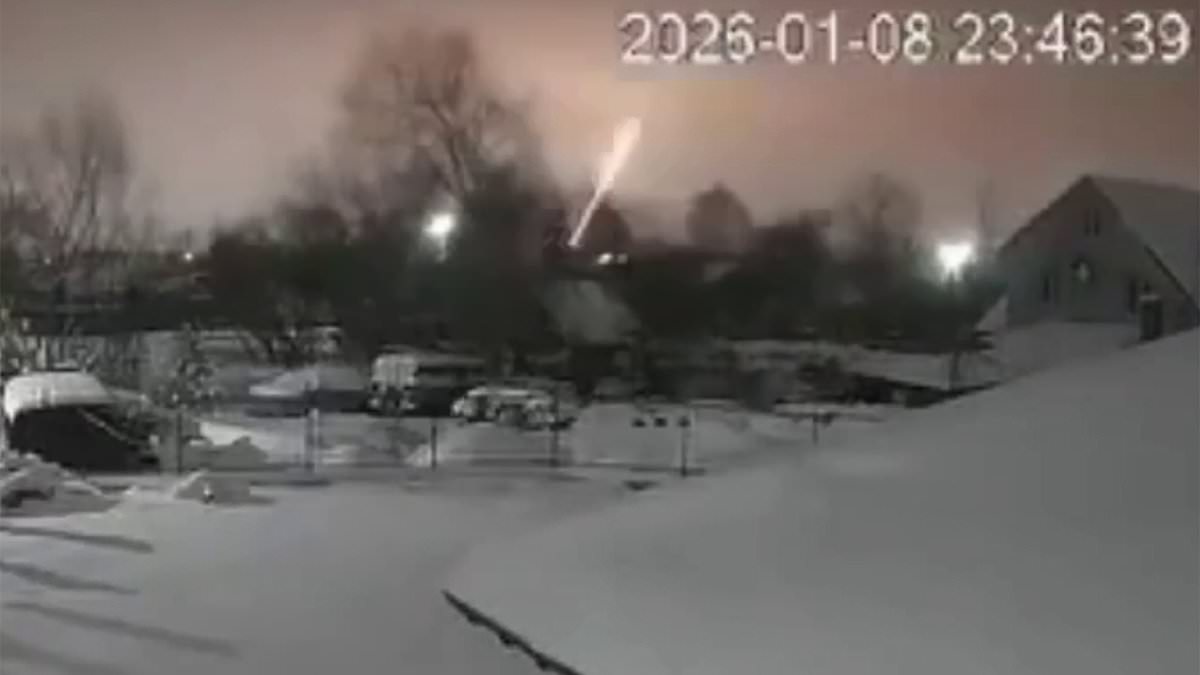
The Oreshnik was fired from Astrakhan region, deep in Russia, and took less than 15 minutes to explode over Lviv in a trademark shower of bright flashes with the night sky turning pink-red.
The extraordinary speed initially fuelled speculation online that Russia used an Oreshnik-type ballistic weapon, but Ukrainian investigators say confirmation of the weapon used will only be possible after analysis of the debris.

Vladimir Putinunleashed his sinister nuclear-capable 8,000 mph Oreshnik missile in a strike on the outskirts of Ukrainian city Lviv, Russian confirmed

The menacing attack close to NATOand EU territory was aimed at Europe’s largest underground gas storage facility, it is believed

The menacing attack close to NATO and EU territory was aimed at Europe’s largest underground gas storage facility, it is believed
However, the Russian defence ministry admitted to using Oreshnik – claiming it was in response to a Ukrainian bid to kill Putin with a strike on his palace in Valdai, north of Moscow.
Western intelligence and Ukraine are adamant there was no such strike.
‘In response to the Kyiv regime’s terrorist attack on the residence of the President of the Russian Federation in the Novgorod region, which took place on the night of December 29, 2025, the Russian Armed Forces launched a massive strike using long-range, land- and sea-based precision weapons, including the Oreshnik medium-range ground-mobile missile system, as well as unmanned aerial vehicles (UAVs), against critical targets in Ukraine,’ said the Moscow defence ministry.
‘The strike’s objectives were achieved.
‘The [drone] production facilities used in the terrorist attack were hit, as well as energy infrastructure supporting Ukraine’s military-industrial complex.
‘Any terrorist actions by the criminal Ukrainian regime will not go unanswered.’
It was only the second time it has been used in anger, the first being in Dnipro in 2024 when it was deployed without a warhead in a ploy to terrorise the population.
The ‘unstoppable’ Oreshnik system is now based close to Ukraine and NATO territory in Belarus – but this strike came from the Kapustin Yar missile test range in Astraphan region, and may have taken less than seven minutes to cover the 900 mile range to hit its target.
Russian pro-Putin propaganda channel War Gonzo boasted: ‘The power of the explosions was so great that…they were felt by residents of the entire region.’
The damage to the giant Stryi gas storage facility – vital for Ukrainians supplies, especially in midwinter – was initially unclear.
Even a reduced or inert warhead strike by Putin amounts to a high-speed show of force — used less to level targets than to terrify, signal escalation and advertise that nowhere feels out of range.
The strike on Lviv is the clearest indication yet that Putin has no intention of heeding Donald Trump’s warnings for an end to the war and a peace settlement.
Russia also repeatedly struck Kyiv in a long and hellish night of deadly attacks, killing and maiming dozens of Ukrainians in a missile and drone onslaught hitting civilians in residential districts.
In the Ukrainian capital, at least four people were killed and 19 wounded in strikes over six hours.

A dead body of a paramedic lies on the ground in front of a residential building damaged by a Russian strike on Kyiv, Ukraine, Friday, January 9, 2026

In the Ukrainian capital, at least four people were killed and 19 wounded in strikes over six hours

Russia repeatedly struck Kyiv in a long and hellish night of deadly attacks, killing and maiming dozens of Ukrainians in a missile and drone onslaught

Firefighters clear debris in a damaged residential building following a Russian attack in Kyiv early on January 9, 2026,
In Kryvyi Rih, one residential property was ‘simply cut in half’ in a ballistic missile attack.
There were 23 victims, including six children, with one woman killed.
Putin also staged new artillery strikes on Ukraine’s Sumy region – as the war appears to be worsening, not edging towards peace.
Ukraine struck Russia with a fearsome explosion at Orlovskaya Thermal Power Station in Oryol region.
There is no suggestion the overnight Oreshnik strike was nuclear – despite its atomic capability.
Putin claims targets are incinerated by conventional Oreshnik missiles unleashing a temperature of 4,000C, almost as hot as the surface of the sun.
An Oreshnik launch from Belarus could hit London in eight minutes, far shorter than the time it would take from its earlier launch site in Kapustin Yar in southern Russia, according to Moscow sources.
Before today, Putin had only used the ‘game-changing’ nuclear-capable weapon once – in a ‘test’ launch in November 2024 against Ukrainian city Dnipro, without a live warhead, an operation aimed at scaring both Kyiv and the West.