
Share this @internewscast.com
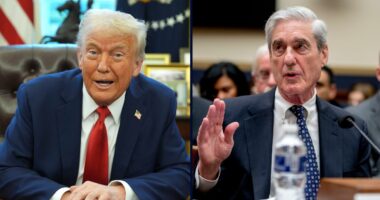
Left: United States Secretary of State Marco Rubio is seen in the Department of State building in Washington D.C. on Friday, June 20, 2025. (Photo by Aaron Schwartz/Sipa USA)(Sipa via AP Images). Right: Chief U.S. District Judge James Boasberg (U.S. District Courts). Inset: President Donald Trump talks with reporters in the Oval Office of the White House, Wednesday, June 18, 2025, in Washington. (AP Photo/Alex Brandon).
Secretary of State Marco Rubio has stated that the Trump administration cannot comply with a federal judge’s directive to return or provide hearings for hundreds of deported Venezuelans, citing the “delicate” state of diplomatic relations between the United States and Venezuela.
This complexity arises in the aftermath of U.S. forces’ decisive action to remove Nicolas Maduro from power, subsequently extraditing him to New York. As a result, the administration argues it is unable to fulfill Chief U.S. District Judge James Boasberg’s order to grant due process rights to 137 individuals.
In a two-page document, Rubio responded to Boasberg’s mandate by detailing the “surgical” operation that led to the arrest of Maduro and his wife, Cilia Flores, who are now facing charges related to narco-terrorism conspiracy, among others.
Rubio noted, “In the wake of this operation, the situation in Venezuela remains fluid.” He emphasized the ongoing U.S. efforts to foster beneficial changes in Venezuela, not only for U.S. interests but also in hopes of alleviating the hardships faced by the Venezuelan people. These efforts involve delicate and continuous engagement with the regime of Maduro’s successor, Delcy Rodríguez, whom the U.S. recognizes as the acting president.
Despite the U.S.’s influence in shaping Venezuela’s current political climate, Rubio asserts that complying with Boasberg’s order would jeopardize U.S. foreign policy objectives. He argues that requesting cooperation from Rodríguez could be detrimental, risking “material damage” to these interests.
Rubio concludes that this risk is significant regardless of whether the proposal involves transporting individuals to a U.S. jurisdiction or arranging remote hearings from Venezuela. The latter option, he warns, poses a “serious risk” of interference by anti-American elements in Venezuela, potentially undermining justice.
The chief judge of the U.S. District Court for the District of Columbia has been severely critical of the administration previously in this case. Following the Venezuelan men’s summary deportation to El Salvador on allegations of gang affiliation and their subsequent lawsuit seeking their return, Boasberg wrote in his December order that “this Court is declaring that Plaintiffs should not have been removed in the manner that they were, with virtually no notice and no opportunity to contest the bases of their removal, in clear contravention of their due-process rights.”
The fact that the 252 Venezuelans — of whom 137 joined the suit — had since been sent back to Venezuela and released from law enforcement custody made little difference, Boasberg opined. The Trump administration still had to take steps to ensure they could file habeas petitions — or directly challenge their detentions.
Rubio and the Department of Justice (DOJ), however, still maintain that their return to Venezuela last July changes things.
“Given the passage of time, the U.S. government does not know—nor does it have any way of knowing—the whereabouts of class members, including whether anyone has departed Venezuela or whether the regime subsequently took anyone back into custody,” he wrote.
The DOJ elaborated, saying, “circumstances in Venezuela have materially changed since the Court issued its order.”
“Nicolas Maduro is now in United States custody awaiting trial; the situation on the ground in Venezuela is in flux; and the United States’ relations with the regime of Maduro’s successor, so-called Acting President Delcy Rodriguez, are at an extraordinarily sensitive juncture,” the DOJ wrote to the judge. “In response to the Court’s order, given the fluid situation in Venezuela, Defendants do not believe there is any feasible way to allow class members to file habeas petitions at this time.”
The agency continued, saying it is not feasible to hold so many remote hearings — as the U.S. could not reasonably enforce perjury laws, verify the identities of the individuals testifying, or prevent against purposeful interference, and conducting such hearings in the country could “prompt diplomatic issues with the existing regime in Venezuela.” Furthermore, “requiring engagement with the Rodriguez regime on this issue would disrupt ongoing negotiations.”
The DOJ declared that if Boasberg reaffirms his order, it intends to appeal it.
The latest filings reflect a new chapter of the roughly 10-month saga between the Trump administration and Boasberg. While the Barack Obama appointee has excoriated the administration for its actions, so too has Trump himself taken aim at the judge. The commander in chief has called for Boasberg’s impeachment and members of his Cabinet have accused him — without evidence — of being an “activist” judge.
Maduro, for his part, has pleaded not guilty to the charges against him, saying he was “kidnapped” from his country.