
Share this @internewscast.com
Residents in proximity to two prominent American cities have been urged to remain indoors as air pollution levels have soared to hazardous heights. Recent measurements from the U.S. Environmental Protection Agency (EPA) have highlighted the perilous air quality affecting Daytona Beach, Florida, and Atlanta, Georgia, as of Tuesday morning.
EPA monitors have recorded alarming spikes in PM2.5, tiny particles laden with toxic substances and heavy metals. These particulates are small enough to infiltrate the lungs, potentially causing respiratory inflammation and increasing the risk of heart attacks.
The surge in pollution levels is linked to smoke from nearby wildfires, which, coupled with stagnant air conditions, has led to pollution becoming trapped near the Earth’s surface. Stagnant air occurs when there is minimal wind and high atmospheric pressure, preventing pollutants from dispersing.
Daytona Beach, a coastal hub with a population of about 80,000, has seen PM2.5 concentrations soar to 12.5 times the World Health Organization’s recommended safe levels. This dramatic increase in particulate matter has prompted both the EPA and air quality monitoring site IQAir to issue warnings.
In Florida, air quality has deteriorated to ‘unhealthy’ levels for all residents, as indicated by readings surpassing 150 on the Air Quality Index (AQI). This situation necessitates caution and vigilance for the affected communities, underscoring the pressing need for awareness and action regarding air quality issues.
Both the EPA and air quality-tracking website IQAir warned that the air in Florida had reached ‘unhealthy’ levels for all residents, exceeding 150 on the Air Quality Index (AQI).
Around Atlanta’s suburban areas, multiple readings surpassed 150 and even 160, including in Dallas, Powder Springs, Roswell, and Vinings.
Air quality levels are measured on a scale from 0 to 500: good (0–50) carries little risk, moderate (51–100) may affect sensitive individuals, unhealthy for sensitive groups (101–150) poses increased risk, and unhealthy (151–200) impacts everyone, limiting outdoor activity.
This is a breaking story. More details to follow.

The EPA’s air quality-tracking system AirNow has warned of ‘unhealthy’ levels in multiple parts of Florida on Tuesday (Seen in red)

Daytona Beach, Florida blanketed with dense fog in January 2026. A new weather system has set off air quality alerts for similar conditions on Tuesday
Parts of the Georgia suburbs saw PM2.5 concentrations more than 15 times higher than the WHO’s recommended safe levels.
Residents in the affected areas have been advised to avoid outdoor exercise, wear a face mask if going outside, close all windows to prevent polluted air from coming inside, and turn on air purifiers if you own one.
Even short-term exposure to high levels of these particles can cause concerning health problems, including irritating the eyes, throat, and nose.
Among vulnerable individuals, breathing in particles produced by smoke, car exhaust, and factory emissions can also lead to irregular heartbeats, asthma attacks, coughing, chest tightness, and shortness of breath.
On Sunday and Monday, a portion of I-95 was shut down just south of Daytona Beach due to wildfire smoke and low visibility.
To understand the impact of stagnant air on this situation, it’s helpful to look at atmospheric pressure. Pressure is measured in millibars, with normal sea-level pressure being 1,013 millibars.
High pressure in both areas of Georgia and Florida registered above 1,020 millibars on Tuesday, often bringing calm, stable, dry weather with clear skies and light winds.
However, it also keeps whatever is in the air from moving out or scattering higher up in the atmosphere.

Air quality-tracking website IQAir reported multiple zones in the Atlanta suburbs that were experiencing unsafe conditions on Tuesday morning, exceeding 150 on the Air Quality Index

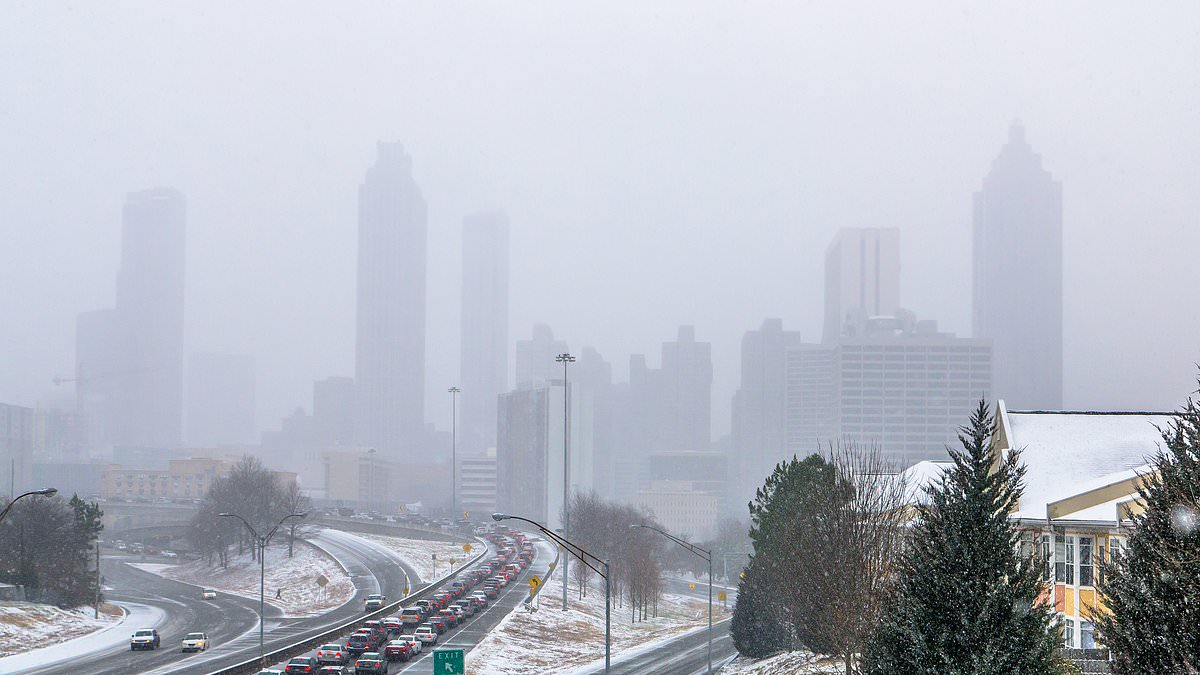
Atlanta, Georgia seen in the fog during winter (Stock Image)