
Share this @internewscast.com
Amidst ongoing turmoil at U.S. airports, a glimmer of hope emerges as President Donald Trump has authorized payments to Transportation Security Administration (TSA) workers, despite the persistent congressional stalemate.
TSA employees, who have not been paid in six weeks, are expected to receive their paychecks as soon as Monday. This development follows the president’s directive to the Secretary of Homeland Security to issue the payments, aiming to alleviate the crisis triggered by the department’s prolonged shutdown.
In a memo justifying the decision, Trump stated, “America’s air travel system has reached its breaking point. I have determined that these circumstances constitute an emergency situation compromising the Nation’s security.”
This move comes on the heels of House Republicans rejecting a Senate-approved bill that provided funding for the TSA, the U.S. Coast Guard, and the Federal Emergency Management Agency (FEMA), while excluding Immigration and Customs Enforcement (ICE) and Border Patrol.
The Department of Homeland Security’s shutdown, now stretching to 44 days, has left 61,000 employees without pay and caused significant travel disruptions across the nation.
Travel experts suggest that the disbursement of paychecks next week could signal the end of the chaos, potentially restoring normalcy to air travel operations in the coming days.
‘I suspect people will be showing up for work more consistently now, and these delays will come to a somewhat abrupt end,’ aviation expert Sheldon Jacobson told Time.
‘It may take a day or two for people to recalibrate themselves for work, but for the most part, I think, certainly by Tuesday or Wednesday, we should see a certain sense of normalcy around airport checkpoints.’

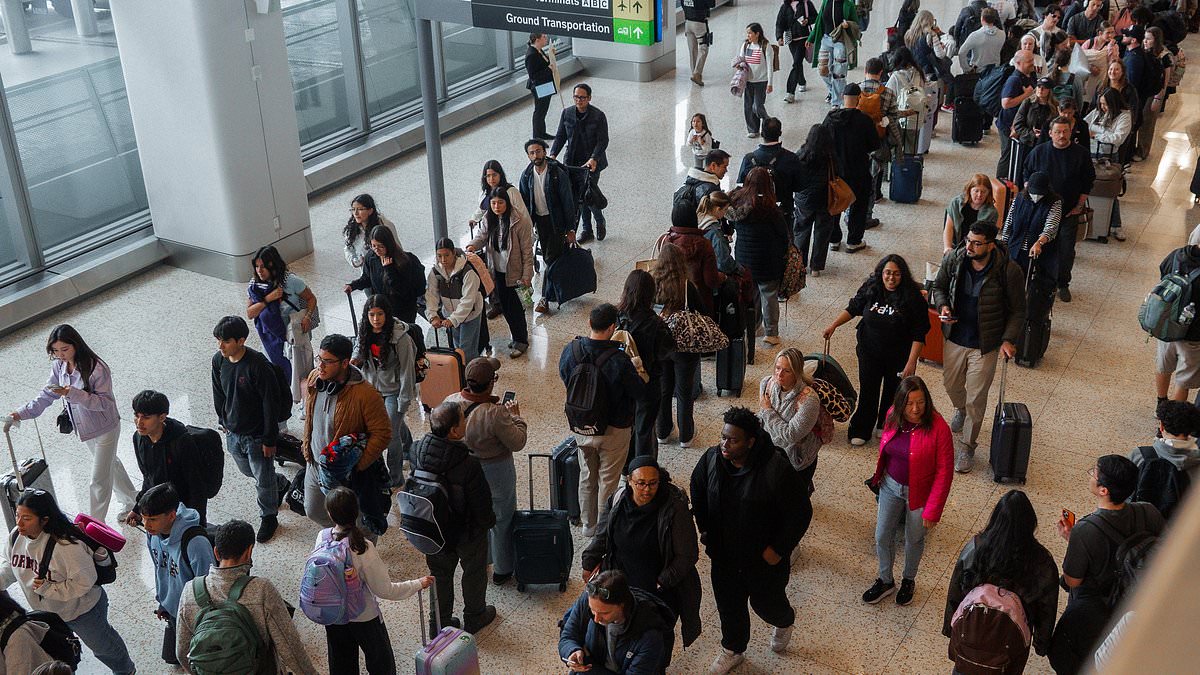
TSA staffing shortages during the shutdown have led to security lines stretching for hours at major US airports. Pictured, long lines at New York’s LaGuardia Terminal B is seen here

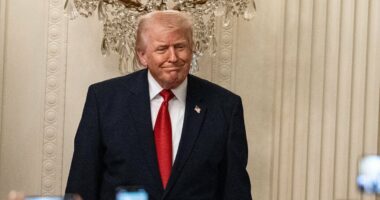
President Donald Trump signed an emergency executive order to ensure TSA workers are paid amid the ongoing Department of Homeland Security shutdown
The executive order does little to alleviate the shutdown, however, which is on track to eclipse the record 43-day shutdown last fall that affected all of the federal government.
The blowback from House Republicans to the Senate funding deal that passed early on Friday came quickly.
House Speaker Mike Johnson, upon opening the chamber for business, accused Democrats of playing a dangerous game and said he needed to talk with fellow Republicans about how to proceed.
After a lengthy conference call, Johnson blasted the Senate’s action and announced that the House would be going in a different route. ‘
This gambit that was done last night is a joke,’ Johnson said.
Johnson said House Republicans would instead seek to pass a bill that would fund the entire department until May 22.
He also said he had spoken with Trump about the House Republican plan and the president supported it.
House Republicans were livid that the bill passed by the Senate does not fund ICE and Border Patrol. Democrats refused to fund those departments without changes to immigration enforcement practices.

ICE has remained operational during the shutdown due to prior funding allocations, even as other DHS agencies face disruptions. Pictured, ICE agents patrol at Washington Reagan National Airport in Arlington, Virginia

Passengers stand in the TSA line after the Senate voted to end a partial government shutdown that has caused severe delays at airports across the country. Pictured, lines at Baltimore/Washington International Thurgood Marshall Airport in Baltimore, Maryland

Travelers reported waiting up to four hours at checkpoints as fewer TSA agents showed up to work without pay. Pictured, travelers wait in a long security line at Terminal B at LaGuardia
‘We’re going to do something different,’ Johnson said. He challenged the Senate to take up the House’s short-term fix to fund Homeland Security into May, assuming that bill does pass the House, which is uncertain.
But senators have left town after voting to fund most of DHS, so it would take time for them to return if the House ends up passing a different measure.
And even if they were to return, Senate Democratic leader Chuck Schumer made clear the House GOP plan would be ‘dead on arrival in the Senate, and Republicans know it.’
House Democratic leader Hakeem Jeffries said his party’s members are prepared to support the Senate bill.
‘This could end, and should end, today,’ Jeffries said. ‘There is a bipartisan bill that has been sent over from the Senate that would reopen the non-controversial parts of the Department of Homeland Security.’
Senators worked through the night to approve a bill by voice vote that would fund much of DHS.
Senate Republicans said they were disappointed by the lack of funding for ICE and Border Patrol, but noted that immigration enforcement has remained largely uninterrupted.
That is because the GOP’s big tax cuts bill that Trump signed into law last year funneled billions of dollars in extra funds to DHS, including $75 billion for ICE operations.

Travelers wait in line for security screening at Chicago O’Hare as hundreds of TSA agents quit or work without pay during a partial government shutdown

Passengers line up at Luis Munoz Marin International Airport in Carolina, Puerto Rico,
Conservative Republicans were adamant against establishing a precedent that allows Congress during the yearly appropriations process to fund some agencies within DHS, but not others.
‘We will fully fund ICE. That is what this fight is about,’ Sen. Eric Schmitt, R-Mo., said. ‘The border is closing. The next task is deportation.’
Democrats have refused to provide funding for ICE and the Border Patrol after the deaths of two Americans protesting the sweeping immigration crackdown in Minneapolis.
They want federal agents to wear identification, remove their face masks and refrain from conducting raids around schools, churches or other sensitive places.
Democrats have also pushed for an end of administrative warrants, insisting that judges sign off before agents search people’s homes or private spaces, something Markwayne Mullin, the new DHS secretary, said he is open to considering.
The rejection of the Senate deal creates a noticeable rift between Johnson and Senate Majority Leader John Thune, Republican-South Dakota, who have mostly worked in tandem this Congress trying to enact Trump’s agenda.
With all Democrats opposed, Thune had to find a solution to the funding impasse that would win the 60 votes needed to break a filibuster in the 53-47 Senate.
After more than a week of intense negotiations, some involving the White House, the two sides agreed early Friday to fund all parts of DHS except for ICE and parts of CBP.

An ICE agent assists TSA in screening passengers at a security checkpoint at O’Hare

ICE agents check IDs at the TSA security checkpoint at Atlanta Airport. Trump deployed ICE agents to US airports on Monday, with border czar Tom Homan in charge of the effort
It passed by voice vote with no objections from either side just after 2am.
Asked if he had cleared the compromise with Johnson, Thune said the two had texted.
‘I don’t know what the House will do,’ Thune said.
The White House was silent as senators reviewed the compromise and Trump did not weigh in publicly.
The next day, as the deal fell apart in the House, Thune did not respond to Johnson’s comments that he was left in the dark.
The speaker, asked about a rift with Thune, said Democrats in the Senate were to blame for the situation.
The DHS shutdown has resulted in travel delays and even warnings of airport closures as more TSA workers missing paychecks stopped going to work.
Multiple airports have been experiencing greater than 40 percent callout rates of TSA workers, and nearly 500 of the agency’s nearly 50,000 transportation security officers have quit during the shutdown.
Nationwide on Thursday, more than 11.8 percent of the TSA employees on the schedule missed work, according to DHS, equivalent to more than 3,450 callouts.