
Share this @internewscast.com
Investigators are currently examining whether the firetruck involved in a collision with an Air Canada aircraft was without a transponder, which would have prevented it from receiving a critical alert about runway hazards.
This development was shared by National Transportation Safety Board Chairperson Jennifer Homendy, amidst ongoing consequences from the crash. Passengers departing from New York’s LaGuardia Airport must still navigate past the visible wreckage.
According to Homendy, transponders would have allowed air traffic controllers to detect the presence of the firetruck and other emergency vehicles on the runway.
“Controllers should be equipped with all necessary tools to perform their duties,” Homendy stated during a press briefing.
She emphasized, “Whether dealing with aircraft or vehicles on taxiways, all movements should be visible to them.”
LaGuardia Airport is among 35 major airports in the United States equipped with an advanced surface surveillance system designed to minimize runway incursions and avert accidents.
Controllers in these airports have a display in the tower that’s supposed to show them the location of every plane and vehicle.
The system, known as ASDE-X, didn’t work as intended this time because the fire truck wasn’t outfitted with a transponder, Homendy said.

Investigators are looking into the possibility that the firetruck that collided with an Air Canada jet didn’t have a transponder, which would let the air traffic controller off the hook for the deadly collision

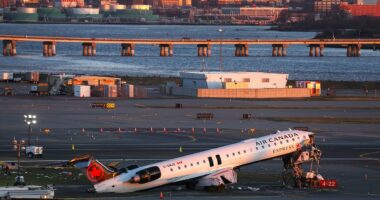
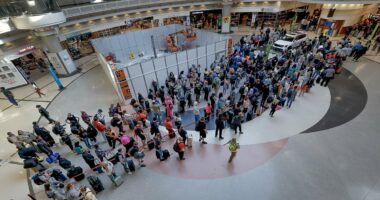
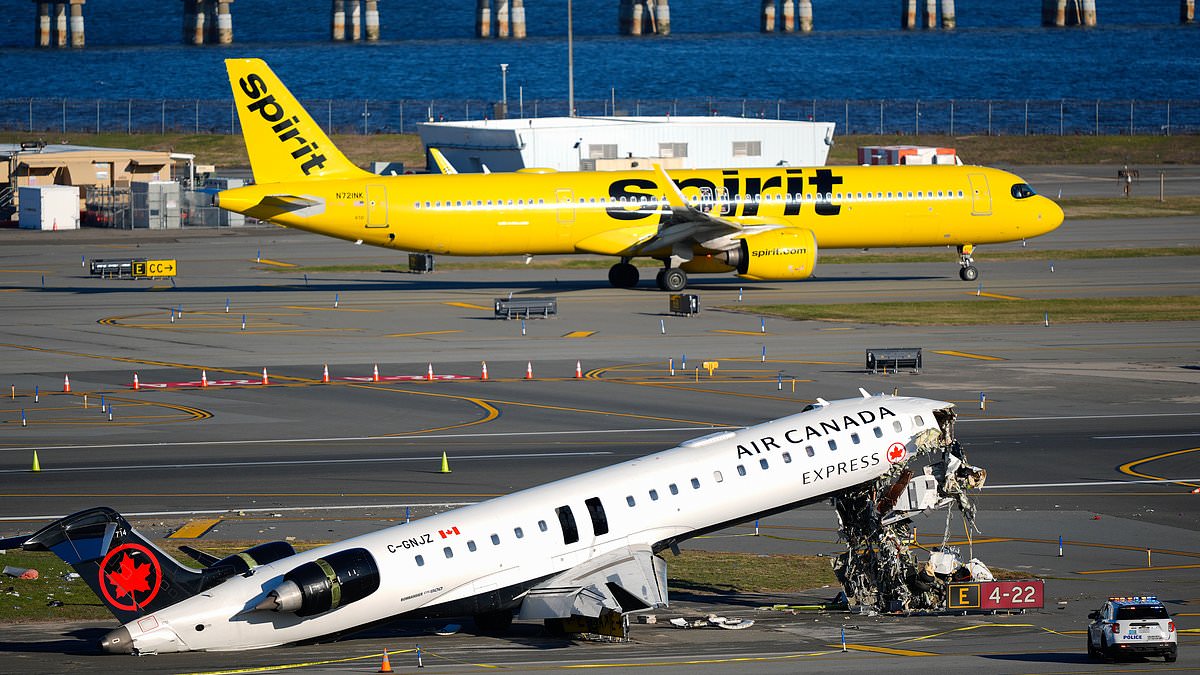
It comes as the fallout from the crash continues, with passengers flying out of New York’s LaGuardia Airport having to taxi past the still visible wreckage
The shocking development would mean the controller who sent a fire truck into the path of the Air Canada plane may not be solely to blame.
‘We rarely, if ever, investigate a major accident where it was one failure,’ Homendy told The Wall Street Journal.
‘Our aviation system is incredibly safe because there are multiple, multiple layers of defense built in to prevent an accident. So when something goes wrong, that means many, many things went wrong.’
Homendy added that its not clear yet whether the drivers of the firetruck actually heard the calls to stop before the collision.
More work is needed to determine whether an alert could have prevented the crash, she said.
The fire truck, which had been given permission to cross the runway to respond to an incident with the United plane, pulled onto the runway less than 20 seconds before impact, investigators said.
Just last May, the FAA urged airports that have advanced surface surveillance systems like LaGuardia’s to equip their vehicles with transponders.
While the NTSB hasn’t recommended that vehicles on airport grounds have transponders, they should be standard equipment, Homendy said.

National Transportation Safety Board Chairperson Jennifer Homendy (pictured) is now looking into the possibility that the controller who sent a fire truck into the path of the Air Canada plane may not be solely to blame

Terrified pilots have raised the alarm over LaGuardia’s problems with air traffic control and miscommunication long before a crash on its runway on Sunday claimed the lives of two people
‘Air traffic controllers should know what’s before them, whether it’s on airport surface or in the airspace. They should have that information to ensure safety,’ she said.
Asked about the lack of a transponder in the fire truck, the Port Authority of New York and New Jersey, which operates the airport, said it was ‘unable to comment due to the ongoing investigation.’
Other possible issues being probed include possible multi-tasking by night shift controllers.
‘The midnight shift, as a reminder, is one that we have many times at the NTSB raised concerns about with respect to fatigue,’ she said.
Meanwhile, Homendy noted there’s still a ‘tremendous amount of debris’ at the scene, meaning passengers taking off and landing at LaGuardia now have to stare the wreckage down.
The scene was expected to be cleared until the completion of the NTSB investigation.
‘At first I was just shocked at the proximity, it was right there. It’s shocking, you land and it’s the first thing you see when you’re on the tarmac,’ Sherrie Katanach, who flew in from Chicago, told The New York Post.
‘That was unbelievable to me,’ added Sherman Criner, who was returning from a longshoremen convention in New Orleans.

Pilots have previously flagged a number of close calls at LaGuardia – including one in October 2024 when two Delta aircraft collided on the runway (pictured), snapping a wing and injuring one person

An Air Canada Express CRJ-900 sits on the runway on Tuesday after colliding with a Port Authority fire truck at LaGuardia Airport in New York City late Sunday night
‘I figured they would get that off the runaway as quickly as possible, but from the plane you could see it still sitting there.’
It was revealed earlier Tuesday that the air traffic controller continued to work after the deadly crash, the NTSB revealed.
Homendy said that the unidentified controller was ‘still on duty for several minutes’ after the plane slammed into the truck late Sunday night.
‘Normally they would be relieved,’ Homendy said during a press briefing. ‘We have questions about that. Was anybody available to relieve that controller? We don’t know that yet.’
Investigators are working to determine what happened during shift change, who else was in the air traffic control tower and who was available at the time of the crash.
Officials have questions about the role of the air traffic controllers and whether they were distracted while juggling a late night emergency with another plane.
The Air Canada plane carrying 72 passengers and four crew collided with the fire truck while landing, killing the two pilots and injuring several passengers.
Federal investigators said a runway warning system didn’t trigger an alarm before the jet and truck collided at the New York City airport.

Antoine Forest, 30, was killed upon impact when the Air Canada flight he was flying from Montreal collided with a fire truck at LaGuardia International Airport on Sunday night

The fire truck was completely destroyed by the wreck, but both firefighters were expected to survive
The collision late Sunday came after the fire truck was given permission to check on a United plane that had aborted its takeoff after reporting an odor on board and started crossing the runway.
An air traffic controller can be heard on airport communications frantically telling the fire truck to stop on realizing disaster was imminent.
Roughly 20 minutes later, the controller appears to blame himself. ‘We were dealing with an emergency earlier,’ the controller said. ‘I messed up.’
Many questions remain about why the airport fire truck was crossing the runway while the plane was landing and why it didn’t stop despite frantic, last-second warnings from the control tower.
Homendy said NTSB investigators have not yet had a chance to review data from the flight data recorder, but that she has seen surveillance video and still needs to interview the firefighters in the truck to find out whether they braked or turned to avoid a collision.
The wreckage from the crash remained on the closed runway, which is likely to stay shut down for days during the investigation, Homendy added.
Investigators need to sift through a lot of debris, she said.
Authorities recovered the plane’s cockpit and flight data recorders by cutting a hole in the aircraft’s roof and then drove them to the NTSB lab in Washington for analysis, Homendy said.
About 40 passengers and crew members on the regional jet from Montreal, and two people from the fire truck, were taken to hospitals.
Some suffered serious injuries, but by Monday morning, most had been released, and others walked away without needing treatment.
The pilot and copilot who died in the first fatal crash at LaGuardia in 34 years were both based out of Canada, said Kathryn Garcia, executive director of the Port Authority of New York and New Jersey, which operates the airport.
Jeannette Gagnier, the great aunt of one of the pilots, identified him as Antoine Forest, and said he always wanted to be a pilot.
The crash on Sunday night is not the first dangerous incident at LaGuardia in recent history, with air traffic controllers and pilots alike claiming the airport is plagued by miscommunications and staffing issues.
A CNN review of government records revealed a number of close calls and near disasters have been reported to NASA’s Aviation Safety Reporting System by concerned pilots.
This included just months ago in October, when two Delta Airlines jets collided on the taxiway, hospitalizing one person as the wing of one of the aircrafts was snapped off.
Previous incidents flagged in the system also include a December 2024 close call, where a plane came perilously close to smashing into another aircraft on the ground, blaming inaccurate instructions from air traffic control.
Sunday night’s crash bears eerie similarities to that incident and happened when an air traffic controller told a fire truck to cross a runway to inspect a United aircraft experiencing technical difficulties.
Moments later the unidentified air traffic controller begged the truck to stop, but it was too late and the vehicle collided with the Air Canada plane.
Months before that in July 2023, a pilot reported to the NASA system that two aircraft almost collided after air traffic controllers said one was cleared to cross a runway that another jet was landing on.
The report said air traffic controllers only realized their mistake at the last second, noting that it ‘issued a stop command just in time.’
The deadly crash on Sunday night shut down LaGuardia – the New York region’s third busiest hub – during what was already a chaotic time at US airports because of a partial government shutdown.
Flights resumed Monday afternoon on one runway and with lengthy delays. The shutdown caused some disruptions at other airports, too, especially for Delta, which has a major presence at LaGuardia.
Air traffic controllers are not impacted by the partial government shutdown that has caused long delays at airport security checkpoints in recent days. They have been affected by past shutdowns.
The FAA has been chronically short on air traffic controllers for years.