
Share this @internewscast.com
Providing homeless young adults with up to $15,800 in cash, free of any conditions or spending guidance, might initially seem like an unusual way to allocate taxpayer resources.
Yet, this is precisely the approach being adopted by New York City through a new and somewhat contentious initiative known as Cash with Care, which seeks to help young people transition permanently out of shelters.
This pilot program offers 60 homeless individuals, aged 18 to 24, a monthly stipend of $1,200 for nine months, along with a one-time payment of $5,000, culminating in a potential total of $15,800 per recipient, all without any spending limitations.
Since its approval by the City Council in December, the $1.5 million initiative has sparked debate, drawing skeptical reactions from both taxpayers and critics in City Hall, as well as from leaders at the shelter housing these young adults.
Covenant House, the city’s largest service provider for homeless youth, operates out of an impressive facility featuring amenities like a professional recording studio, an NBA-sponsored basketball court, and a well-stocked wardrobe offering free clothing.
Many of the program’s beneficiaries have fled perilous home situations, faced familial rejection, or been victims of sex trafficking.
City council member Frank Morano told the Daily Mail that while youth homelessness was ‘a real and heartbreaking problem,’ he was skeptical of the handouts and questioned whether unrestricted cash was the answer.
‘New Yorkers deserve to know exactly what outcomes we are getting for that money,’ Morano said, pointing to housing stability, education, and long-term independence as ways to measure success.

Young adults enrolled in a New York City pilot, which gives the homeless cash to help move them out of shelters, told the Daily Mail how the handouts have been changing their lives

Recipients live in a facility called Covenant House, where Republic Records donated and installed a professional-grade music studio for youth pursuing creative paths

The site includes a huge closet provides free, professional and everyday clothing so young people can dress for work, school and daily life without added financial strain

The closet is full of donated items so the youths can pick a new outfit for free
Taxpayers agreed, in a Reddit thread last month, they expressed their concerns with one writing: ‘I’d like to keep my tax money on useful things instead, thanks!
‘I would say taxes are for roads and public works and national defense. This is something you can privately opt into if you believe in [it] or opt out of if you don’t. You think it’s useful you should feel free to support it – I am skeptical of its utility so I prefer to stay out of it and direct my philanthropy elsewhere.’
Another added: ‘Guaranteed Income Program is a social construct. It may or may not work.
‘You can argue that having a guaranteed income will make people unmotivated to work and others who have to struggle, see their hard-earned money going to the lazy.’
Speaking to the Daily Mail during an exclusive tour of the facility, the Covenant House New York CEO admitted she was not immediately convinced when the free cash was first floated but has since changed her mind.
‘”You’re going to give kids this influx of cash and not give them any kind of guidance?”‘ Shakeema North-Albert recalled thinking, as she worried about how young people with limited financial experience would manage the handouts.
She said similar programs in other parts of the country had raised concerns after some participants spent impulsively or diverted funds to family and friends before stabilizing their own housing.
But what ultimately shifted her view was that the initiative gives young people support alongside the cash, from financial coaching and education support to mental health services, in the hope it will help them secure more permanent housing sooner, build food security and clear debt.

Covenant House New York chief executive Shakeema North-Albert said she was initially skeptical of giving young people unrestricted cash

North-Albert speaking with Daily Mail reporter Alexa Cimino this week
Lyndell Pittman, Covenant House’s senior vice president of support services, said his initial reaction to the proposal was even blunter.
‘When we first got this, I was not a believer,’ Pittman told the Daily Mail. ‘I was like, “This doesn’t make sense. We’re just gonna give these kids this money, and how are we going to protect them from themselves?”‘
Pittman was most concerned that the free funds did not ’cause any harm.’
Both leaders said that as the program unfolded, their views shifted, with early indications that participants were spending cautiously and, in some cases, barely touching the money at all.
Although the payments have only been rolled out for the past two months, Pittman said roughly 40 percent of participants had ‘barely spent any money since the start’ – a detail that challenged assumptions that young people would quickly blow through the funds. He said the behavior could reflect either smart saving or fear.
‘Because they’ve never had this type of money, there’s a fear in spending it,’ he said, comparing it to the shock of being ‘trusted’ with a first credit card.
North-Albert believes that, in the long term, this will be a cost-saving measure. She noted that keeping a young person in shelter for a year can cost the city roughly $70,000, compared with $15,800 in direct cash support under Cash with Care, arguing that even modest reductions in shelter stays could significantly shift the financial equation.
The Daily Mail spoke to young people enrolled in the program, whose identities are kept anonymous, about how they were using the cash.

Pam Sandonato, who works in communications at Covenant House, gave the Daily Mail a tour

Lyndell Pittman, Covenant House’s senior vice-president of support services, admitted he was ‘not a believer’ at first, raising concerns about what harm the free money could cause
A 20-year-old musician said that before he received his first payment, he had no income, but now he was juggling jobs and working toward his GED. He talked about his future with striking certainty.
‘I’m planning on going to Juilliard soon,’ he said – not if, but when.
The pianist, who also plays viola and clarinet, sings, raps, performs at events, and teaches lessons, said the monthly payments allowed him to invest directly in his craft, covering music supplies and one-on-one training.
‘I’ve saved most of it – a good 95 percent,’ he said, explaining that he is setting the money aside for college and future expenses.
Above all else, the cash has afforded him time to plan and get work rather than scrambling to survive.
Another participant, 20, is learning what it means to manage money for the first time – and how to invest in himself.
He has been using the payments to experiment with photography, shooting on his iPhone and teaching himself to edit using built-in apps. It is a starting point, but one that is already helping him build skills and confidence.
He described the income as both practical support and a lesson in responsibility.

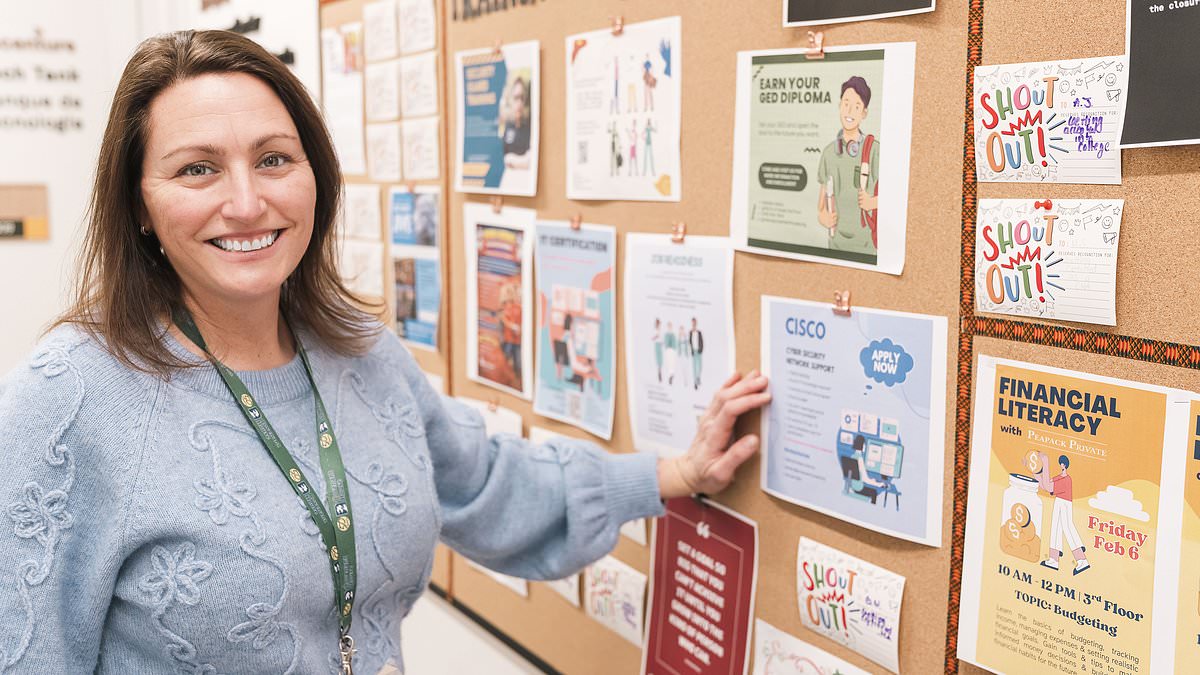
A job board lists employment training opportunities for Covenant House youth

Covenant House served 1,256 young people in 2025, offering them support to find their own housing and become financially independent
‘It feels good, but I know that it’s supposed to teach me about financial responsibilities, on how to save money, how to budget with money,’ he said. ‘I know I can’t be reckless and spend all of it.’
The money helps cover food outside the shelter, transportation, monthly bills, his phone plan, extra storage for his photos – and the occasional treat.
‘It’s good to treat yourself, but… don’t overly spend,’ he said. ‘There has to be a limit.’
A 19-year-old man who had landed at Covenant House in June with no plan beyond finding somewhere safe to sleep had just moved into a Brooklyn apartment with another facility resident when he started getting the monthly payments.
The money is now helping pay for the basics, such as the $3 subway fare, which he no longer has to worry about affording.
However, he did make one small spontaneous purchase as a treat – a pack of Pokemon cards, but he is hoping they are an investment and he may later trade them at a higher price.
Nearly 154,000 young people experienced homelessness in New York City between 2024 and last year, according to the Citizens’ Committee for Children of New York.
North-Albert said organizers opted for a lottery to choose who would take part in the pilot, ‘for the sake of fairness and equity,’ noting that participants still had to meet eligibility requirements.

One the first floor of the facility is a space dedicated to art and creative pursuits

A salaried worker serving food to the youth in the kitchen at the home

The computer room at Covenant House ensures youths have access to workstations to be able to apply for jobs

The first floor houses the welcome center and a health and wellness center

Daily Mail Reporter Alexa Cimino received an exclusive tour of Covenant House
The random selection has also allowed Chapin Hall to create a control group of 60 Covenant House youth who qualified but were not chosen.
Researchers will track housing stability, food security, debt, employment, and education, comparing outcomes between those who received payments and those who did not.
Covenant House is a state‑of‑the‑art hub, with each floor dedicated to a different part of a young person’s journey to securing their own home.
Thanks to major corporate donors – including Cisco, Madison Square Garden’s Garden of Dreams Foundation, and Take‑Two Interactive CEO Strauss Zelnick – the new facility looks nothing like a traditional homeless shelter.
Over four floors, there is a health and wellness center, the CovCafe, a space for art and hands‑on creative work, a computer room, mental health services, and classrooms such as the Discovery Center to support career and educational development.
Below ground, the sub‑cellar features the CovDome gym, where the NBA and NBPA funded a full basketball court, along with Covenant’s clothing room, which looks like a huge closet and gives out free clothes, and a professional‑grade music studio.
Covenant House served 1,256 young people last year.