
Share this @internewscast.com
Queen Mary and King Frederik of Denmark have embarked on a whirlwind six-day journey, commencing with a visit to one of Australia’s most renowned landmarks.
Upon their arrival in Perth on Friday, the royal couple made their way to the Northern Territory on Saturday, marking their first public appearance at the iconic Uluru.
Queen Mary, originally from Australia, was seen in a stylish ensemble that included a beige long skirt, a vibrant blouse, and comfortable flats, waving to the press as she disembarked at Ayers Rock Airport.
On the tarmac, they were warmly welcomed by NT Police Southern Commander James Gray-Spence and the newly appointed NT Administrator, David Connolly.
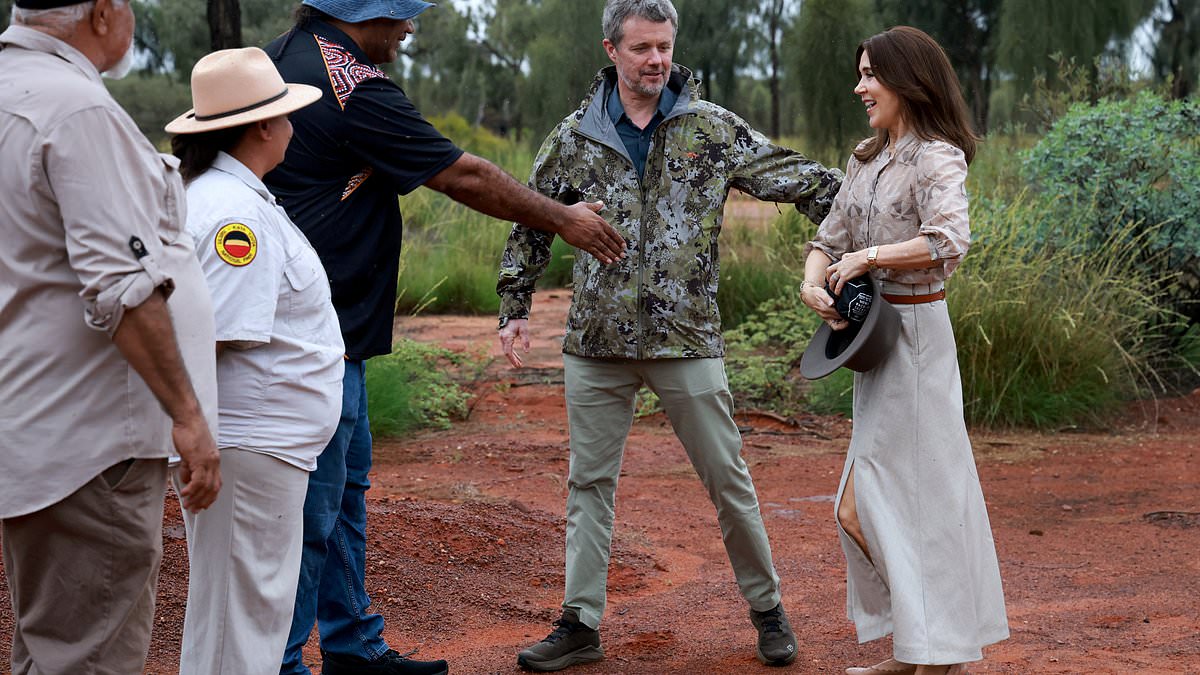
Later, Queen Mary donned an Akubra hat as the royal duo were introduced to local guides.
Their afternoon commenced with a tour of the Uluṟu-Kata Tjuṯa National Park Cultural Centre, where they engaged with Indigenous elders and the park’s traditional landowners.
They also enjoyed a traditional song and dance ceremony, where King Frederik was seen helping his wife put on a waterproof jacket when it began to rain.
The Danish royals will later watch the stunning sunset at Uluru.

Queen Mary and King Frederik X of Denmark were all smiles when they arrived in Uluru

Australian-born Queen Mary was seen waving to the awaiting media as she stepped off the plane at Ayers Rock Airport on Saturday afternoon

The Danish royals enjoyed a traditional song and dance ceremony at the Uluru-Kata Tjuta National Park Cultural Centre
The Uluru visit is reminiscent of the 1983 British royal tour, when the late Princess Diana and then Prince Charles, now King, visited the culturally significant monument.
The historic tour marks Mary’s first return to her homeland since she became Queen in January 2024, the first by any Danish monarch in 40 years.
The couple will travel to Canberra on Sunday, where they will be welcomed at Government House by Governor-General Sam Mostyn, Prime Minister Anthony Albanese and his wife Jodie Haydon.
Ms Mostyn will host a formal state dinner for the royals.
The Danish royal couple will visit Parliament House, where they will receive a ceremonial 21-gun salute.
There will be an opportunity for the public to see the Danish royals at Canberra’s Australian War Memorial on Monday morning.
The tour will also take them to Melbourne, where they will attend a state banquet and events highlighting Denmark-Australia relations.
They will then travel to Queen Mary’s home state of Tasmania , where she will visit her old school in Hobart and other hometown sites, where she still has family, including her elderly father John Donaldson.

King Frederik helped his wife put on a waterproof jacket when it began raining during the ceremony

They began the afternoon with a tour of Uluṟu-Kata Tjuṯa National Park Cultural Centre, which included a traditional ceremony

The couple chatted with local guides at the iconic Aussie landmark
The last time the royals visited Australia officially was 13 years ago, making this their fourth tour together.
More than 50 Danish business leaders will accompany the royal couple on their Australian tour.
The Danish royals are promoting industry and trade ties during their visit, highlighting clean energy and urban development.
As the royals touched down in Perth, their official Instagram page shared photos of the couple early in their relationship, which began after they met during the 2000 Olympics in Sydney.
‘On the way! We have been greatly looking forward to seeing Australia and the people of the whole country again,’ the post, accompanied by iconic Aussie anthem Down Under from Men At Work, read.
‘A lot has happened since we last met here more than 25 years ago!’

Queen Mary needed a fan in the humid conditions

It’s Queen Mary’s first return to her homeland since she became Queen in January 2024, the first by any Danish monarch in 40 years.

The couple’s visit is reminiscent of the 1983 British royal tour, when the late Princess Diana and then Prince Charles, now King, visited Uluru

The Danish royals were greeted by local guides on the first stop of their six-day tour
The couple met in Sydney during the 2000 Olympics, striking up a friendship at the CBD bar The Slip Inn.
They married in 2004 and have made several official and private visits to Australia since.
Previous visits have involved introducing their children – Christian, 20, Isabella, 18, and 15-year-old twins Vincent and Josephine, to Australia.