
Share this @internewscast.com

BUDAPEST – As the European Union seeks to completely eliminate its dependency on Russian energy and the U.S. government under President Donald Trump calls for NATO members to forsake Russian oil, one nation’s populist leadership remains unmoved.
Hungary, led by Prime Minister Viktor Orbán, has consistently asserted that Russian energy imports are crucial for the country’s economic stability. The transition to fossil fuels from other sources, they argue, would lead to an immediate economic downturn.
Orbán, who has maintained the closest relationship with the Kremlin among EU leaders, staunchly resisted the alliance’s initiatives to sanction Moscow following its incursion into Ukraine in February 2022. He criticized efforts aimed at undermining Russia’s energy earnings, which are crucial to funding the conflict.
While the rest of Europe has managed to move away from Russian energy, Hungary has not only retained but actually increased its Russian imports, arguing there is no feasible alternative.
Nonetheless, some energy specialists—and critics of Orbán, who perceive his allegiance to Russian energy as evidence of his favorable stance towards President Vladimir Putin—contend that Orbán’s stance is driven more by political motives than practical ones.
Orbán warns economy would be ‘on its knees’
Hungary’s government claims that its central European landlocked position makes it reliant on Russian fossil fuels transported through pipelines constructed during Soviet domination.
With no alternative sources and infrastructure to bring oil and gas to Hungary, officials say, the country’s economy would cease to function without Russian supplies.
“If Hungary is cut off from Russian oil and natural gas, then immediately, within a minute, Hungarian economic performance will drop by 4%,” Orbán told state radio in September. “This would be catastrophic, the Hungarian economy would be on its knees.”
But László Miklós, a chemical engineer and energy industry analyst, told The Associated Press there was “no rational explanation” for Orbán’s government’s reluctance to seek alternative fuel sources and ample infrastructure is already in place to supply Hungary with affordable, non-Russian oil and gas.
“Disconnection from Russian energy in an integrated European market should not be a problem, all conditions are there. It’s the intention that is missing,” Miklós said.
Cutting off Russian imports
EU countries moved quickly to slash their imports of Russian oil and gas after Russia invaded Ukraine, instituting an embargo on Russian oil in 2022 and, this year, announcing a proposal to gradually stop the import of all Russian gas and oil into the bloc by the end of 2027.
Yet as the EU sought to deprive Putin of revenue that helps fuel the war, it also granted a temporary exemption for supplies delivered by pipeline to three landlocked countries: the Czech Republic, Hungary and Slovakia.
That carve out, Miklós said, has allowed the Hungarian government and the national oil and gas conglomerate MOL to take in major windfall profits and deliver billions of dollars to Russia’s budget.
“People think that Hungary purchases Russian energy for economic benefit. This is wrong,” said Miklós, who previously served as MOL’s director of corporate relations. “Hungary buys Russian energy because the Hungarian government wants to help Russia arm itself … MOL and the Hungarian government’s significant profits are a side effect of that.”
Transitioning to a western route
The EU’s push to cut Russia off from energy revenues has sparked fury from Hungary’s leaders, who portray the steps as misguided and ideologically motivated.
“It is quite astonishing that the leaders of European countries … are unable to see that each country’s geographical location determines where it can purchase energy sources,” Hungarian Foreign Minister Péter Szijjártó said in a September social media post. “We can dream about buying gas and oil from places that are not connected by pipelines, but we cannot heat our homes, boil water or run factories with dreams.”
Despite insistence that a lack of infrastructure precludes a transition to non-Russian energy sources, other countries in the region, similarly landlocked, have brought Russian oil first to a trickle, then to a stop.
Earlier this year, leaders of the Czech Republic, which previously received about half its oil from Russia via the Druzhba pipeline, celebrated the country’s “oil independence day” after doubling the capacity of an Italian pipeline, the last infrastructural development necessary to end Russian oil imports.
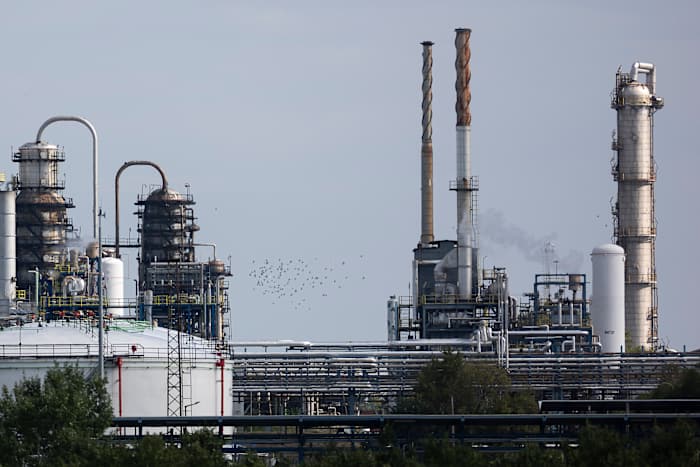
Hungary, which currently receives the vast majority of its crude from Russia via the Druzhba pipeline, already has a second pipeline in place: the Adria, which runs from Croatia’s Adriatic Sea.
MOL says it requires around 14 million tons (12.7 million metric tons) of crude per year, but recent tests on the Adria pipeline showed it is incapable of reliably delivering such a quantity.
The Croatian oil transport company Janaf disputes that claim, saying it is prepared to cover both Hungary and neighboring Slovakia’s total annual demands for crude oil.
Miklós said even if Adria were incapable of providing for all of Hungary’s oil needs, it can still play a major role in decreasing imports from Russia.
“It is possible to bring oil from elsewhere, the Adria pipeline has been available for several decades,” he said. “If what they say is true and they need 14 to 15 million tons (per year), it would still be logical to take 10 million tons from the Adria and bring the rest on Druzhba.”
The cost of finding alternatives
Hungary’s government has portrayed EU efforts to cease Russian energy imports as an existential threat to a popular, government-backed household utility reduction program. In May, Orbán claimed in a video that household electricity bills would double and gas bills would nearly triple if Russian supplies were eliminated.
Yet according to Borbála Takácsné Tóth, a gas industry research analyst, the price Hungary pays for Russian gas is based on European benchmark prices and is not substantially cheaper than what other countries pay for non-Russian gas.
Tóth, who works at the Regional Centre for Energy Policy Research, an independent institute affiliated with Corvinus University of Budapest, said her group’s modeling shows breaking with Russian gas would likely cause “a temporary increase of 1.5 to 2 euros per megawatt hour,” a price hike she called “minimal, below 5%.”
Despite the rhetorical commitment to Russian energy from Hungary’s politicians, national energy company MOL has undertaken investments in recent years to diversify its supplies and outfit its refineries in Hungary and Slovakia to process non-Russian crude.
The company said in an email that due to a multiyear, $500 million investment, “we will be (in) a much better position to have a more diverse crude oil sourcing capability” by the end of 2026.
Miklós said that despite the Hungarian government’s determination to continue purchasing Russian energy, EU regulations will soon bring that to an end.
“Things will clearly never be the same again, because the European Union has learned that, to put it simply, Russia cannot be trusted,” he said. “It is a matter of political will to break away from Russian energy sources. There is a small price to pay for this, which every other European country is paying.”
Copyright 2025 The Associated Press. All rights reserved. This material may not be published, broadcast, rewritten or redistributed without permission.