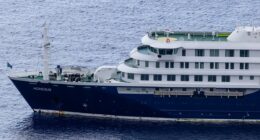

The Centers for Disease Control and Prevention (CDC) has raised an alert after a hantavirus outbreak aboard a cruise ship resulted in three fatalities and infected at least seven more individuals.
In an official statement, the CDC emphasized, “We are closely monitoring the situation involving US travelers on the M/V Hondius cruise ship, where hantavirus cases have been confirmed. Our primary focus remains the health and safety of all US passengers.”
The State Department is spearheading a comprehensive response, coordinating efforts across various government sectors. This includes maintaining direct communication with passengers, engaging with international and domestic health authorities, and fostering diplomatic cooperation.
Concerns are mounting over a potential broader outbreak, as passengers who disembarked from the M/V Hondius have traveled back to various countries, including the United States.
In the US, returning passengers are currently under observation in Georgia, California, and Arizona.
The CDC further stated, “As a global leader in health security, the United States is leveraging its top health experts to manage and guide the response to this developing situation.”
‘We are working closely with our international partners to provide technical assistance and guidance to mitigate risk.’
For Americans, the CDC said, the current risk is low, but the agency is urging those on the cruise ‘to follow the guidance of health officials as we work to bring you home safely.’
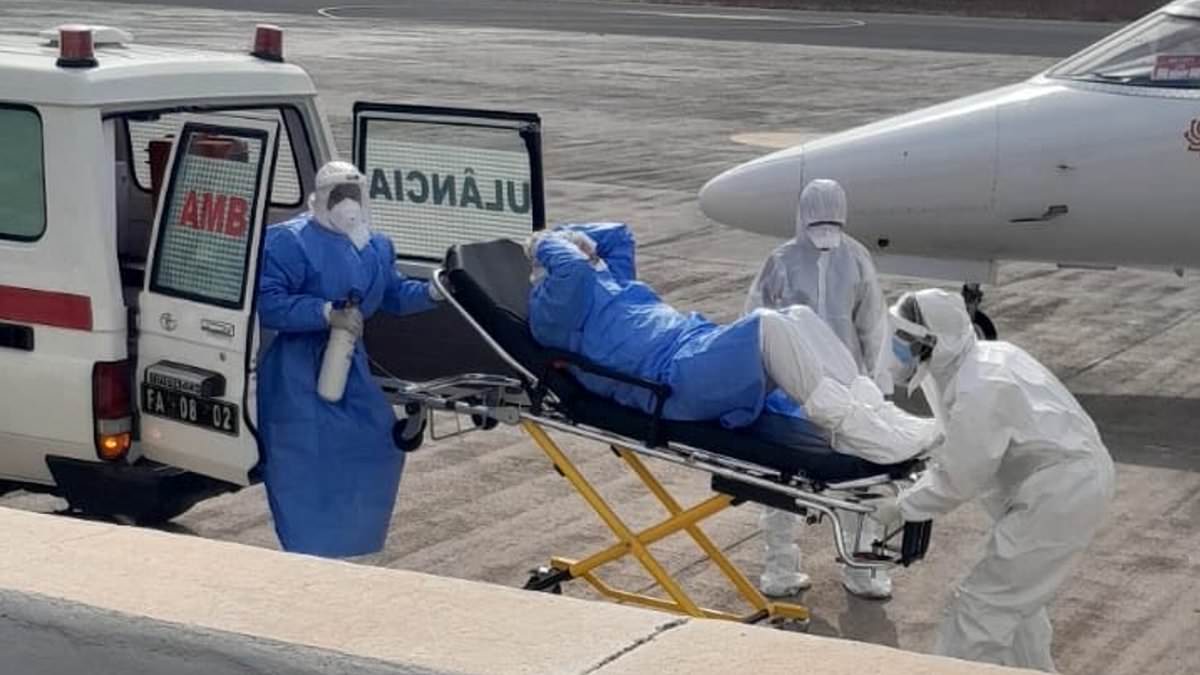
Health workers are seen evacuating a patient from the cruise ship M/V Hondius, which is experiencing a hantavirus outbreak
On Tuesday, three patients were flown to Europe for treatment. A fourth passenger, who was also infected, remains in South Africa in a critical condition.
Argentine officials have noted that a Dutch couple who boarded the M/V Hondius had visited a landfill site to take pictures of birds in the city of Ushuaia, Argentina, which may have exposed them to rodents carrying hantavirus.
Hantavirus is typically spread via breathing in dust from the droppings of infected rodents, which may be disturbed during sweeping or cleaning.
But the World Health Organization (WHO) has warned about the possibility of rare human-to-human transmission of the virus taking place on the ship.
The hantavirus strain behind the outbreak is the Andes strain – which has been linked to previous outbreaks where the virus has spread between people.
‘Out of all the hantaviruses we know about, only one (the Andes virus) has ever been proven to spread from person to person,’ Dr Zaid Fadul, a physician and CEO of Bespoke Concierge MD, told the Daily Mail.
‘Every other hantavirus strain stays in its rodent host and only jumps to humans when we breathe in aerosolized particles from their droppings, urine, or saliva. Andes virus is the exception.’
Fadul explains human-to-human spread of the Andes strain can occur when someone is in the ‘prodromal’ phase of illness, which means they have early symptoms like fever, muscle aches and fatigue.

Because the vessel is sailing under the Dutch flag, the Netherlands is coordinating consular assistance for passengers, including those with other nationalities
‘During this window, the virus is actively replicating in their lungs and salivary glands, and it can be spread through respiratory droplets, saliva and close contact,’ he said.
‘What’s genuinely surprising is that viral shedding begins up to two weeks before a person feels any symptoms at all. That pre-symptomatic window is part of why this virus is so hard to contain.’
Since the outbreak, the WHO is attempting to locate at least 69 people who may have come into contact with the 69-year-old Dutch woman, who boarded two flights before she died of the virus on April 26 in South Africa.
In person-to-person transmission of hantavirus, people must be in close contact with someone infected in order to contract it.
Close contact is considered having prolonged, repeated exposure to a person’s respiratory droplets or saliva.
‘Hantavirus exists in rodent saliva, so there could be transmission via saliva and droplets. For people, that would include coughing, kissing, or prolonged close person to person contact,’ Dr Carrie Horn, chief medical officer at National Jewish Health in Colorado, told the Daily Mail.
On cruise ships, that could be tight accommodations, crowded pool and deck areas, as well as busy restaurants and bars.
Close contact could also include planes and being in close quarters with someone while traveling on an aircraft.
Buffets are common on cruise ships with shared utensils and potentially contaminated surfaces that many passengers touch at once, raising the risk of illness.
‘If you touch something that’s contaminated with the virus and then you touch your face or your nose, you could become infected that way,’ Dr Nicole Lovine, chief epidemiologist and an infectious disease expert at the University of Florida Health Shands Hospital, told the Daily Mail.
‘Or it could be that you’re breathing air that contains the virus, and that makes it pretty difficult when there’s a organism that is spread in the air.’
Dr Maximo Brito, infectious diseases specialist at the University of Illinois and vice president of the Infectious Diseases Society of America, added: ‘If there’s a disease such as this that has an ineffective mode of transmission – person-to-person – if we’re ever going to see a transmission, it’s going to be in environments like this, where there’s close quarters.’