
Share this @internewscast.com
Amid the repercussions from the expenses scandal and the Bondi incident, the Labor Party maintains a 54-46 advantage according to the latest Resolve survey, although Anthony Albanese’s popularity has taken a hit.
Following the Bondi attacks, a targeted national survey held from December 17 to 20, with 1,010 participants, showed Labor leading 54-46 based on respondent preferences, reflecting a one-point improvement for the Coalition compared to the early December Resolve poll.
In the primary vote breakdown published by Nine newspapers, Labor stands at 32 percent (a decrease of three points), the Coalition at 28 percent (up by two points), One Nation at 16 percent (an increase of two points), the Greens at 12 percent (up by one point), independents at 8 percent (unchanged), and others at 4 percent (a drop of two points).
Albanese’s net approval rating plunged by 15 points to -9, marking his lowest level in this poll since the May election, with 49 percent rating him poorly and 40 percent positively. Sussan Ley also saw her net approval decrease by seven points to -4.
Reports concerning the expenses scandal surfaced the week preceding the Bondi attacks, and a Morgan poll indicated a decline for Labor associated with this issue.
It’s uncertain whether the expenses scandal, the Bondi events, or a combination of both contributed to the impact on Albanese and Labor.
By 46–29, respondents in Resolve thought the federal government’s response to Bondi was weak rather than strong. By 37–30, they thought social cohesion was good rather than poor.
By 72–9, respondents thought there had been a rise in racism in Australia as a result of the Israel-Gaza conflict. By 55–13, they thought there had been more antisemitism than Islamophobia in recent months.

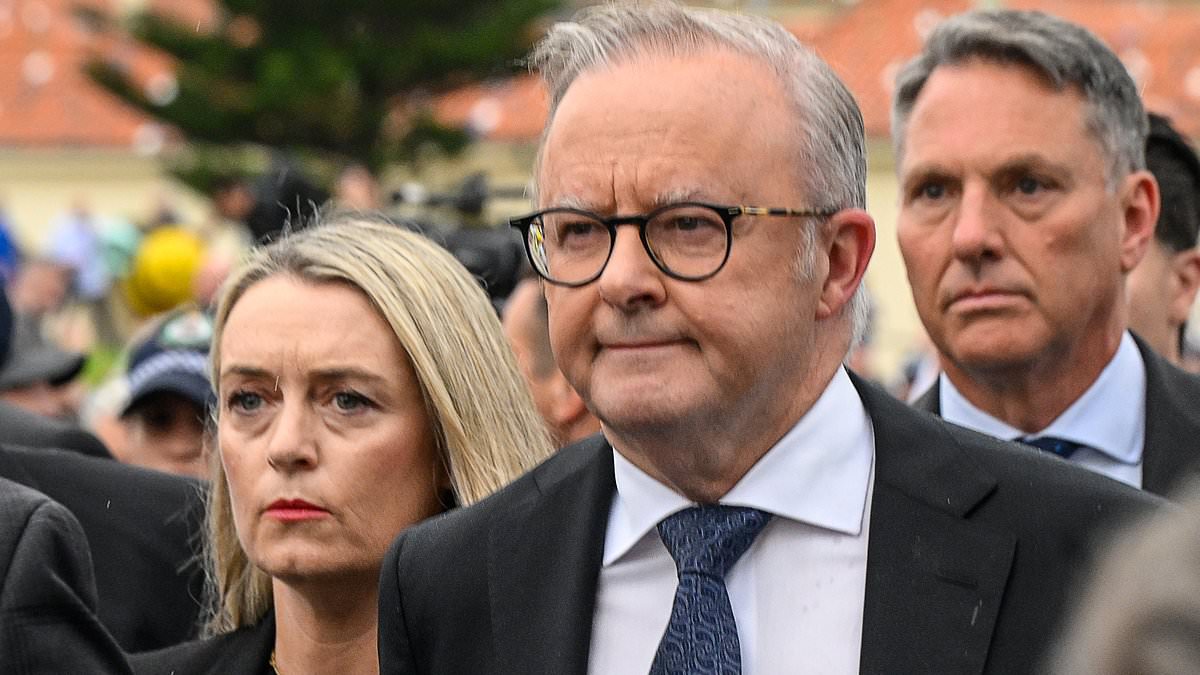
Prime Minister Anthony Albanese (pictured with wife Jodie Haydon) has suffered a 15 point net approval drop since the terror attack at Bondi Beach
On gun laws, 76 per cent wanted them to be toughened, 10 per cent kept as they are and just 6 per cent thought they should be relaxed. Four of five proposals for toughening gun laws had over 80 per cent support, with ‘restrict gun licences to Australian citizens’ the exception at 72 per cent support.
Asked to pick two priorities for the government, 49 per cent selected preventing terrorism, 45 per cent tackling crime generally, 35 per cent restricting access to guns, 33 per cent preventing extremism, 29 per cent tackling antisemitism and 26 per cent tackling hate speech.
By 66–9, respondents thought Australia needs stronger laws to ban hate speech on the basis of religion and faith. The most popular proposal for tackling antisemitism was tougher immigration screening to identify antisemitic views (76–7 support).
Holding a Royal Commission was at 48–17 support.
In the small New South Wales subsample of around 300 voters, Labor Premier Chris Minns’ net likeability jumped eight points since November to +22.
Morgan released its November 17 to December 14 national poll. For the last week, December 8–14 with a one-week sample of 1,574, Labor’s lead dropped to 54.5–45.5 by respondent preferences, a 1.5-point gain for the Coalition from weeks 1–3.
Primary votes were 30.5 per cent Labor (down 2.5), 27.5 per cent Coalition (up 1.5), 17 per cent One Nation (up two), 13 per cent Greens (down 0.5) and 12 per cent for all Others (down 0.5).
By 2025 election preference flows, Labor would have led by about 53–47, the lowest Labor lead by this measure of any poll since the last election. A Redbridge poll suggested Labor had not been damaged by the expenses claims, but this contradicts that. Those interviews were conducted before the Bondi attacks.

A special national Resolve poll surveyed 1,010 voters after the Bondi attacks between December 17 and December 20 (pictured, the Bondi memorial)
The Australian released aggregate data for the three national Newspolls conducted between September 29 and November 20 on December 26.
The total sample size was 3,774, with Labor holding an overall 57–43 lead.
These polls were taken before the expenses scandal and Bondi.
Labor led by 58–42 in NSW, (a two-point gain for the Coalition since the September quarter Newspoll aggregate according to The Poll Bludger), 60–40 in Victoria (a two-point gain for Labor), 52–48 in Queensland (a one-point gain for Labor), 56–44 in Western Australia (a two-point gain for Labor) and 58–42 in South Australia (a three-point gain for Labor).
Among those without a tertiary education, primary votes were 30 per cent Labor (down two), 26 per cent Coalition (down six), 20 per cent One Nation (up nine) and 14 per cent Greens (up one), for an unchanged 53–47 Labor lead.
With TAFE educated, primary votes were 35 per cent Labor (down two), 24 per cent Coalition (down one), 19 per cent One Nation (up seven) and 9 per cent Greens (steady) for a 54–46 Labor lead (a three-point gain for the Coalition).
However, with the university educated, primary votes were 41 per cent Labor (up three), 26 per cent Coalition (down three), 13 per cent Greens (down two) and 6 per cent One Nation (up one), for a 62–38 Labor lead (a two-point gain for Labor).
Resolve’s poll of net likeability of federal politicians was taken in early December, before Bondi and the expenses scandal. Only two politicians had negative net likeability: Lidia Thorpe (-12) and Barnaby Joyce (-4).

Labor Premier Chris Minns’ (pictured) net likeability has increased by eight points since November
Net likeability of prominent Labor politicians were Chris Bowen (net zero), Murray Watt (+4), Jim Chalmers (+5), Richard Marles (+6), Tony Burke (+7), Tanya Plibersek (+9) and Penny Wong (+11). David Pocock and Jacqui Lambie were on top with both at +15. Greens leader Larissa Waters was at +5.
One Nation leader Pauline Hanson’s net likeability increased 16 points since December 2024 to +3, but was down five points since November. Joyce’s net likeability was up 18 since December 2024 and up four since November. Thorpe’s net likeability surged 29 points since December 2024.
Only one politician suffered a fall in net likeability since December 2024: Liberal Jacinta Price was down five points to +3.