
Share this @internewscast.com
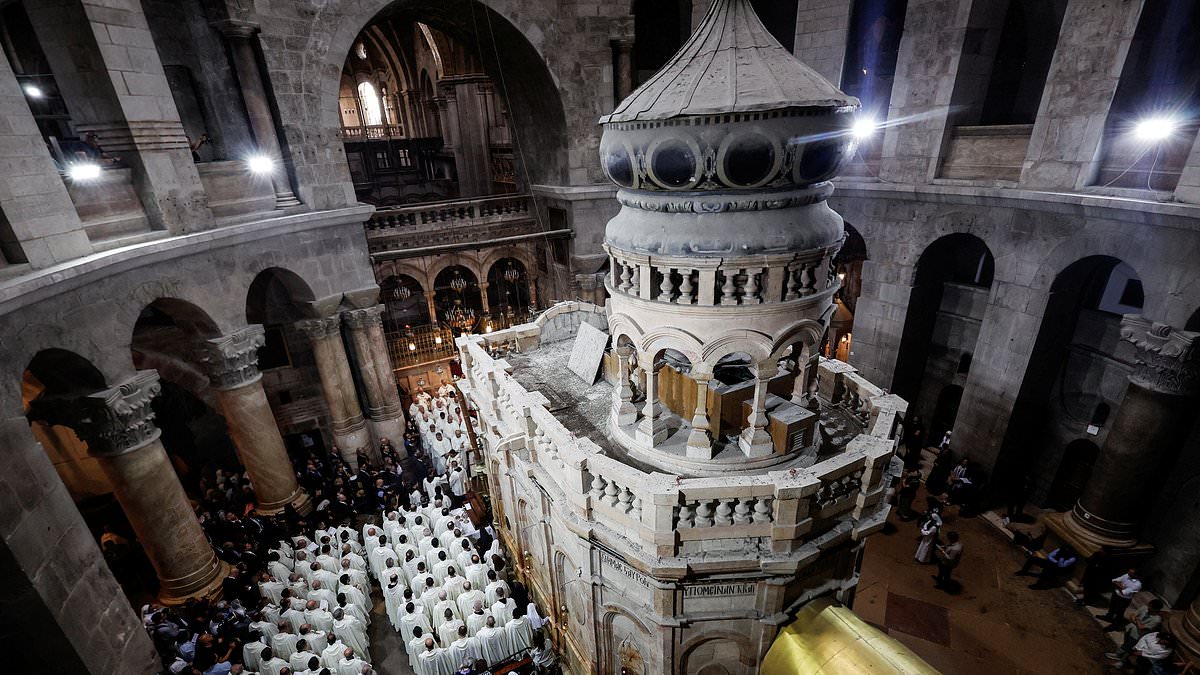
The unexpected closure of the Church of the Holy Sepulchre during Holy Week has stirred speculation among believers, raising concerns that biblical prophecies regarding the Antichrist could be unfolding. This iconic religious site, constructed nearly 1,700 years ago under the reign of Roman Emperor Constantine, is revered by many as the location of Jesus Christ’s crucifixion, burial, and resurrection.
Typically, the Church of the Holy Sepulchre draws thousands of worshippers and tourists during Holy Week. The Holy Saturday ceremony, known for the sacred Holy Fire ritual, often sees attendance numbers soaring to 10,000 in peak years. However, this year’s events have taken a dramatic turn.
Recent Iranian ballistic missile strikes over Jerusalem have caused debris to scatter throughout various parts of the city, including the vicinity of the church itself. In response to these tensions, Israeli officials have made the unprecedented decision to shut the church’s doors indefinitely and restrict access to holy sites in the region, citing safety concerns.
This development has led some observers to revisit passages from the Book of Revelation, which describe turbulent times and persecution in the end days, specifically referencing the location ‘where also their Lord was crucified.’ Revelation 11 speaks of two prophetic figures who preach in a holy city before being slain by a fearsome entity known as the ‘beast,’ often associated with the Antichrist by many interpreters.
While the closure was a necessary action due to the conflict, for those who follow biblical prophecies, these events resonate with the ancient texts, igniting discussions and debates about their potential implications in the modern world.
In Revelation 11, the text describes two prophetic witnesses who preach in a holy city before being killed by a powerful figure known as the ‘beast,’ often interpreted by some as the Antichrist.
The Antichrist is a figure in Christian theology believed to be a powerful deceiver who will oppose Jesus Christ and lead many people away from the faith before the end of the world. The passages also speak of the city being ‘trampled’ for a set period, alongside widespread fear, destruction and divine judgment.
Though the scripture does not refer to any specific modern location or event, some see parallels in the disruption of worship at one of Christianity’s most sacred sites, particularly during one of its holiest weeks.

Israel has closed the Church of the Holy Sepulchre indefinitely due to escalating security concerns as the war in Iran intensifies

Israeli police said that on Monday afternoon local time, fragments struck sites in Jerusalem’s Old City, including a few hundred feet from the Church of the Holy Sepulchre, injuring at least one person
Biblical scholars, however, caution that such passages are widely understood to be symbolic or tied to early Christian contexts, rather than direct predictions of present-day events.
In the Book of Revelation, the text describes a period in which a holy city is overrun for a set time while two prophetic witnesses deliver warnings and perform signs.
The account culminates in their deaths at the hands of a figure known as the ‘beast,’ followed by their sudden revival and a destructive earthquake that strikes the city.
The Church of the Holy Sepulchre is the second most visited attraction in Israel, with over two million annual visitors, following the Western Wall – the last remaining remnant of the Second Temple complex destroyed by the Romans in 70AD.
Church leaders in the Holy Land have called the closure unprecedented, as even during past wars and periods of tension, worship at the site continued in some form.
The move highlights how escalating tensions are now reaching even the most sacred and historically resilient religious sites in Jerusalem.
There were no casualties or major damage reported at the Church of the Holy Sepulchre or the nearby hilltop plateau known to Muslims and to Jews as Temple Mount, a flashpoint site that is holy to both faiths.
Photos distributed by police showed debris sitting on a red-tiled roof adjacent to the Holy Sepulchre.

Photos distributed by police showed debris sitting on a red-tiled roof adjacent to the Holy Sepulchre

Church leaders in the Holy Land have called the closure unprecedented, as even during past wars and periods of tension, worship at the site continued in some form
Another image showed a police cordon around a small area in the Al-Aqsa compound plaza, which also houses the golden Dome of the Rock, with small fragments strewn on the floor.
The shutdown has drawn strong reaction from Christians worldwide, especially in Greece, where the church plays a central role in the Holy Fire tradition.
In the days leading up to Easter, the flame is flown to Athens and shared across the country as part of Resurrection celebrations.
For centuries, the church has remained open to worshippers even during periods of conflict, making the current closure especially striking.

Israeli soldiers are guarding the church during the closure
The church, which is nearly 5,400 square feet, was built above a Roman temple dedicated to the goddess Venus in 335 AD.
The construction was commissioned by Emperor Constantine I, and during the conversion, a tomb was uncovered that is believed to be that of Jesus, who died nearly 300 years earlier.
The Church of the Holy Sepulchre was under attack throughout centuries, destroyed by the Persian army in 614, nearly demolished in 1009 and then burst into flames during the 1800s.