Share this @internewscast.com
In recent years, an increasing number of affluent Americans have been opting to exchange their city penthouses for expansive countryside properties. They’re leaving behind coastal views and hefty tax obligations for more spacious living and the expansive landscapes of Texas.
This trend has significantly favored Dallas more than any other place.
The Dallas–Fort Worth metropolitan area has emerged as a prime destination for those relocating from other states. According to data from Texas Realtors, nearly one-third of newcomers to Texas hail from states like California, Florida, New York, and Colorado. Of these, about 30% are choosing to settle in Dallas.
With Texas’ median home price sitting at $335,000—considerably less than the national average of about $415,000—and the absence of a state income tax, the allure is undeniable.
“People are voting with their feet,” explained Jennifer Wauhob, chair of Texas Realtors, in an interview with Fox Business.
“They desire locations that are livable, workable, sustainable, and affordable. This migration, as we refer to it, appears to be evolving into a lasting trend.”
The shift accelerated during the pandemic, when remote work untethered employees from office towers and many began questioning the logic of paying sky-high taxes for cramped city living.
With space suddenly more valuable than proximity to Midtown, the appeal of bigger homes, lower costs and warmer weather proved hard to resist.

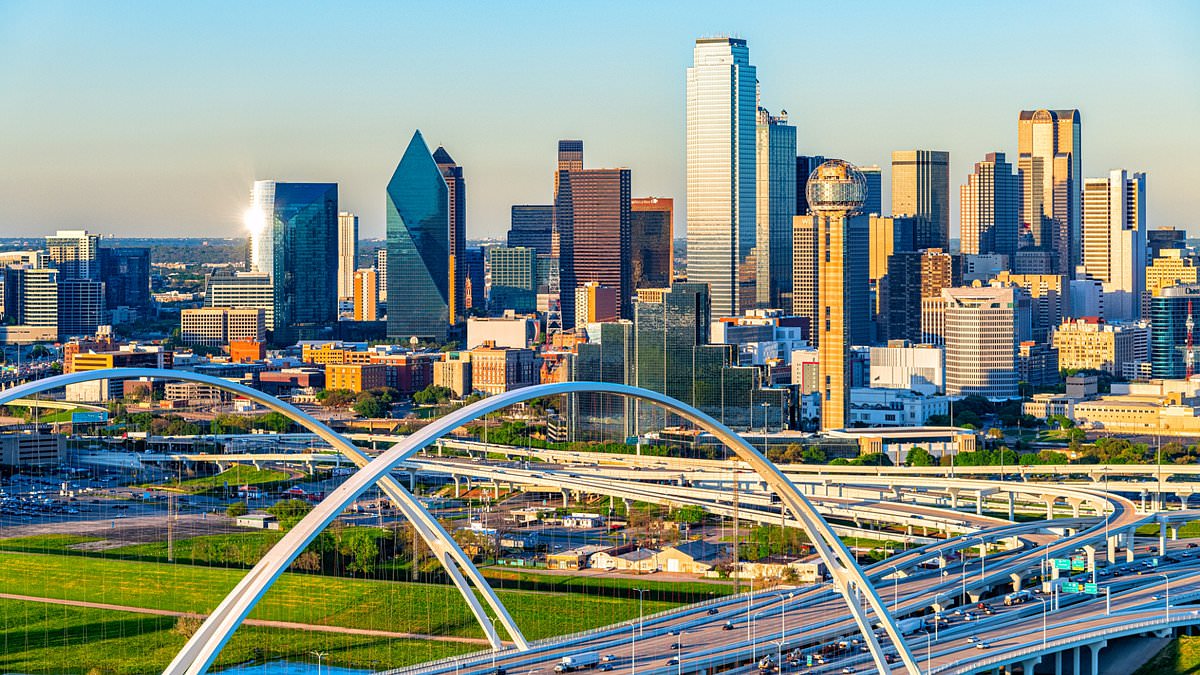
Recent data indicates that one-third of new residents are relocating from California, Florida, New York, and Colorado, with 30 percent of out-of-state movers opting for Dallas (pictured)

When remote work became the norm, the appeal of more space, warmer weather, and greater personal freedom elsewhere proved hard to resist and drew many to Dallas (pictured)

Texas’ median home price stands at $335,000 – well below the national median of roughly $415,000 (pictured: a Dallas home)
Dallas’s housing market reflects the migration trends being seen. In November, PwC and the Urban Land Institute released their annual Emerging Trends in Real Estate 2026 report, ranking the top 10 markets to watch in 2026.
The Dallas–Fort Worth market was ranked the top one to watch for the second year in a row, ranking first this year for both commercial real estate and homebuilding prospects, according to the report.
It stands out for its strong transportation access, relatively low cost of living, and business-friendly climate. Between 2018 and 2024, the area attracted 100 corporate headquarters, further cementing its reputation as an easy place to do business.
‘What’s really changed in the last couple of years is that the financial services shift in Dallas has further accelerated. Companies are moving and populations are moving, but it’s not all about financial services,’ Andrew Alperstein, partner with PwC’s US real estate practice told CNBC.
‘It has a pretty diverse economy, is still relatively affordable, and there’s easy access to it. Dallas has a great story that will likely continue from a migration perspective and ongoing development and expansion.’
‘What we’re seeing with this migration of all these people moving to our state is, it’s creating a really steady demand for housing, and that spans to all levels. We’re seeing a demand for entry-level housing, and we’re still seeing a strong demand for luxury-level housing. So it’s, right now, a really balanced, healthy market,’ Wauhob said.
It’s not just beachgoers abandoning their oceanfront views – urban high-rises are being traded in for wide-open acreage, as former city dwellers swap skyscrapers for saddle-ready ranches and skyline sunsets for sprawling horizons.
The New York Stock Exchange even established a ‘NYSE Texas’ in Dallas – a move President Donald Trump described as ‘unbelievably bad’ for New York City.
Join the debate
Is the migration of wealthy Americans to Dallas helping or hurting local communities and culture?

Dallas (pictured) stands out for its strong transportation access, relatively low cost of living, and business-friendly climate

The Dallas–Fort Worth market was ranked the top one to watch for the second year in a row, ranking first this year for both commercial real estate and homebuilding prospects (pictured: Dallas condos)

Local realtors say Dallas has a pretty diverse economy, is still relatively affordable, and there’s easy access to it (pictured: a historic house near downtown Dallas)

The Lone Star State grants some things not many bustling coastal enclaves can: peace, quiet, tranquility, privacy and a slower pace

Texas Realtors chair Jennifer Wauhob
Along with multiple of Silicon Valley’s finest firms opting for Austin, this widespread migration show that even the biggest industries in the US are heading South.
Millionaire business owner Frederic Lepoutre decided to move his family from the coast of South Florida to Texas Hill Country because it was far less hassle than trying to move elsewhere in Florida.
Lepoutre’s 11-acre Texas estate cost him just $26,000 per acre, and he claimed the initial tax bill with agricultural exemptions was $8 per year.
Not only was it a bargain, the construction of Lepoutre’s Texas house took one-third of the amount of time it would have taken to build a second home somewhere in South Florida.
‘It takes three years to build a house here. It took us one year from literally getting the ground ready to moving in. In Texas, it took us one year, and the only permit we needed was for the water well and the sewer system,’ Lepoutre told Fox. ‘It’s the opposite [of Florida]. It’s a total 180.’
The Lone Star State also granted Lepoutre’s family some things not many bustling coastal enclaves can. ‘We were looking for peace, quiet, tranquility, privacy and a slower pace,’ his wife Lynn said.
‘We wanted to be somewhere where you can look at the stars at night and not see one light. You can’t see your neighbors. The trees are still low enough where you can see out, the view from our house now is 40 miles,’ Lepoutre added. ‘It’s very rare to see properties like this in America anymore.’