
Share this @internewscast.com
In a bold act of defiance, protesters have taken down the Iranian flag from its embassy in London. This symbolic gesture comes as thousands gather across the UK and Europe to demonstrate against the Islamic Republic’s government.
Amidst these gatherings, activists have been seen burning images of Supreme Leader Ayatollah Ali Khamenei and voicing anti-regime slogans. Their actions are in solidarity with the countless individuals protesting on the streets of Iran.
For the past two weeks, Iran has witnessed widespread protests. Initially fueled by frustration over soaring living costs, these demonstrations have evolved into a formidable movement calling for an end to the clerical rule established since the 1979 Islamic Revolution.
According to the Iranian rights organization HRANA, as of January 9, the unrest has resulted in 65 fatalities, including 50 protesters and 15 security officers, amid a harsh crackdown led by the notorious Revolutionary Guards. Additionally, the Norway-based human rights group Hengaw reports that over 2,500 arrests have occurred in the past fortnight.
Iranian expatriates and their supporters across Europe are now rallying to demand the downfall of the Khamenei regime, showing solidarity with those who face arrest and danger in Iran.
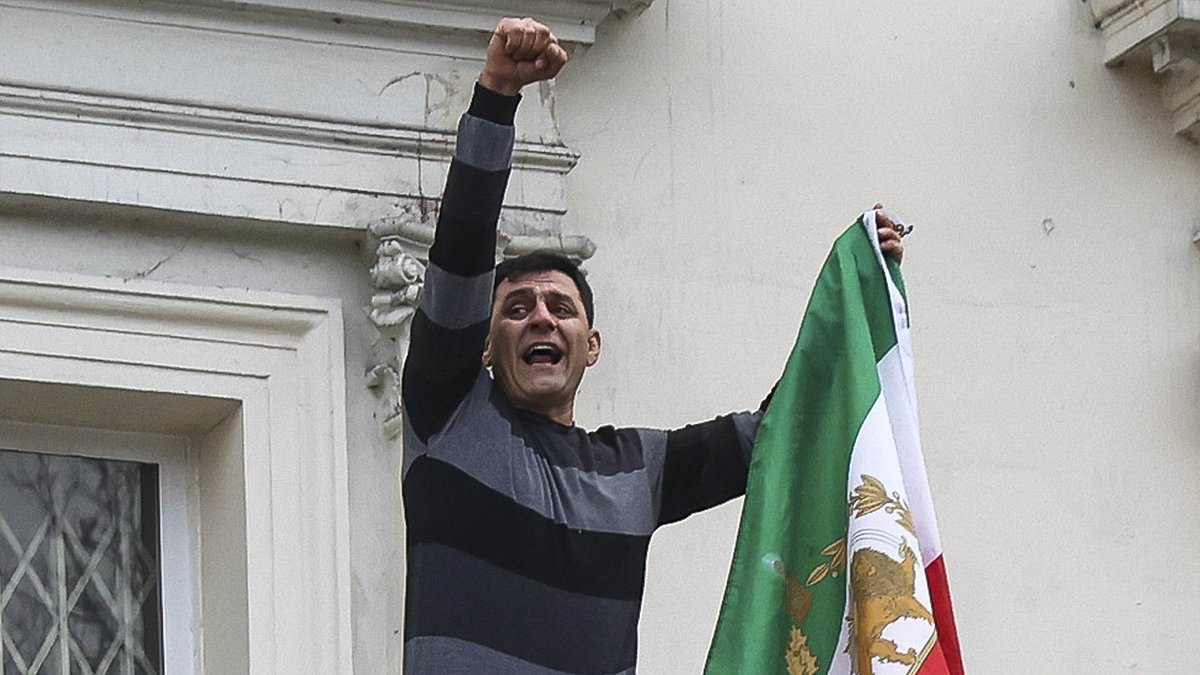
On Saturday in London, a protester dramatically scaled the balcony of the Iranian embassy in Kensington, where he tore down the flag representing the current regime.
To cheers and applause, he replaced it with the former Iranian lion and sun flag that the nation used prior to the Islamic revolution of 1979.
The Metropolitan Police said additional officers have been sent to the scene in Kensington. Several officers in riot gear were seen standing guard outside following the incident.

In London on Saturday a male protester was seen climbing onto the balcony of the Iranian embassy in Kensington and tearing down the flag of the current regime

He was filmed replacing it with the lion and sun flag instead, which was used by Iran prior to the Islamic revolution in 1979

A mother and young daughter attend a protest for Iranians in Glasgow, Scotland on Saturday

Around 100 people gathered in Newcastle on Saturday afternoon in support of protesters in Iran

In Newcastle city centre, protesters burned photographs of Iran’s Supreme Leader Ayatollah Ali Khamenei
As the evening drew in, a large crowd continue to protest peacefully. They were heard taking part in loud chants including ‘the homeland will not be free until the mullahs die’ and ‘death to Khamenei.’
In a statement on social media, the force said: ‘We are aware of a protest currently taking place outside of the Iranian Embassy which has seen a protester climb onto the balcony of the building.
‘Officers are on site and additional officers are being deployed to prevent any disorder.’
In video footage taken at the scene, the embassy’s white walls appeared to have had red paint thrown at it, with splotches of red visible around the balcony.
Hundreds of people earlier gathered outside the embassy in London on Saturday, waving flags and expressing solidarity with protesters in Iran.
Similar protests were held in other cities across Europe, including Glasgow, Nottingham, Dublin and Brussels.
Unrest continued overnight in Iran, with state media reporting a municipal building was set on fire in Karaj, west of Tehran, for which they blamed ‘rioters’.
Protests have spread to more than 220 towns and cities in every one of Iran’s 31 provinces.
Social media images showed thousands participating in Tehran, while videos published by Persian language television channels based outside Iran showed large numbers taking part in new protests in the eastern city of Mashhad, Tabriz in the north and the holy city of Qom.

A woman with a map of Iran painted on her face joins a protest in Glasgow on Saturday

A man holds a sign reading ‘Free Iran’ during a protest in the German capital, Berlin, on Saturday

Hundreds of people gathered in central Berlin on Saturday to protest against the Iranian regime

Protesters also gathered in Malieveld Square at The Hague, Netherlands today

A woman holds a sign that reads ‘death to Khemenei’ during a protest in Milan, Italy

Hundreds of people join a march through central Berlin in support of protesting Iranians in Berlin on Saturday

Protesters in the Netherlands had a huge Iranian flag and signs which declared Reza Pahlavi, the son of the former shah of Iran, the ‘King’

Protests have taken place across Iran for 13 days in a movement sparked by anger over the rising cost of living, but which have escalated into calls for regime change

Demonstrations continued overnight in Tehran’s Kaj Square (pictured) as unrest across Iran entered its third week

Thousands of people took to the streets in Tehran as well as cities and towns across all of Iran’s 31 provinces (Pictured: Protesters in Mashhad, northeastern Iran)
But the country’s infamous Revolutionary Guards and other law enforcement agencies are launching a brutal crackdown, with the nation’s attorney general, Mohammad Movahedi Azad, warning anyone taking part in protests would be considered ‘an enemy of God’.
This offence is punishable by death under Iran’s strict laws, and even those who assisted protesters would also be prosecuted, a statement on state TV reported.
‘Prosecutors must carefully and without delay, by issuing indictments, prepare the grounds for the trial and decisive confrontation with those who, by betraying the nation and creating insecurity, seek foreign domination over the country,’ it read.
‘Proceedings must be conducted without leniency, compassion or indulgence.’
It appears to be a desperate bid to try and limit the number of protesters after Friday night saw some of the largest swells of activists yet.
Videos show many chanted ‘death to the dictator’ and ‘death to Khamenei’, while other banged pots and pans.
While some protests have been peaceful, videos in some cities show burning buildings, overturned cars and authorities opening fire.
A doctor in northwestern Iran said that since Friday, large numbers of injured protesters had been brought to hospitals. Some were badly beaten, suffering head injuries and broken legs and arms, as well as deep cuts.

Thousands of protesters gather in Tehran on Friday night as protests continue to sweep the country

A fire is filmed by protesters in Tehran, the capital of Iran, on Friday

The movement marks the biggest threat to the Islamic Republic in years and has seen a typically brutal crackdown from the country’s Revolutionary Guards

A nationwide internet blackout has now been going on for more than 36 hours, making monitoring of events increasingly challenging (Pictured: Protesters in Kermanshah, Iran on January 8)

The Supreme Leader of Iran Ali Khamenei described protesters as ‘vandals’ – 30 seconds of his speech was aired during the BBC’s news report
At least 20 people in one hospital had been shot with live ammunition, five of whom later died.
The US-based son of Iran’s ousted shah urged Iranians on Saturday to stage more targeted protests with the aim of taking and then holding city centres.
‘Our goal is no longer just to take to the streets. The goal is to prepare to seize and hold city centres,’ Reza Pahlavi said in a video message on social media.
The rallies came as internet monitor NetBlocks said authorities imposed a ‘nationwide internet shutdown’ for the last 36 hours that was violating the rights of Iranians and ‘masking regime violence’.
Amnesty International said the ‘blanket internet shutdown’ aims to ‘hide the true extent of the grave human rights violations and crimes under international law they are carrying out to crush’ the protests.
On Saturday morning, a local governor of the Tehran province told Tasnim news agency, which is associated with Iran’s Revolutionary Guards, that 100 people had been arrested.
Those detained were accused of having ‘disrupted public order’ and ‘used firearms and cold weapons against the people and security and law enforcement forces’ in the county of Baharestan.
In his first comments on the escalating protests since January 3, Khamenei on Friday called the demonstrators ‘vandals’ and ‘saboteurs’.
Khamenei, in a speech broadcast on state TV, said US President Donald Trump’s hands ‘are stained with the blood of more than a thousand Iranians’, in apparent reference to Israel’s June war against the Islamic republic, which the US supported and joined with strikes of its own.