
Share this @internewscast.com
Labour is grappling with so many challenges that the looming threat of electoral defeat seems almost secondary.
However, the approach of May 7 marks significant elections in English councils, the Welsh parliament, and notably, Holyrood.
Predictions suggest Labour won’t fare well in any of these contests, with Holyrood likely delivering a particularly harsh setback.
Not too long ago, Scottish Labour carried a sense of optimism. There seemed to be a path forward for Anas Sarwar, especially after the General Election hinted that ousting the SNP was within reach.
During this hopeful period, Sarwar was even heralded as ‘The Next King of Scotland’ in a particularly flattering piece.
That optimism has since evaporated. As May approaches, the focus has shifted to damage control. For Sarwar, it’s a small consolation that his colleagues in Wales are confronting a similar predicament.
Wales is the very definition of Labour territory. Labour has won every single devolved election. You have to go back more than a century to find a Westminster election in which Labour didn’t come first. The most recent poll puts the incumbent party in third place.
We are more than 25 years into the devolution experiment and there is as much prospect of Labour winning this Holyrood election as the one before and the one before that. The last time Labour won, Sarwar was at university.
There will be voters in May’s election whose entire lives have been lived under an SNP devolved government.
There were two rationales for devolution. The official reason was to close the supposed ‘democratic deficit’ between votes cast in Scotland and electoral outcomes at the UK level.
The ulterior motivation was to give institutional expression to Labour’s Scottish fiefdom. Some naively believed a Scottish parliament would be Strathclyde Regional Council writ large.
Devolution has failed on both fronts, and it has done so emphatically.

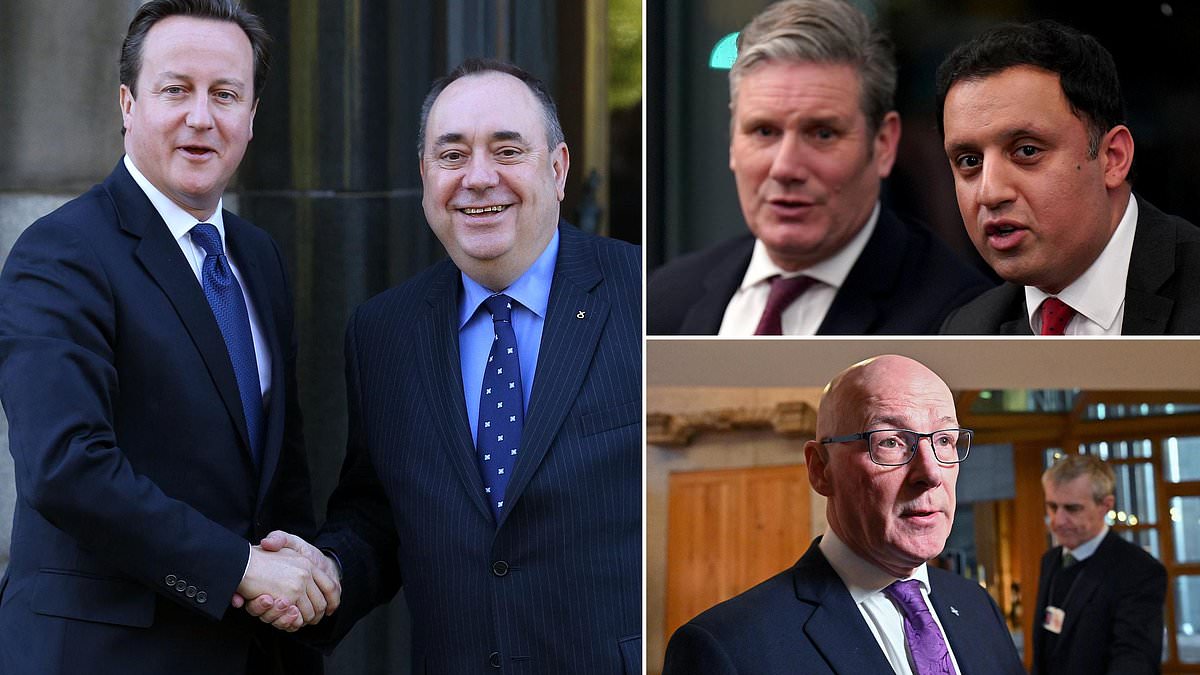
David Cameron with Alex Salmond in Ediinburgh in 2012

First Minister John Swinney – in his era, SNP outcomes have been dismal
Even if we accept the logic of democratic deficits – a Nationalist logic, incidentally – Holyrood could hardly be said to have increased the democratic character of Scottish governance.
Devolution has entrenched a narrow, unrepresentative elite at the apex of decision-making in this country, a clique that crosses political parties and constitutional differences and asserts that it knows better than the populace how they ought to be governed.
Polls consistently showed public opposition to legislation such as the Gender Recognition Reform Bill and the Hate Crime Act, yet Holyrood not only passed these Bills on a cross-party basis, it dedicated a significant amount of parliamentary time to them.
These were not the priorities of the electorate but that didn’t matter: they were what the political class wanted.
Much more grievous for Labour is that, far from embedding their half- century of electoral dominance, devolution created the means by which that dominance could be smashed.
Before Holyrood came along, the SNP’s chances of holding executive power beyond local government level were essentially zero. With no prospect of executive power the SNP never had to look like an executive in waiting.
The arrival of Holyrood meant the party had to undergo a bout of professionalisation. The opportunity to wield power forced the SNP to shape up and, under Alex Salmond’s leadership, it was able to enter government – after just eight years of the Scottish parliament.
Labour not only lost power in 2007, it lost much of its ideological infrastructure. Even when out of power at Westminster and with a Tory calling the shots via the Scottish Office, Labour’s unchallenged electoral position meant it enjoyed extensive influence through the unions, the charitable sector, the churches, and the rest of civic Scotland.
Back in power, it could reward its friends and allies with appointments to quangos and public sector boards.
Labour has been out of office for the better part of a generation now. So long that, the last time it was running the Scottish Government, it wasn’t even called the Scottish Government. As a result, Labour has become a political as well as an electoral irrelevance.

Labour leader Anas Sarwar faces a tough time at the May Holyrood elections

Nigel Farage’s Reform party now has a major oportunity to pick up votes in Scotland
All those quango posts it once filled with its friends have been filled by the Nationalists with their friends. The ideological direction of the third sector long ago reoriented in favour of the SNP.
This begs the question: devolution, what is it good for? Transformative policy changes are few. The smoking ban has saved countless lives by helping drive down cigarette use, but even this legislation was passed at Westminster not long after.
In the SNP era, outcomes in health, education, drugs and procurement have become progressively more dismal.
The government’s agenda is prisoner to one fashionable cause after another, transparency and accountability are treated with scorn, the quality of MSPs and parliamentary scrutiny have never been lower, and Scotland is stuck in permanent constitutional limbo over independence.
The foremost achievement of devolution has been to preside over the transfer of power from one political establishment to another.
Other than that, it’s only real significance is giving voters a high-profile chance to send a message to the Labour government of the day.
If there was no parliament in Edinburgh or Cardiff, Labour would be bracing itself for nothing more than a bad night in council elections, a time-honoured tradition for central government.
But because so many legislative powers have been transferred to Holyrood and the Senedd, parties elected on a protest vote stand a chance of wielding significant power.
The SNP has used that power to hike taxes in Scotland and Plaid Cymru could be expected to do something similar in Wales. Real world consequences not just for political parties, but for ordinary people.
I say ‘parties’ plural because the Tories deserve their share of the blame.
After opposing devolution in opposition, their arrival in Downing Street in 2010 heralded a conversion worthy of Saul on the road to Damascus, and David Cameron’s government set about showering Holyrood with extra powers.
Now that parliament provides Reform with its first major opportunity to wipe out and replace the Conservatives as the main political force on the Right.
Devolution was a trap, one which Labour laid for itself. It did not improve social or economic outcomes, raise the quality of public services or settle the constitutional question.
What it did was give the SNP a foot in a door the party would otherwise have had to knock on in vain, begging for entry.
Labour is the author of its own demise. It championed devolution to head off the rise of the SNP and create a policy buffer between English Toryism and the (mildly) more social-democratic electorate of Scotland.
The Conservatives chipped in by devolving more and more powers and rewriting the law to make Holyrood legally permanent.
With May will come a reckoning for this foolishness and cowardice.
At Holyrood and in Cardiff, Nationalist and populist foes of the Labour-Tory duopoly will get their first credible opportunity to sweep it away and replace it with a new political class.
A feat infinitely more difficult to achieve in the Commons, but which would benefit from a powerful gust of wind in its sails if the devolved parliaments could illustrate to the electorate that a new political map is possible.
Finally, someone found a use for devolution, but it’s nothing like what its arrogant, idealistic architects imagined.