
The Spice Girls need to move aside, as girl power may have started 9,000 years ago.
Archaeologists have unearthed evidence that women, not men, ruled an ancient city in Turkey that has been buried for thousands of years.
The discovery could rewrite what we know about the earliest days of civilization and about gender roles throughout history.
In a significant study released in Science, researchers examined ancient DNA from almost 400 skeletons from Çatalhöyük, an exceptionally well-preserved Neolithic settlement in southern Turkey. Their findings suggest that this early civilization might have been governed by a matriarchal system.
The settlement, a warren of mudbrick homes and goddess-like statues dating back to 7100 BCE, has long been a source of mystery and wonder.
The DNA analysis revealed that women were interred with considerably more grave goods compared to men, and that daughters often remained in their maternal households, whereas sons typically left.
This remarkable discovery has stirred the archaeological community, challenging long-held beliefs about power dynamics in humanity’s earliest cities and proposing that the initial great urban cultures might have been primarily led by women.
The vast settlement – spread over 32.5 acres (13.2 hectares) – was already known for its sprawling homes, elaborate art and mysterious goddess-like figurines.

Archaeologists have uncovered a bombshell at the hidden ancient city of Çatalhöyük that had been buried for thousands of years – evidence that women, not men, may have ruled society

Women were buried with far more grave goods than men – and that daughters stayed with their maternal households, while sons often left suggesting the world’s first great urban cultures may have rested on the shoulders of women
Now, the latest genetic evidence has jolted the field of archaeology with clues that women were not only the spiritual symbols of Çatalhöyük but may have been its true rulers.
In a painstaking investigation spanning more than a decade, a team of geneticists, archaeologists, and biological anthropologists extracted DNA from the skeletons of over 130 people buried beneath the floors of 35 separate houses at the site.
In total, nearly 400 individuals have been recovered in graves at Çatalhöyük, a city once bustling with life for more than a thousand years.
What they found was extraordinary: a strong genetic pattern showing maternal connections within the buildings.
Women and their daughters were consistently buried together, while men seemed to arrive from outside, suggesting they married into the households of their wives.
Researchers believe that as many as 70 to 100 percent of female offspring stayed attached to their maternal homes across generations, while males moved away.
And the evidence of women’s elevated status does not end there. Grave goods such as precious ornaments, tools, and other offerings were found five times more often in female burials than in male ones, a clear sign of preferential treatment and status in death that mirrored social power in life.
Dr. Eline Schotsmans, a co-author of the study and research fellow at the University of Wollongong’s School of Science in Australia, urged modern audiences to rethink outdated assumptions about ancient gender roles.

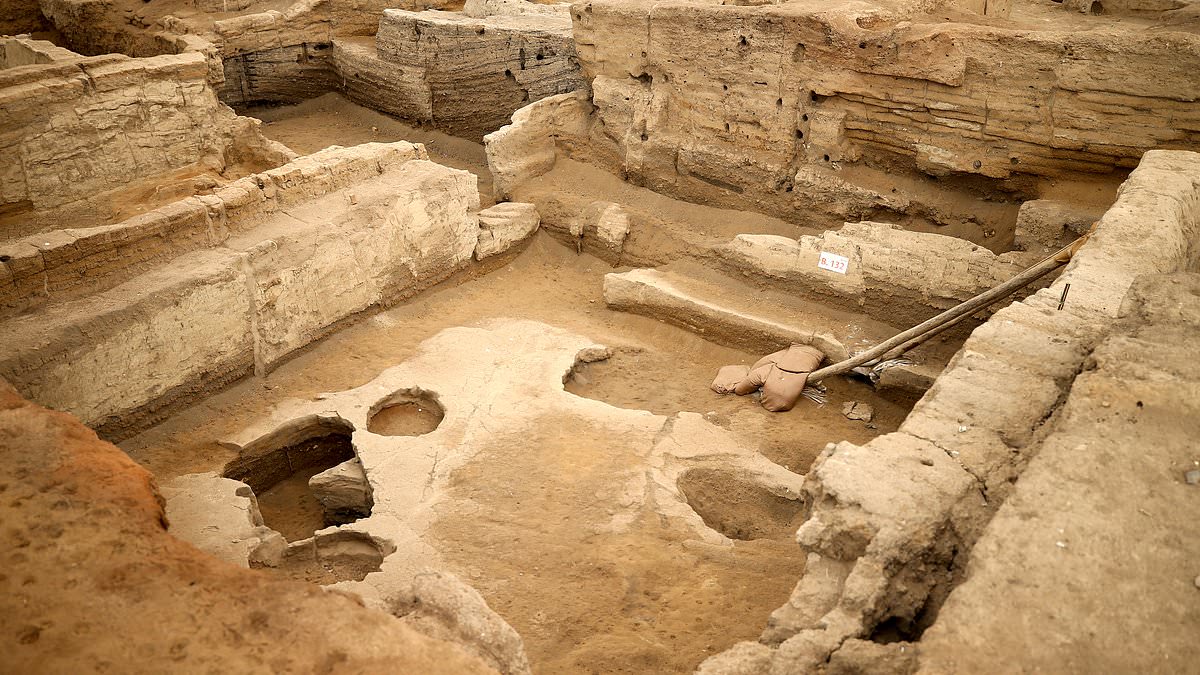
A excavation site is seen at Çatalhöyük which was inscribed as a UNESCO World Heritage Site in July 2012. New finds are being encountered at Çatalhöyük, where about 8,000 people lived together during the Neolithic period

The research is a culmination of 31 years of excavation and the analysis and marks one of the most important geological studies in recent history

In total, nearly 400 individuals have been recovered in graves at Çatalhöyük, a city once bustling with life for more than a thousand years. Bones found at the site can be seen above

The city of Çatalhöyük, located in Turkey, flourished around 7000 BC with a population of 1,000 and these days is one of the largest Neolithic sites found to date (pictured)

Çatalhöyük was composed entirely of domestic buildings with no obvious public buildings

Çatalhöyük is a tell of a very large Neolithic and Chalcolithic proto-city settlement in southern Anatolia, which existed from approximately 7500 BC to 5600 BC and flourished in 7000 BC
The idea that a Neolithic city could have been matriarchal is not new in myth or folklore.
Çatalhöyük’s iconic clay statues depicting rounded, powerful female figures have long teased the possibility of a society with women at the helm.
But this new DNA evidence offers the first scientifically grounded window into how such a social structure might have worked in practice.
The implications go far beyond Turkey. Only months ago, a separate team of researchers studying the late Iron Age in Britain published evidence in Nature showing that women in Celtic communities also held powerful positions through maternal kinship.
Analyzing DNA from 57 graves in Dorset, scientists revealed that two-thirds of the buried individuals came from a single maternal lineage – suggesting that women maintained community ties while men likely migrated in after marriage.