
Share this @internewscast.com
Residents of a quaint Texas town are grappling with persistent noise disturbances from a nearby cryptocurrency mining operation.
Those living in Granbury describe the relentless sounds from the data center as akin to being on an airport runway with jets perpetually taking off. This comparison forms the basis of a lawsuit filed against MARA Holdings, the facility’s owners.
The lawsuit alleges that the continuous noise is responsible for various health issues among the community, including headaches, vertigo, and hearing impairment.
“It’s incredibly intrusive and annoying,” stated Rodrigo Cantu, the attorney representing the residents, in an interview with the Daily Mail.
“This is the kind of noise that penetrates walls, can jolt you awake, or prevent you from falling asleep,” Cantu elaborated.
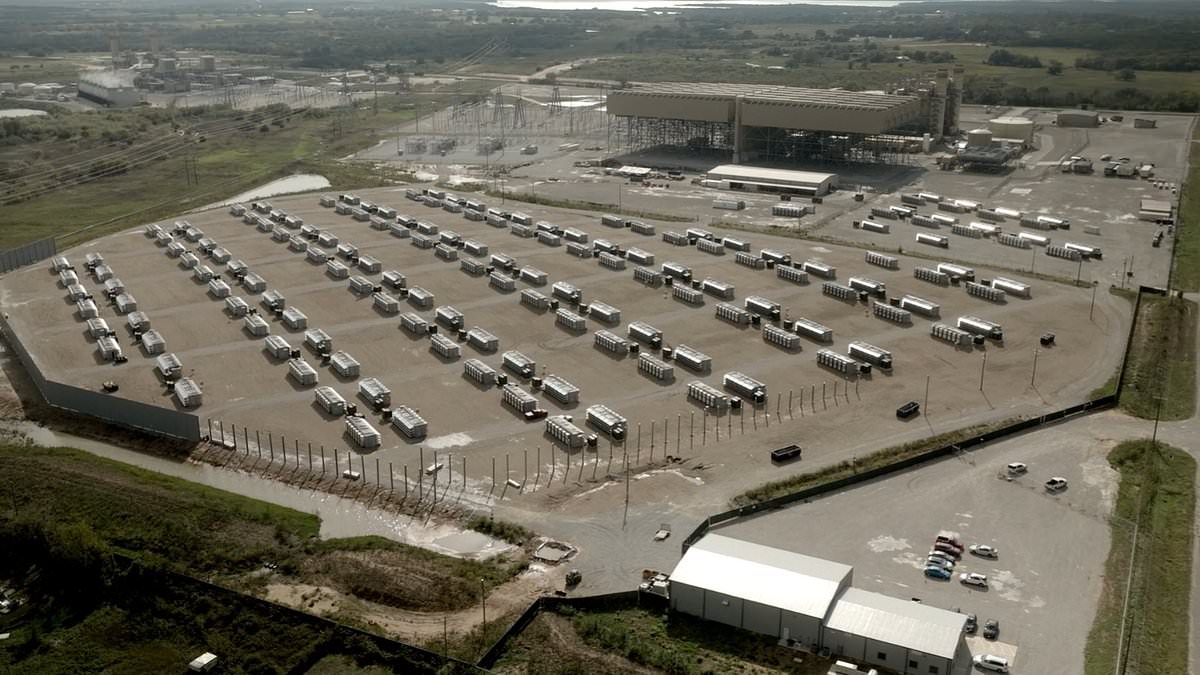
The facility in question operates between 60,000 to 80,000 computer rigs, all dedicated to Bitcoin mining. This complex and time-intensive process demands vast amounts of electricity and costly equipment.
Bitcoin is currently trading at around $88,000 and firms who can amass enough computing power unlock the chance to compete for the newly minted currency by validating transactions on the blockchain.
While MARA stands to make huge gains, Granbury locals claim they are losing sleep due to colossal noise generated by fans needed to cool the center’s computer chips.

Pictured: An overhead view of the MARA Holdings’ Bitcoin mining data center in Granbury, Texas

Daniel Lakey and his wife claim they have been dealing with the bitcoin mine’s loud noise since 2022, when it was installed

Pictured: Air-cooled containers on the site that contain the computers that run day and night to earn Bitcoin rewards
The group of residents sued MARA last year in attempt to quiet down the data center, which has been operating since 2022.
‘It can be heard during the day, when people are going about their business, but it can also be heard at nighttime, which is especially damaging because one has a reasonable expectation of peace and quiet at night,’ Cantu said.
‘There are people in the community who are saying that they feel like they don’t hear as well anymore, or that it’s contributing to other physiological effects, like headaches, like a sense of vertigo.’
Cheryl Shadden, who is one of the plaintiffs in the lawsuit, has said the Bitcoin mine ‘sounds like you’re being on a runway with jets taking off 24/7, nonstop. You hear it in your home, it penetrates the walls, it shakes your windows.’
MARA argues that these claims are overblown and disproven by Hood County’s own sound study that was prepared in November 2024.
Texas state law stipulates that noise levels above 85 decibels, equivalent to a running lawnmower at close range, is unreasonable. Consistent exposure to sounds above 85 decibels can lead to hearing loss.
The officials who conducted the sound study tested the noise levels at 38 different locations around MARA’s Bitcoin mine and found that it ranged between 35 to 62 decibels, well below the legal limit.
MARA also says it has implemented sound mitigation strategies, including by replacing 67 percent of its fans with a quieter, liquid-based cooling system and by extending a 2,000-foot-long, 24-foot tall soundproof wall around the facility.
Join the debate
Should companies making millions from crypto be allowed to disrupt entire communities with noise?

Pictured: The town square in Granbury, which is in Hood County. The county’s sound study did not detect unacceptable levels of noise

Pictured: The level of noise measured at various sites throughout Granbury. This sound study was done by Hood County officials in November 2024
Some Granbury residents remain unsatisfied with these fixes and continue to claim that the Bitcoin mine is too loud.
Daniel Lakey, who lives about a half a mile away from the mine, started an ill-fated petition to create a new city called Mitchell Bend, named after a road in the neighborhood, in a bid to take back control.
If the city had been formally incorporated, its roughly 600 residents would have had the power to create a stricter noise ordinance to rein in MARA’s operations.
However, the measure failed in November, with 62 percent of the 138 voters who cast ballots rejecting the idea, The Texas Tribune reported.
‘It was very disappointing last night. We were hoping to have some tools to fight the noise a little,’ Lakey, who is also a plaintiff on the lawsuit against MARA, told the outlet.
MARA celebrated the incorporation effort’s failure in a statement to the Daily Mail.
‘While a few residents recently sought to incorporate a new town to penalize law-abiding companies like MARA, we’re pleased the community rejected this at the ballot box, and we remain committed to being good neighbors and investing in the long-term strength of Granbury and Hood County,’ the company said.
In an earnings call on November 4, MARA CEO Fred Thiel said the company installed its first ‘AI inference racks’ at the Granbury facility in the quarter ending in September 2025.

MARA CEO Fred Thiel revealed in an earnings call in November that MARA added 10 AI inference racks to the Granbury facility to help with its mining operations. MARA declined to answer further questions about the AI racks

Pictured: A crane installs more computers to mine bitcoin at the Granbury data center
According to a shareholder letter, just ten of these racks were added at the facility. They are cooled with high-speed fans, not with liquid-immersion cooling, which is much quieter.
Air cooling is louder, but given that only ten racks have been added so far in a facility that supports tens of thousands of computers, it’s unlikely that the AI chips have meaningfully contributed to an uptick in noise over the last few months.
MARA declined to comment on the AI inference racks and would not say if it plans to expand them over the coming months and years.
The residents of Granbury who sued MARA are now trying to obtain more documents about the company’s operations.
Cantu told the Daily Mail that MARA is stonewalling and has so far refused to produce any meaningful information.
‘What we’re wanting from MARA is information on its equipment and its operations, so that we can figure out what mitigation efforts they might be able to take. Ultimately, it’s going to be about MARA deciding whether or not it’s willing to bring down its noise levels,’ he said.
‘We filed a motion to compel documents in state court this summer, and that shows how they have not responded to our requests for information.’
MARA operates nine data centers across four states, including Texas, Nebraska, Ohio and North Dakota.
The facility it acquired in Hopedale, Ohio, last November has also been criticized for being too loud, though others who live nearby say they don’t hear anything.