Rory McIlroy has once again triumphed at the Masters. Mirroring his victory from a mere 364 days prior, it was nothing short of spectacular. If there ever comes a time when he relinquishes the coveted green jacket, those closest to him might consider securing one that closes at the back.
Undoubtedly, this remarkable and resilient Irishman, who continuously makes history, possesses one of the most fascinatingly eccentric minds in sports. Let’s hope that aspect of his persona remains unchanged.
The drama McIlroy conjured on his singular path to becoming the first man since Tiger Woods in 2002 to secure consecutive wins at Augusta National’s hallowed grounds was simply spellbinding.
Joining an elite group, which includes the likes of Woods, Sir Nick Faldo, and Jack Nicklaus, McIlroy’s achievement cements his status as one of the greats across 90 editions of the Masters. His latest victory places him tied for 12th on the all-time list of major winners, alongside Faldo and Phil Mickelson, and ahead of Seve Ballesteros.
These accomplishments define McIlroy’s enduring legacy. At the age of 36, there is every reason to believe that his journey has even more milestones to reach.
For those interested in the statistics, McIlroy wrapped up the final round with a 71, clinching a one-stroke victory over Scottie Scheffler and finishing with a 72-hole tally of 12 under par. In a notable four-way tie for third were Tyrrell Hatton, delivering an impressive performance, along with Russell Henley, Cameron Young, and Justin Rose.

Rory McIlroy clinched a historic second green jacket after winning the Masters on Sunday

The Northern Irishman becomes just the fourth player in history to win it back-to-back

McIlroy with wife Erica Stoll, daughter Poppy, mother Rosie McDonald and father Gerry McIlroy
But let’s now dwell on the how, because that is what makes McIlroy unique and it is why this tournament took such mad turns. Crazy turns. McIlroy turns.
That being the McIlroy who built a record lead of six on Friday and blew the lot on Saturday. The same McIlroy who across a scorching Sunday then fell two strokes behind Young and, later, Rose.
But he turned it around. He wrestled it back. And then he ran away from them until he had another one of those brain-farts that make him so compelling to watch, just as he stepped onto the 18th tee knowing he had the comfort of a two-stroke lead.
What did he do with it? Well, he sliced it so far right into the trees that Scheffler, long since finished after his 68, was being nudged that a play-off might be necessary. McIlroy’s ball was in a dire spot, with the only route to salvation involving a strike in the direction of the 10th fairway and the hope that it hook to the same postcode as the 18th green.
What followed was not as dramatic as his hook the 15th in 2025. Nor was this win quite the same magnitude as that one. But boy did it turn in flight and eventually rested in a greenside bunker. From there, McIlroy was sufficiently composed to find the putting surface and two strokes meant a bogey. And bogey was glorious. Bogey was enough.
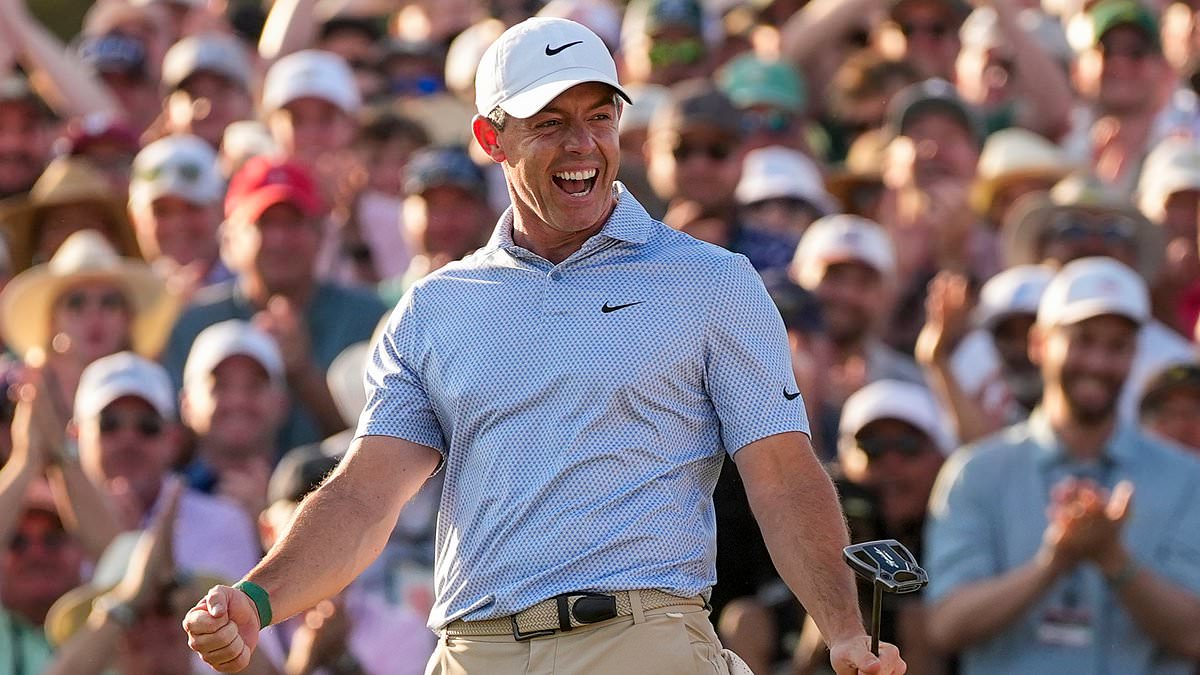
And so, just like last year, he roared and screamed. It was the scream of a madman at the end of a mad trek.
We should spend a little time on that, too.
It was 2.15pm when he and Young made their way to the first tee for the final round and were immediately greeted by a muffled cheer from 445 yards away – Sam Burns had birdied on the green up ahead and joined them at 11 under. That was the tone-setter for bedlam.

Chairman of Augusta National Golf Club Fred Ridley presents McIlroy with his green jacket

The Northern Irishman was overcome with emotion as he waited to putt on the 18th hole

In the end, it was sheer joy for McIlroy who etched his name into the history books once again
After McIlroy and Young traded pars on the opening stroll, the only observation worth making was that Irishman had ditched his driver for the three-wood, evidently tired of living by the mood swings of his biggest dog. It steered him towards a renewed level of accuracy that would eventually prove itself essential, but Young drew first blood by birdieing the second.
What of Rose two groups ahead? He was staying under our radars at nine under. We’ll never learn.
But we did notice McIlroy birdieing from nine feet at the third to pull level on 12 under. And we noticed even more of what came next, when he threw in the obligatory meltdown on the fourth.
Slipping into his habit from Saturday, he yanked his approach to the par three so far left that he needed to float over a bunker to get back to the green. Once there, he three-putted. At two down to Young, his story was being written and then overlooked for a better one. Because Rose will never let it lie, will he?
Aged 45, we must surely regard him a British sporting treasure by now. If we don’t, see what he did between the fifth and ninth holes, when he collected four birdies, illuminated by a postcard moment that fell in the middle of the run. It involved an escape from the pine straw on the seventh that flew 162 yards before resting eight inches from the cup.
Those strides carried Rose to 12 under at the turn and, amazingly, he had the lead, but maybe the almighty has an issue with him, given what unfolded on Amen Corner. A bogey at the 11th was acceptable, but less so another on the iconic 12th, because it involved a chunked chip that travelled eight yards and fell short of the green. A three-putt par on the par-five 13th meant two shots had gone and he was back at 10 under.
What did this mean for the leaderboard? Well, that was carnage. Hatton was safely in the clubhouse on 10 under after his second 66 of a sublime week, Henley would eventually tie that mark, and both Collin Morikawa and Scheffler were lurking on nine under. Added to Rose, they were five horses in a race of seven.
Which takes us back to McIlroy and Young. The latter had a ropey final approach to the turn, meaning he was in the cluster at 10 under – a position from which he was never able to extricate himself. He couldn’t rise. McIlroy? That was a different tale.

An emotional McIlroy wipes away tears during the jacket ceremony at Augusta National

McIlroy looked as though he might fumble a historic six-shot lead before going on to win
The theme of his Saturday had been the way he started bad and crumbled. Here he showed the other side of that complex character – a feeble bogey at the sixth, dragging him to nine under, had seemingly buried him in bad momentum, but the recovery was remarkable. And rapid. And timely.
He birdied the seventh after one booming drive and then launched himself towards another with a 349-yard rocket up the eighth – his biggest of the week. Two pars carried him to the perils of Amen Corner and by the time he left the 13th, he had shaved a further couple of strokes from his score.
Every fairway and green was hit in regulation on that stretch, and putts were dropping from anywhere between seven and 13 feet. He was now swaggering like the McIlroy of Friday, but more reliable off the tee.
A note at this point – he bashed more than 50 balls on the range on Saturday, so furious was he with those shots that kept slipping left. Evidently it worked, as his driving in this final round was by far the most accurate of his week.
Departing the 14th with a par, his tally was 13 under and his lead three. But up ahead came a roar – Scheffler, fresh from riding a wonderful escape from two sets of trees for a birdie on the 15th, had added another at the 16th to get within two.
That was pressure. And this was McIlroy. We saw how those can mix when he swung at the 18th, but we also saw genius in how he rode it out. Genius and madness? They are almost the same thing with this man.