
Share this @internewscast.com
Earlier this week, most members of the Iranian women’s football team returned to Tehran, leaving only two of the initial seven who intended to seek asylum in Australia still in Sydney following the Asian World Cup.
Their situation has captured global attention, especially after some team members opted not to sing the national anthem at the tournament’s opening match. This decision sparked intense scrutiny and concern worldwide.
This perceived act of rebellion led one conservative Iranian commentator to label them as “wartime traitors,” advocating severe retribution. Initially, six players and a staff member sought refuge in Australia and were granted visas. However, five later chose to rejoin the team. While no official reasons were disclosed, it is speculated that they faced pressure from the Iranian authorities and fears of repercussions for their families.
By Wednesday, all but two team members had embarked on the lengthy journey back to Iran, traveling through Malaysia, Oman, Istanbul, and finally crossing the Gurbulak-Bazargan border.
Concerns are mounting over their homecoming in Tehran. Reports surfaced last week that a player’s mother, who had rejoined, sent her a warning message, stating, “Don’t come back, they’ll kill you,” though it failed to reach her before she departed Sydney.
For many Iranian women, both domestically and abroad, the players’ eventual compliance is profoundly disheartening. The situation starkly highlights the precarious position facing women protesters throughout Iran.
At first the American and Israeli bombs that have pounded Tehran for more than two weeks seemed to offer hope as well as fear.
Despite the swift announcement of a new Supreme Leader – Mojtaba Khamenei, son of the assassinated Ayatollah Ali Khamenei – in the firestorm inflicted on their homeland, women glimpsed the possibility of regime change and an end to their decades of oppression.
Yet now the regime is fighting back with explicit threats that it has its ‘finger on the trigger’ should protests occur again. Some think the new Ayatollah will even blame the activists who took to the streets in January for America’s war against Iran.
‘The sound of missiles and explosions can be heard across the city,’ says Sahar, 39, whose family lives in Tehran. Food is still available, but prices are rising. The internet is largely blacked out and the government is once again terrorising people into silence, she says.
‘Security forces stop people in the streets and check their phones. Anyone who’s taken videos or photos of bomb damage can be detained. People are afraid to record anything. It’s like martial law.’
Sahar, who works as a professor, also fears for the future of the women’s football team. She knows how impossible it is for Iranian women to speak out, and is only doing so herself because she no longer lives there. She is still too afraid to use her real name in case of reprisals against family members who are still in Tehran.
From the beginning of this conflict, she says, it has been the women of Iran who have had the most to gain from regime change in Tehran.
Many feel that any change would be better than the brutal gender apartheid they have endured up to now, and are baffled by western onlookers who ignore the systematic, state-sanctioned subjugation of 50 per cent of the population in their calculations of whether the American offensive is justified.
Since the advent of the Islamic Republic 47 years ago, a 12-man Guardian Council, led by the Supreme Leader, has controlled the rights and bodies of women.
Inheritance laws give daughters smaller shares than sons, according to the Iranian Constitution. Divorce and custody rules favour men. Women are not permitted to sing or dance in public since these acts are deemed ‘indecent’ or ‘immoral’.
If married, women are not allowed to work or travel without the permission of their husband.

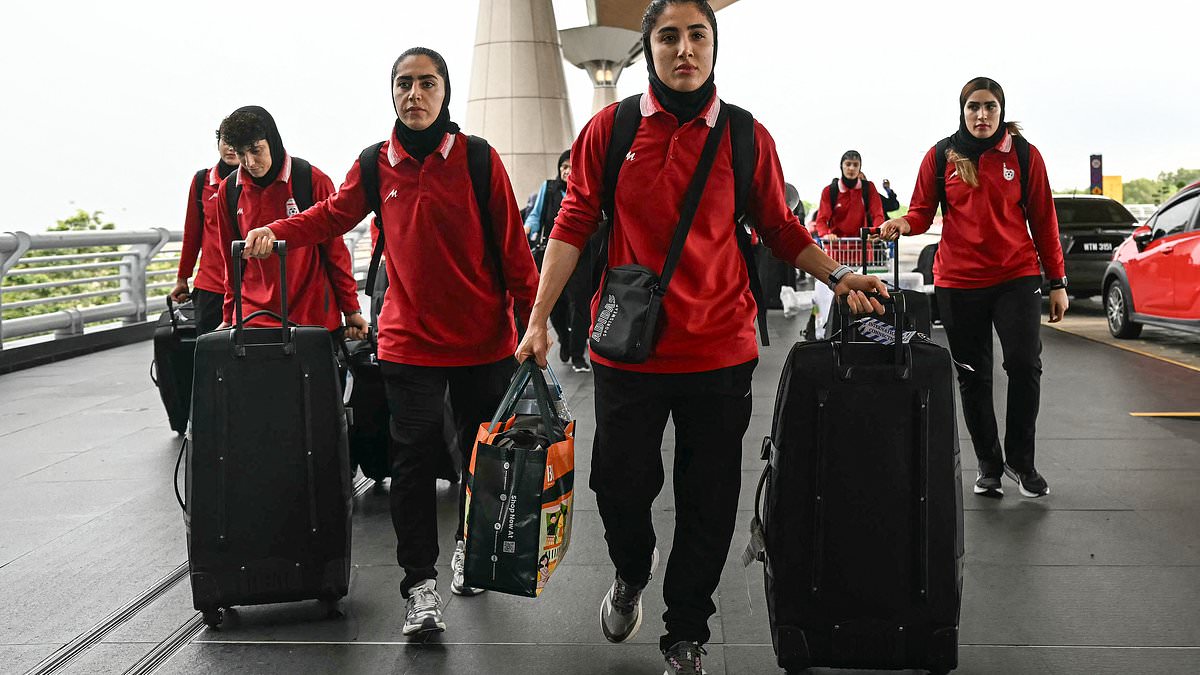
Members of Iran’s women’s football team arrive at the Kuala Lumpur International Airport in Sepang on March 16 en route back to Iran
Every July, Iran officially marks the National Day of Hijab and Chastity to promote the mandatory covering of women’s hair, while in 2024, a new law was introduced which gave impunity to those officials and vigilantes who violently attacked women and girls for not wearing the hijab.
Sahar says the renewed clampdown now happening in Iran reminds her of what women have faced every time they object to their oppression.
On January 8 and 9 this year, the last time she visited her homeland, she watched from the roof of her parents’ apartment in Tehran as protestors against the Iranian regime gathered in the streets below.
‘I saw religious people, women without hijabs, people with children, everybody was out. People were tired of Islamic rules that are not only against women, but against humanity.’
The anti-government protests had started just over a week before, on the December 28, and as we now know, the Iranian authorities reacted with brutal and deadly force.
‘They waited until 10pm to start killing people,’ says Sahar. ‘People told me they started with the front row because they know the front row are the most courageous.’
Sahar retreated to watch from behind a curtain: ‘They shot people who were watching from the window.’
She saw a man ‘with white hair’ killed in the alley near her house. ‘After that, we were afraid even to watch from behind the curtain.’
It’s now estimated that more than 36,500 people were killed during the protests in January, with some reports stating 30,000 deaths were registered in civilian hospitals for January 8 and 9 alone.
But despite the fear, there was still hope. When Sahar’s father heard the news that Iran’s former Supreme Leader Ali Khamenei had been killed in an American air strike, ‘he was so happy, he bought a box of sweets and pastries and gave them to anyone passing our alley,’ says Sahar. It was the same alley where she had seen the murder of an elderly protestor just weeks before.
For many years Sahar has travelled back and forth to Tehran to visit her family. She first escaped the country in 2012 following a crackdown on women’s freedoms that saw her repeatedly arrested for wearing prohibited clothing like jeans and brightly coloured jackets.
She had to escape again on January 12 this year, catching a train from Tehran to Van, a city on the border with Turkey, and from there flew to Istanbul and then to the States.
‘My family say the bombs are loud and scary,’ she tells me now. ‘But there is relief that those responsible for years of violence against Iranians are being removed. Buildings are being destroyed, but we still have so much hope. We are going to build everything again.’

Every July, Iran officially marks the National Day of Hijab and Chastity to promote the mandatory covering of women’s hair

Mahsa Amini, a 22-year old Kurdish woman’s death sparked the Women, Life, Freedom protests that became a larger movement of mass social resistance – women took to the streets, burning their headscarves and chanting ‘Death to the Dictator’ and ‘We don’t want the Islamic Republic’.
Last week Iranian police chief Brig Gen Ahmad Reza Radan warned that anyone attempting to ‘take action in the cities at the behest of the enemy’ would no longer be treated as a protester but as an ‘enemy’.
That might have stopped women’s open activism, but it has not dimmed their passion.
Laleh (not her real name), a thirty-something from north west Iran, says she was overjoyed when the former Ayatollah Ali Khamenei was assassinated. ‘I was screaming and crying out of rage [and joy]. I want to fight against the dictatorial regime. The Islamic Republic regime ruined my life.’
It was in 2022 that Laleh first became involved in protests against the government after moving to the capital Tehran. That September Mahsa Amini, a 22-year old Kurdish woman, was taken to the Vozara detention centre after being arrested for wearing an ‘improper’ hijab with too much hair protruding from her headscarf. She was beaten and died.
Amini’s death sparked the Women, Life, Freedom protests that became a larger movement of mass social resistance – women took to the streets, burning their headscarves and chanting ‘Death to the Dictator’ and ‘We don’t want the Islamic Republic’.
‘I went to the protests and took off my headscarf,’ remembers Laleh. ‘I felt so free.’
But it wasn’t just young women who got involved. While her mother didn’t demonstrate, says Sahar, she ‘stopped praying and took off her headscarf too. She told me, “I don’t believe in God any more.” I was shocked at how my mum changed. And not only my mum. Many middle-aged women stopped wearing the hijab. It was a big thing.’
Punishment was inevitable. At first it happened in small ways – Laleh was fined for not wearing a hijab, then the police took a picture of the number plate on her car, a Renault Clio, and threatened to impound it if she didn’t pay up.
Women were – and of course still are, say activists – at the mercy of a society that treats them with systematised misogyny. ‘It’s not necessarily the morality police that will stop you if you don’t have a headscarf,’ says Lawdan Bazargan, an Iranian human rights advocate.
‘Some religious guy walking on the street will yell at you. Their wife will yell at you. Their children will yell at you. It’s just an ongoing battle. Women don’t think what shall I wear today? They think, what shall I wear not to get arrested?’
Far worse was to come for Laleh, whose younger brother, Mohammed, was killed for leading protests in a town in north western Iran.
‘One night, three military vehicles and seven private cars surrounded his car. They asked him to stop. He didn’t,’ says Laleh, crying. ‘They opened fire and sprayed him with bullets.’
The regime had instructed the commanders of armed forces to ‘severely confront’ protestors, according to leaked documents obtained by Amnesty International. The Revolutionary guards were deployed along with the Basiji paramilitary force, the Law Enforcement Command of the Islamic Republic of Iran, riot police and plain clothes security agents.
The death toll from the Woman, Life, Freedom protests is estimated at around 450, including 40 children.
A year later, Laleh was in a shop, printing photographs to commemorate the anniversary of her brother’s death when plain clothes security agents stormed in and arrested her.
‘It was brutal and crazy. The guy beside me in the car after my arrest started to touch me in private places. Women have no safety in Iran.’
For 24 hours she was kept in the station of the Islamic Revolutionary Guard Corps (IRGC), an ideological militia set up to protect the ‘integrity of the Islamic Republic’.
‘I was forced to sign false confessions saying I was guilty of protesting against the Republic, against God.’
One of her other siblings, a brother Ali, 29, who moved abroad where he works for a human rights organisation which supports people in Iran, alerted the media and the IRGC agreed to release her for three hours. With the help of friends Laleh seized the opportunity to flee over the border to Irbil, the capital of the Kurdistan region of Iraq. From there, she eventually travelled on to her brother’s home, where she’s lived for the past nine months.
Between the ages of 19 and 24, Sahar was arrested ten times by the Guidance Patrol, or religious morality police. Her family was ‘more secular’, and supported her in studying for a BA and then a masters at Tehran University, where she met her husband-to-be. ‘He is open-minded and modern,’ she says. She began wearing short jackets and bright colours.
‘When I look back, I had so much courage. They could have killed me. But there were so many girls like me then.’
Each time she was arrested for wearing prohibited clothing, she was taken to the police station, where there was a designated section for girls.
‘They’d take a mug shot and ask your family to bring in dark clothes. They’d keep the ones you’d been wearing. My father told me never argue with them, just keep quiet and I will come and get you.’
On the last occasion, it was different. ‘It was my 24th birthday. I’d recently dyed my hair blonde. I was standing on the street, and my friend was on the other side. She wanted to pick me up and take me to my birthday party.’
A van pulled up and Sahar was arrested. This time it wasn’t the Guidance Patrol, it was the IRGC. ‘Now I was really scared.’
In the van there were about 20 other women who’d been arrested, including ‘a janitor who was 50’. ‘She’d been standing on the street trying to get a taxi. They said she was a prostitute. She had cleaning equipment!’
Sahar was taken to the Vozara detention centre in Tehran, expecting a fine for ‘improper dressing’ – ‘if you had nail polish, each nail had a fee’ – but the mood was much more menacing. ‘One of them looked at me in a very predatory way. His eyes were on me all the time. He said, “Why are you arrested? You are so beautiful, you have to get married with one of us.”’
Later, human rights organisations reported floggings, rapes, and executions in custody at Vozara, especially after the Woman, Life, Freedom protests.
‘They could have beaten us, raped us, killed us and no one would have known what had happened,’ says Sahar.
In the end, she was lucky – ‘my father came and saved me’ – and the next year she moved abroad with her husband. ‘Before then, I’d never really wanted to leave Iran. I love my country and my family. But that arrest affected me so deeply. It made me much more determined to leave Iran.’
Sahar has since become a professor at a university.
Now she watches the war from afar but still with hope for the women of her homeland. Hugely complex and controversial as the motives for American and Israeli action are, for women like her, the downfall of the men who have ruled Iran for four decades is fervently wished for, she says.
‘[Ali] Khamenei put so much pain in our hearts. He’d done so many bad things to women. I cried for an hour with happiness when I knew he was dead.’
The names and identifying features of interviewees have been changed for their protection.