Share this @internewscast.com
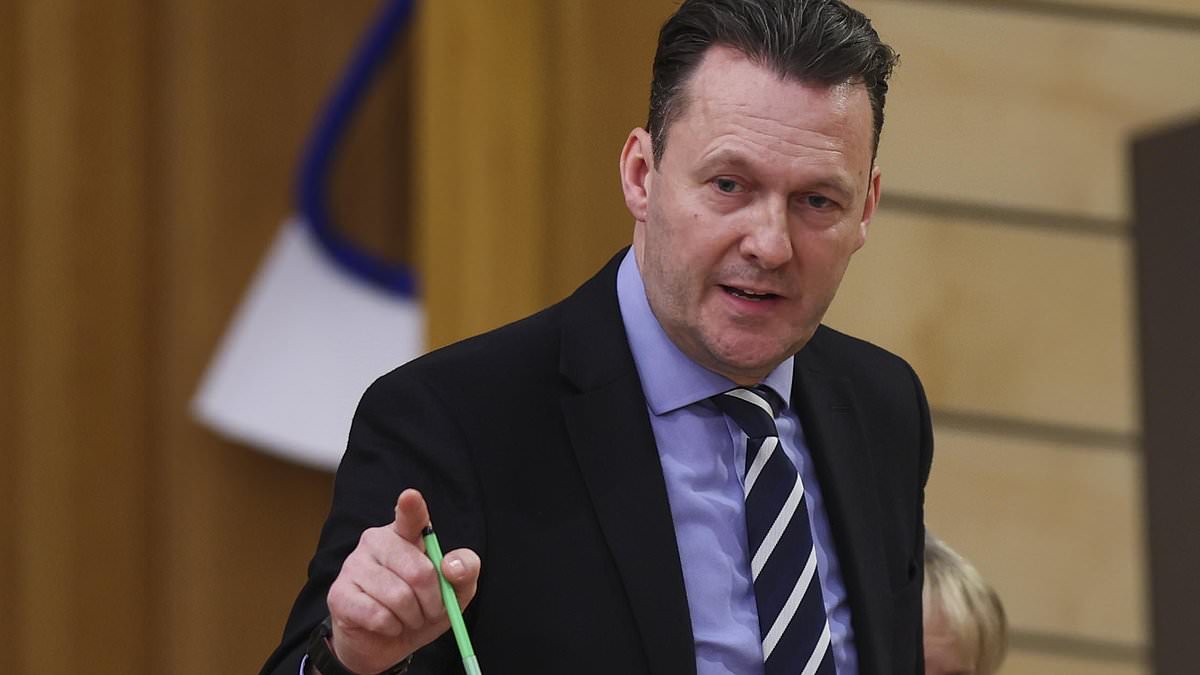
In a significant shift, the head of the Scottish Conservatives has withdrawn his backing for the assisted dying legislation at Holyrood. This decision by Russell Findlay tightens the margins on a pivotal vote, making the outcome uncertain.
Findlay’s opposition stems from worries about potential coercion in the decision-making process and fears of a gradual expansion of eligibility criteria, which he describes as a ‘slippery slope.’
As a result, the leaders of the three major parties in Holyrood are now united in their stance against the bill, which was introduced by Liberal Democrat MSP Liam McArthur.
This development marks Findlay as the third MSP to reverse their initial support for the bill, initially backed at stage one, ahead of the decisive stage three vote.
The bill’s future hangs in the balance, with just four additional MSPs needing to change their stance for it to be defeated.
Speaking to the Scottish Daily Mail, Findlay expressed, “Although I still agree with the fundamental idea that people should have the right to end their suffering, I find myself unable to support the bill in its current form at stage three.”
He said there are ‘numerous’ reasons behind his decision, with a primary concern being that ‘the real risk that people could be coerced into ending their own lives’.
‘Not everyone is fortunate enough to have a loving and supportive family. There are already cases in which unscrupulous relatives, or “trusted” medical or legal professionals, exploit elderly people for financial gain.

Scottish Conservative leader Russell Findlay says he has dropped his support for Holyrood’s assisted dying legislation and will now oppose it – putting the crunch vote on a knife-edge
‘And even without any coercion from others, some elderly people may feel pressured to end their lives because they think they have become a “burden” on loved ones’.
He added: ‘The second concern relates to the possibility that any legislation, no matter how tightly defined upon its passage through parliament, could be potentially widened by way of later court challenges.
‘It seems not just plausible, but inevitable, that people whose conditions do not qualify for assisted dying as legislated for would take legal action to extend that right to them.
‘We have seen examples of this “slippery slope” in other jurisdictions, and I would be deeply uncomfortable at being responsible for legislation that might end up mutating beyond its original remit to, for example, allowing someone with a mental health condition to compel the state to prematurely end their life.’
Mr Findlay said that he has not been persuaded that the legislation can be amended satisfactorily to address his two primary concerns.
He also said other issues have ‘come to the fore’, including concerns about the ability of health professionals to exercise their legitimate right to conscientiously object to having any involvement in assisted dying.
He highlighted that medical regulation is reserved to Westminster and said any approach to assisted dying would be better applied across the whole of the UK.
Mr Findlay said: ‘If a form of assisted dying legislation could be made watertight to prevent the risk of coercion; subsequent extension by the courts; and which would fully protect medical professionals who conscientiously object, it would be my preference that a UK-wide approach is taken.’
All of the Holyrood parties have agreed that they will allow a free vote on the issue, meaning each MSP can make up their own minds as a matter of conscience.
Mr Findlay stressed that he respects the views of those who have a different position but concluded that ‘the risks are too great for this bill to become law’.
But his decision could still prove influential among other Tory MSPs who backed the general principles of the legislation but are now considering whether to support it at stage three.
The Assisted Dying for Terminally Ill Adults (Scotland) Bill passed the first stage of parliamentary scrutiny last May when MSPs voted by 70-56 in favour of its general principles in a stage one vote.
It proposes allowing people with terminal illnesses to ask a doctor to help them end their life.
MSPs will begin debating 328 proposed amendments to the legislation tomorrow, with the final stage three vote currently scheduled for next Tuesday, March 17.
It would only take seven MSPs to switch their vote and oppose the Bill for it to fall.
Join the debate
Do YOU support the right to assisted dying or should it remain illegal?

Liberal Democrat MSP Liam McArthur brought forward the right to die bill
Last month, SNP backbencher Collete Stevenson, who backed the bill at stage one, withdrew her support over ‘significant concerns’ about issues including the practical operation of safeguards and the risk of coercion.
Fellow SNP MSP Audrey Nicoll wrote to fellow parliamentarians earlier this year setting out why she has withdrawn her backing, including her biggest concern about the risk of coercion.
Dr Gordon Macdonald, chief executive of Care Not Killing, said: ‘A majority of only 14 MSPs approved the Bill at Stage 1 with many voicing concerns that it required much more work to go any further. Only seven need to switch sides to defeat the Bill.
‘Clearly, some have not had their fears allayed or concerns addressed. They have told us so and say they will not be voting for it in its present state.’
He said the bill is on a ‘knife-edge’ and he is ‘confident’ that MSPs will reject it.
Mr McArthur said: ‘The bill I have put forward is compassionate and robustly safeguarded. It introduces protections that we simply do not have in place just now. As always, however, I am committed to speaking with any colleague to address any questions and allay any concerns they may have.
‘Elected parliamentarians in Westminster, in the Welsh Senedd, in the Isle of Man and in Jersey have now backed assisted dying.
‘I recognise that this is a difficult decision for colleagues who want to do the right thing. I urge them not to hunt for excuses to vote against a bill that will put in place protections and choice that do not currently exist for too many dying Scots.’